
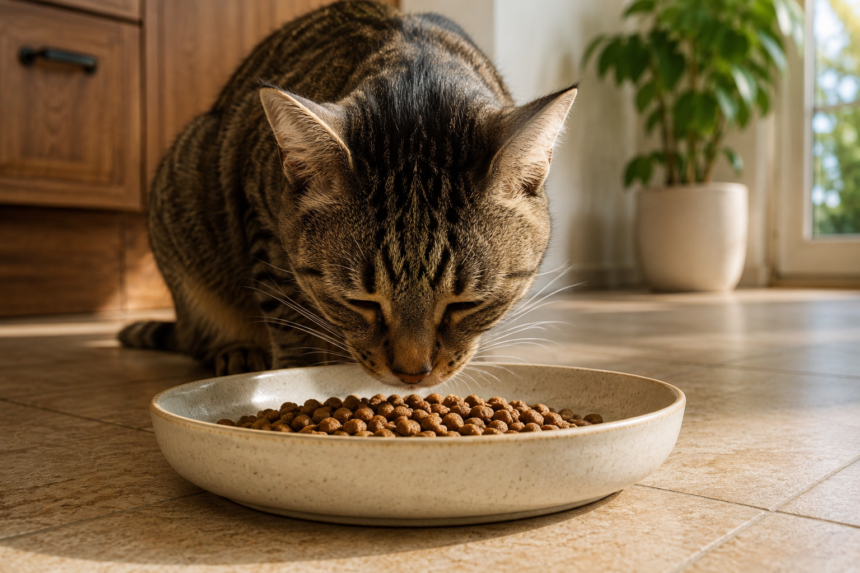
The bowl is the most overlooked object in your cat’s life — and one of the easiest to get wrong.
Thank you for reading this post, don't forget to subscribe!Shape, material, height, placement. Four variables, and most kitchens get at least two of them backwards.
Your cat paws food out of the dish and eats it off the floor, walks away from a half-full bowl, or drinks from every glass in the house except the water you put down for them. Those aren’t quirks — they’re complaints about equipment. Choosing cat feeders and bowls properly fixes most of them, and this guide covers shape, material, height, placement and which specialist feeder types are worth the money.
There's a calmer way — one library that answers it all. See it for yourself.
Explore the Library →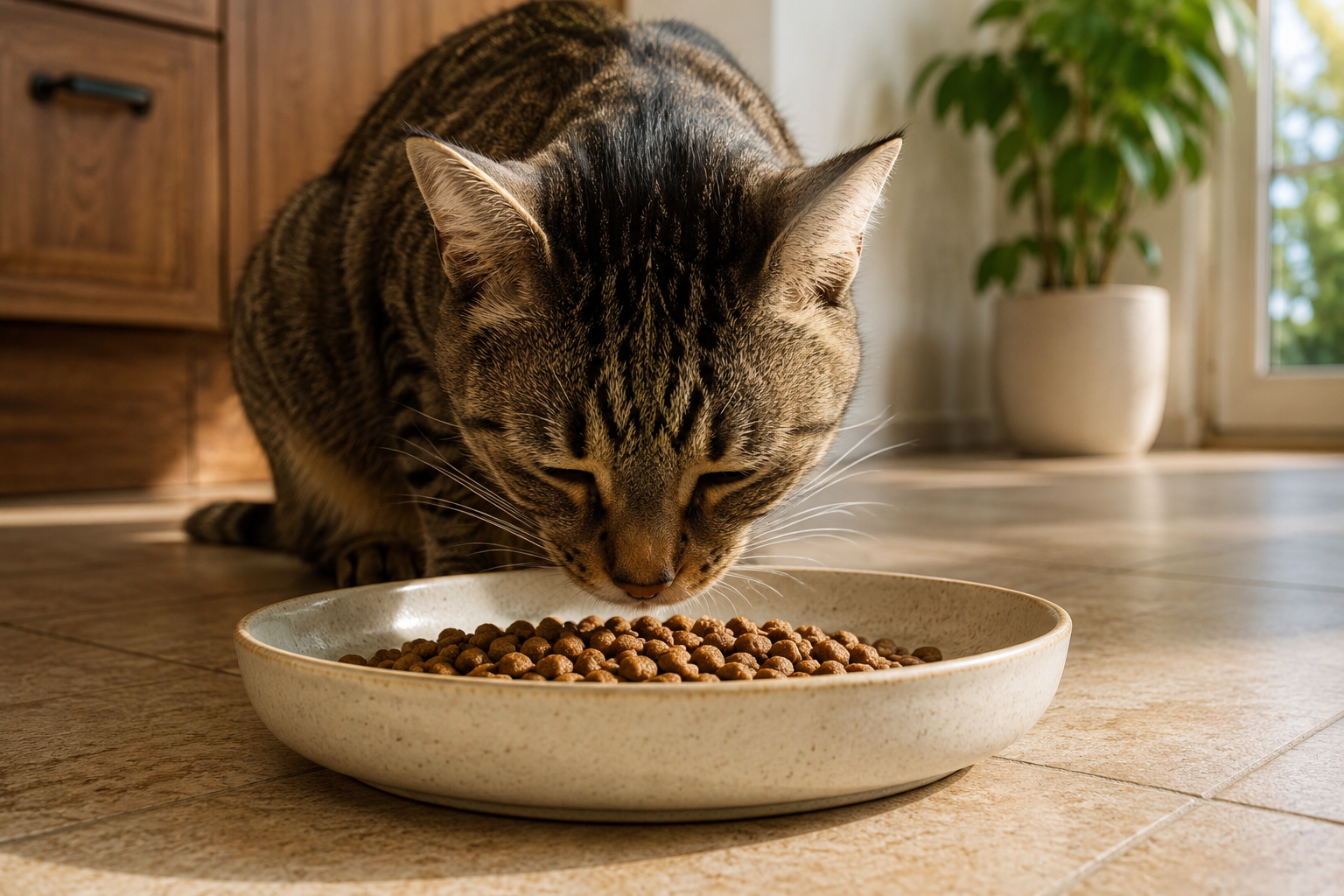
The best cat bowl is wide, shallow and made of stainless steel or glazed ceramic — wide enough that whiskers never touch the sides, shallow enough that your cat isn’t reaching down into a well. Raise it slightly for comfort, keep water bowls well away from food, and use a separate slow feeder or puzzle bowl for cats that gulp. Avoid plastic, deep dishes and double diners.
The rules worth memorizing
✓ Wide and shallow beats deep and narrow. Whisker contact makes some cats abandon a full bowl.
✓ Stainless steel or glazed ceramic only. Plastic scratches, harbours bacteria and is linked to feline chin acne.
✓ Separate the water from the food — different rooms if you can. It’s instinct, not fussiness.
✓ Double diners are the worst common design: too narrow, too close together, and they encourage water-fouling.
✓ A slight elevation — roughly 8–15cm — suits most adults and helps seniors with arthritis.
✓ Wash bowls daily. Kibble oil goes rancid and biofilm forms in water dishes within about 24 hours.
Whisker Fatigue: The Reason Your Cat Empties the Bowl Onto the Floor
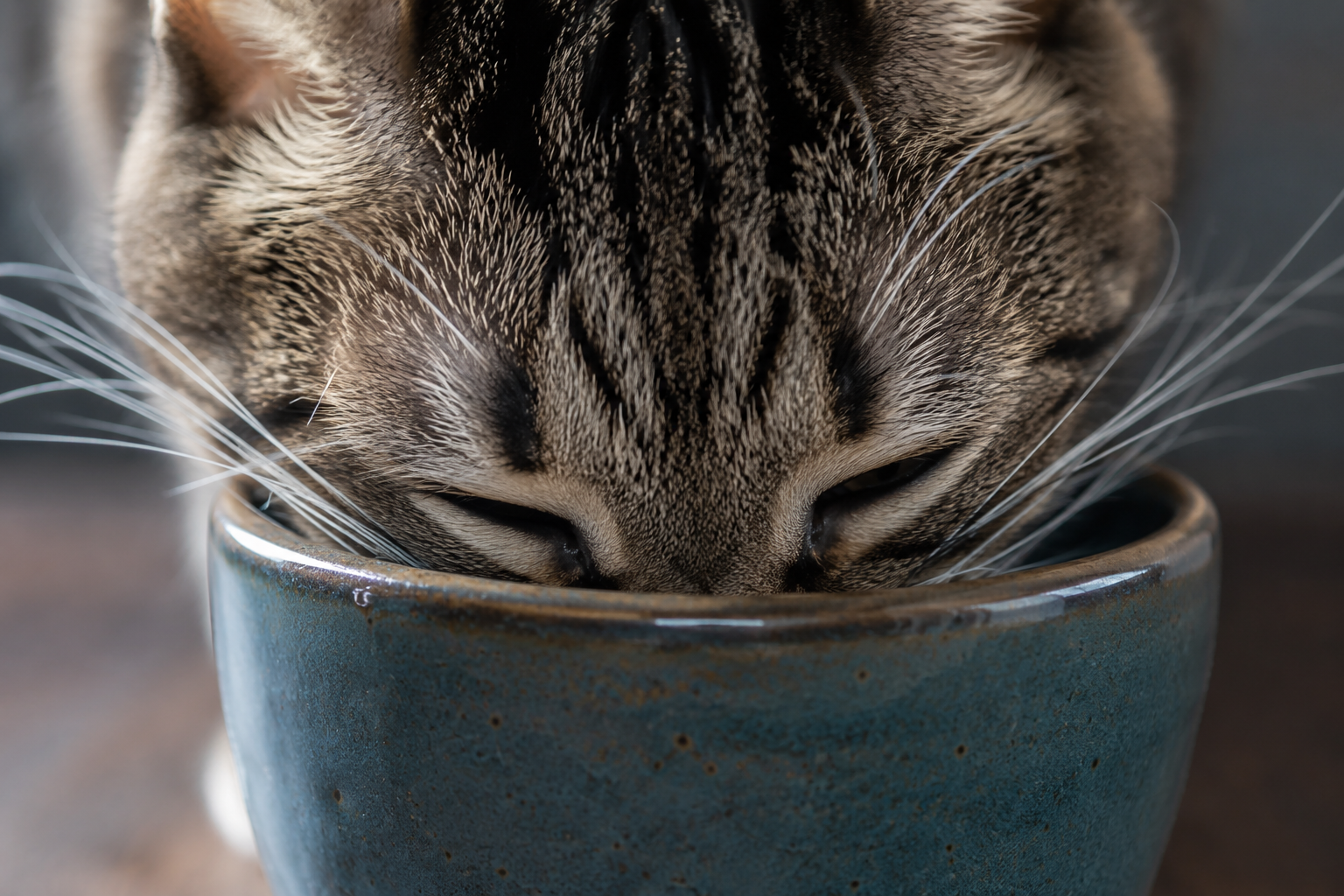
Start with the single most common bowl complaint, because once you understand it you’ll notice it everywhere.
Whiskers — properly called vibrissae — aren’t decorative hairs. They’re specialised sensory organs rooted deep in follicles packed with nerve endings and blood vessels, and they feed your cat constant information about air currents, object proximity and spatial position. They’re the reason a cat can judge whether a gap is passable in complete darkness.
Now put that sensory equipment into a narrow, deep bowl. Every mouthful presses those whiskers against the sides, generating a stream of unnecessary sensory input. Some cats don’t care in the slightest. Others find it genuinely unpleasant, and their behavior tells you: pawing food out onto the floor and eating it there, eating only from the middle and leaving a ring of food around the edges, standing over a full bowl looking dissatisfied, or approaching the bowl and walking away repeatedly.
“Whisker fatigue” is a widely used owner term rather than a formal veterinary diagnosis, and the science is still developing — but the fix costs almost nothing and works often enough to be worth trying. Swap to a bowl wider than your cat’s whisker span, with sides low enough that they never brush anything. If the floor-pawing stops within a few days, you had your answer. If it doesn’t, the cause is elsewhere and worth investigating — persistent food-avoidance can point to dental pain or nausea, which is a vet conversation.
✨ Quick win — test it tonight for free
Serve your cat’s next meal on a small flat plate — a saucer or side plate you already own. Zero whisker contact, zero cost. If your cat eats calmly and cleanly from a plate but paws food out of their usual bowl, you’ve diagnosed the problem in one meal and you know exactly what to buy.
Bowl Materials Ranked: Why Plastic Keeps Losing
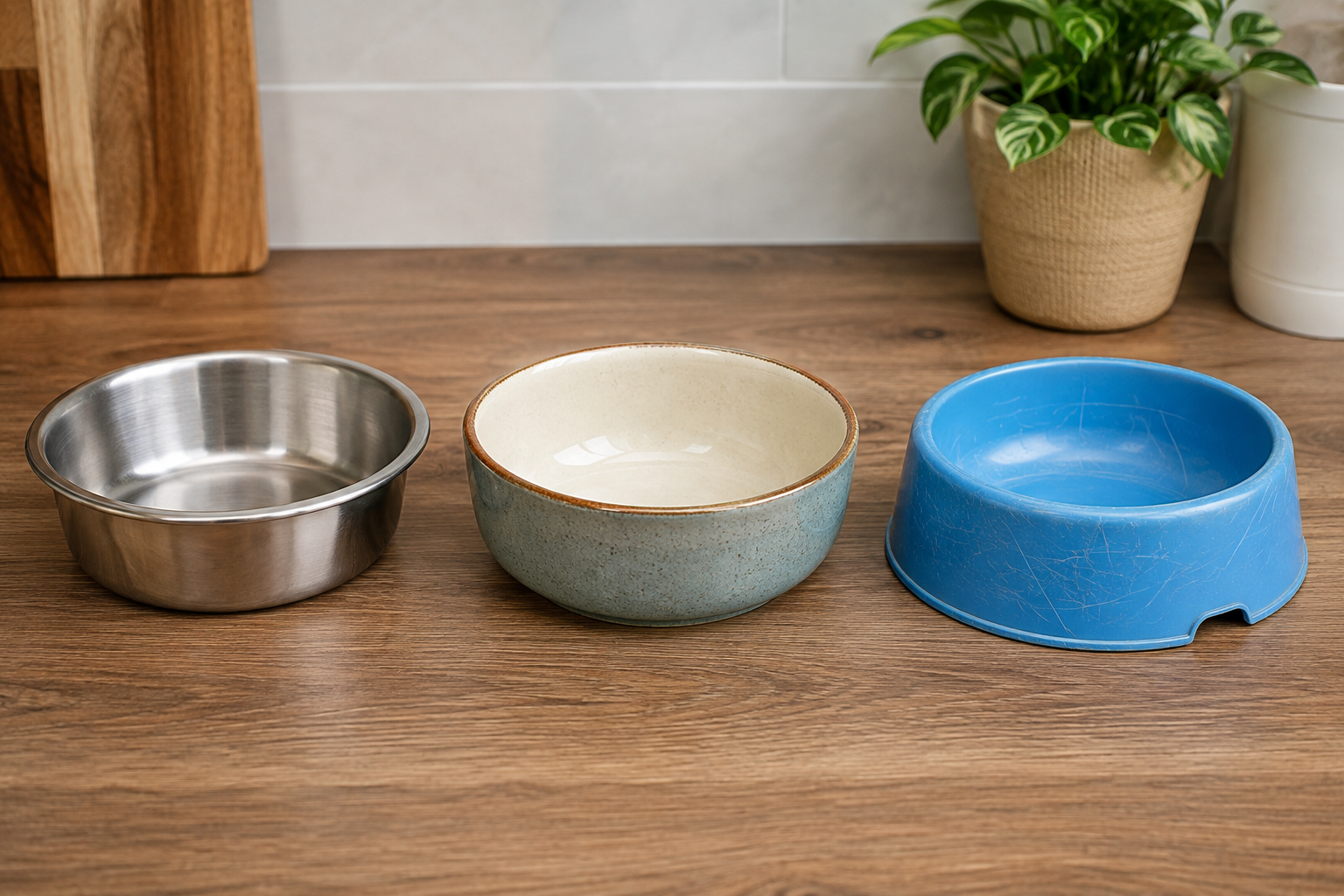
Material matters more than the price tag, and there’s a clear ranking.
Knowing which one you’re looking at is the whole skill.
- Call now — six signs that mean tonight, not tomorrow.
- Call today — two or more of the eleven signals, together.
- Record and watch — one change, with an ordinary explanation.
| Material | Strengths | Weaknesses | Verdict |
|---|---|---|---|
| Stainless steel | Non-porous, dishwasher-safe, near-indestructible, no odor retention | Light — slides around unless it has a rubber base | Best all-round choice |
| Glazed ceramic | Heavy and stable, non-porous, easy to find wide and shallow | Chips and cracks harbour bacteria; check glaze quality | Excellent — retire it once chipped |
| Glass | Non-porous, doesn’t stain or hold smells | Breakable, often too deep or narrow | Fine if the shape is right |
| Plastic | Cheap, light, unbreakable | Scratches trap bacteria and oils; associated with feline chin acne; retains odors | Avoid |
| Silicone (travel) | Collapsible, useful for trips | Too light for daily use; degrades over time | Travel only |
The plastic problem deserves its own note because it’s so common. Plastic scratches with normal use, and those micro-grooves hold bacteria and food oils that survive ordinary washing. That’s part of why plastic dishes are frequently associated with feline chin acne — those small blackhead-like bumps on a cat’s chin, often from contact with a contaminated bowl rim. Not every cat reacts, but if you’re seeing chin bumps, swapping to steel or ceramic and washing daily is the first thing to try, alongside a vet check to confirm what you’re dealing with.
📝 Note — the daily wash isn’t optional
Food bowls develop a rancid oil film within a day or two, and water bowls grow a slippery biofilm you can feel with a fingertip after about 24 hours — that slime is exactly why some cats refuse water they’d otherwise drink. Wash both daily with hot water and unscented dish soap, or run them through the dishwasher. Two bowl sets makes this effortless.
Height, Shape and the Double-Diner Problem
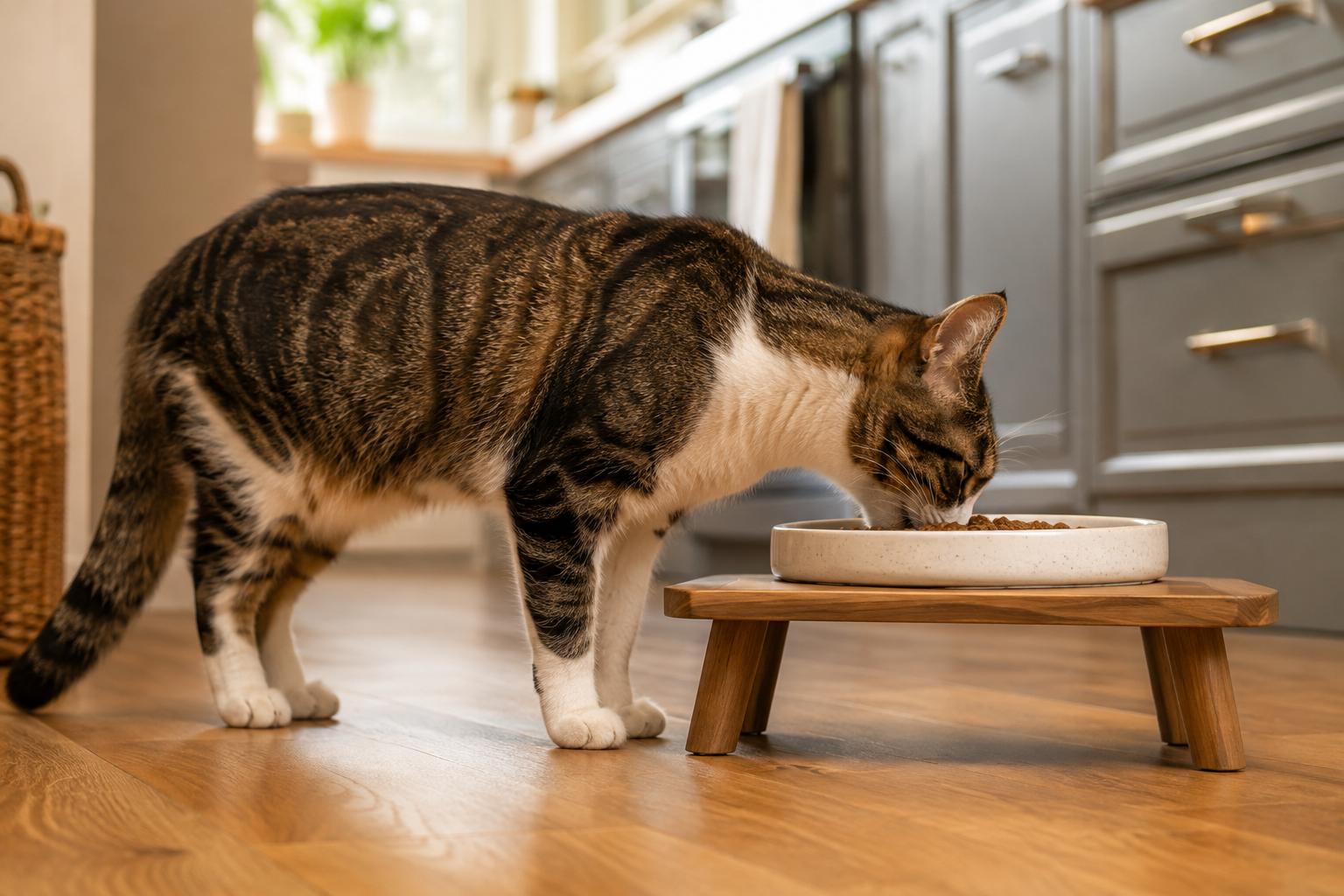
Once material is settled, three physical details do the rest of the work.
Shape. Wide and shallow. Aim for a bowl wider than your cat’s whisker span with sides low enough to avoid contact — often only a couple of centimetres deep for dry food. Deep “well” bowls force a cat to bury their face to reach the bottom, which is the whisker problem plus a visibility problem, since cats dislike eating where they can’t see their surroundings.
Height. A slight elevation — very roughly 8 to 15 centimetres, so the bowl rim sits around chest to lower-shoulder level — lets a cat eat without craning their neck downward. Many owners report less post-meal regurgitation after raising bowls, though the evidence is anecdotal rather than settled. Where elevation clearly helps is with older or arthritic cats: crouching low is uncomfortable for stiff joints, and a raised dish makes mealtimes noticeably easier. Don’t overdo the height — too high and your cat is reaching up awkwardly instead.
Stability. A bowl that slides across a tile floor while a cat eats is annoying enough that some cats stop trying. Look for weight, a rubber base ring, or a non-slip mat underneath — which also catches the inevitable scatter.
Which brings us to the double diner: the single moulded unit with a food bowl and a water bowl attached side by side. It’s the most-sold and worst-designed item in the category. The two compartments are almost always narrow and deep, they’re usually plastic, and — most importantly — they force water directly beside food, which cats instinctively dislike. Kibble crumbs and wet food residue also foul the water within hours. If you own one, replacing it with two separate bowls is probably the highest-impact five minutes in this entire guide.
24h
is all it takes for biofilm to form in a water bowl
2+
water stations per home, in different rooms from the food
n+1
feeding stations in multi-cat homes — one per cat, plus one
Gear is half the answer
The other half is what goes in the bowl, and when
The Complete Cat Owner Library includes What to Feed Your Cat — portions by body condition, meal scheduling, picky-eater strategies and food transitions — plus nine more guides covering behavior, daily care, enrichment and health.
See what’s inside →Water: Why Your Cat Ignores the Bowl and Drinks From the Tap
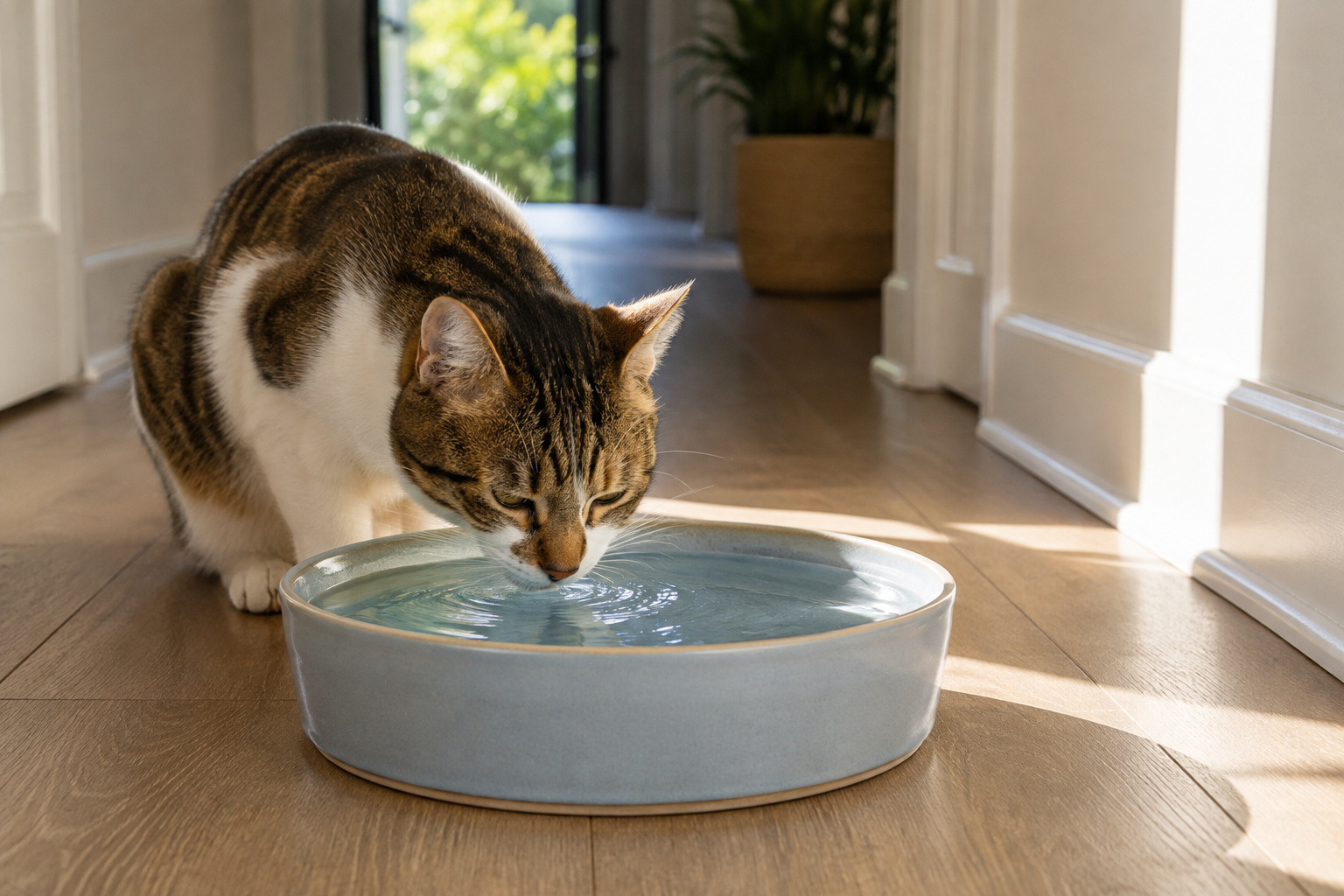
Cats descend from desert-dwelling ancestors and carry a famously weak thirst drive — in the wild, most of their water came from prey rather than from drinking. That legacy makes hydration one of the quiet long-term issues in indoor cats, especially those eating mainly dry food.
Several instincts explain the bowl-refusal. Cats avoid drinking beside where they eat, because in the wild, water near a kill site is water contaminated by the kill — so a water bowl parked next to the food dish reads as suspect. They also prefer moving water, which in nature is fresher than still water, and that’s the whole appeal of the dripping tap. And they dislike the whisker contact and poor sightlines of a deep, narrow water dish just as much as a food one.
The fixes are straightforward. Put water stations in different rooms from food, and put out more than one — two or three around the house dramatically increases casual drinking. Use wide, shallow bowls here too, and fill them right to the top so your cat doesn’t have to dip their face in. Refresh daily and wash the bowl, not just top it up. For cats who genuinely prefer moving water, a fountain often produces a real jump in intake; keep it clean, since a neglected fountain is worse than a fresh bowl. And remember that diet does heavy lifting on hydration — this is one of wet food’s genuine advantages, which we cover in wet vs dry cat food.
Ten focused guides, vet-reviewed, zero fluff. Loved this article? See what's inside.
See What's Inside →⚠️ Warning — a sudden change in drinking is a vet visit
Encouraging a cat to drink more is good. But a cat who suddenly starts drinking noticeably more than usual — hanging around the water bowl, emptying it, drinking from taps when they never did — is showing one of the most important early signs in feline medicine. Increased thirst is associated with kidney disease, diabetes and hyperthyroidism, among others, and catching those early genuinely changes outcomes. Don’t wait to see if it settles. Book the appointment.
Specialist Feeders: Which Ones Solve a Real Problem
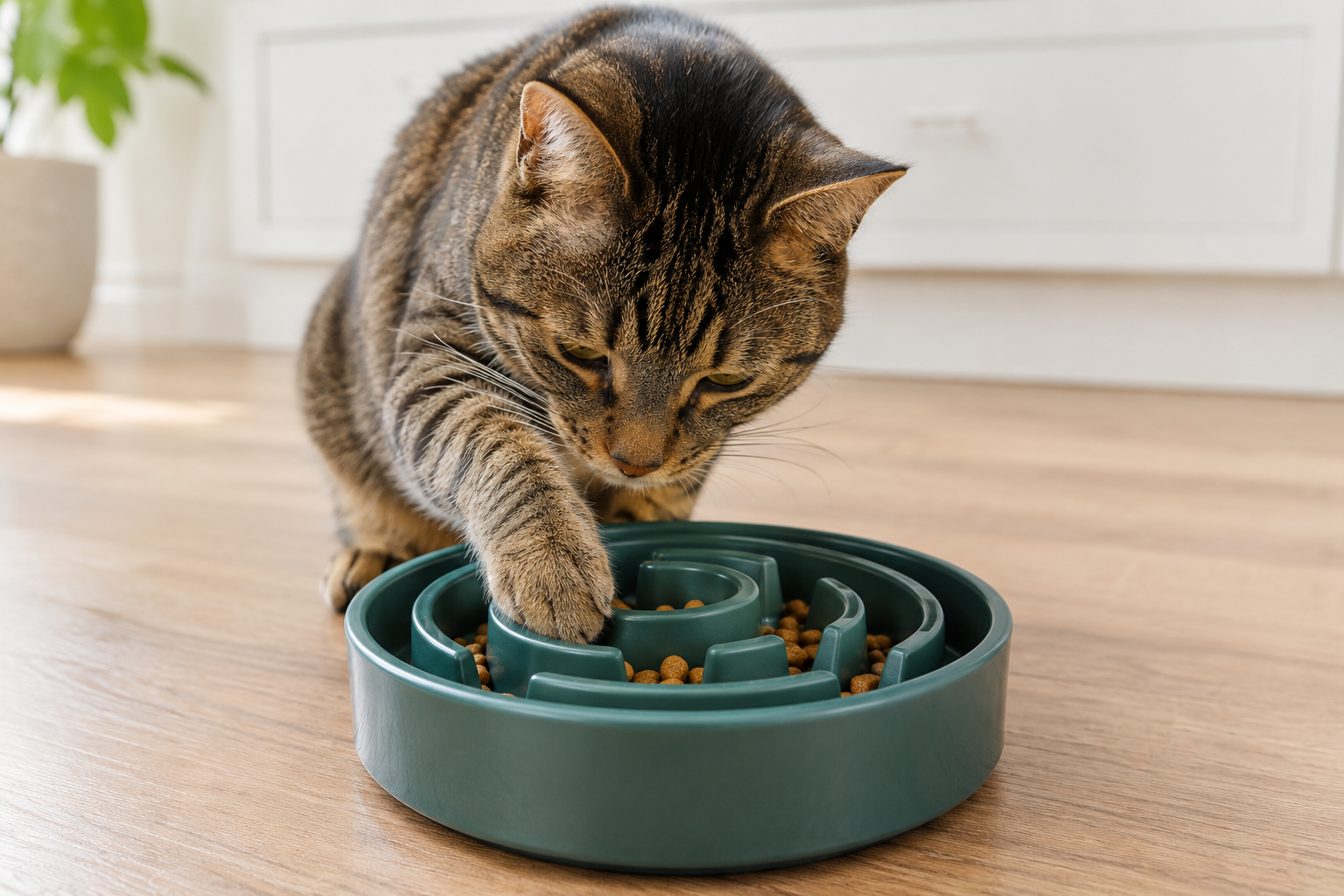
Beyond a plain bowl, four feeder types exist for genuine reasons — and each solves a specific problem rather than being a general upgrade.
| Feeder type | Solves | Worth it when |
|---|---|---|
| Slow feeder / maze bowl | Gulping, vomiting right after meals, food-inhaling | Your cat finishes a meal in under a minute or brings it back up |
| Puzzle feeder / treat ball | Boredom, overeating, an empty afternoon | Indoor cats — this is enrichment disguised as a bowl |
| Elevated / tilted bowl | Neck strain, arthritis, post-meal discomfort | Senior cats or any cat crouching awkwardly to eat |
| Microchip / RFID feeder | One cat stealing another’s food or prescription diet | Multi-cat homes with unequal eaters — the only real fix |
| Automatic timed feeder | Long workdays, portion drift, dawn wake-up calls | You want the machine, not your face, to be the food source |
Two of these deserve emphasis. Puzzle feeders are the most underused item in the category — turning a forty-second meal into a twenty-minute foraging task is one of the highest-value changes you can make for an indoor cat’s day, and it costs less than a bag of premium food. Start on the easiest setting so your cat succeeds quickly, then increase difficulty. There’s a full menu of related ideas in our guide to indoor cat enrichment ideas.
Automatic feeders earn their place when schedules are the problem or when a cat has trained you to serve breakfast at 5am. If that’s your situation, the setup matters as much as the model — we cover choosing and configuring one in our guide to the best automatic cat feeder.
Placement: Where the Bowls Go Matters as Much as What They Are
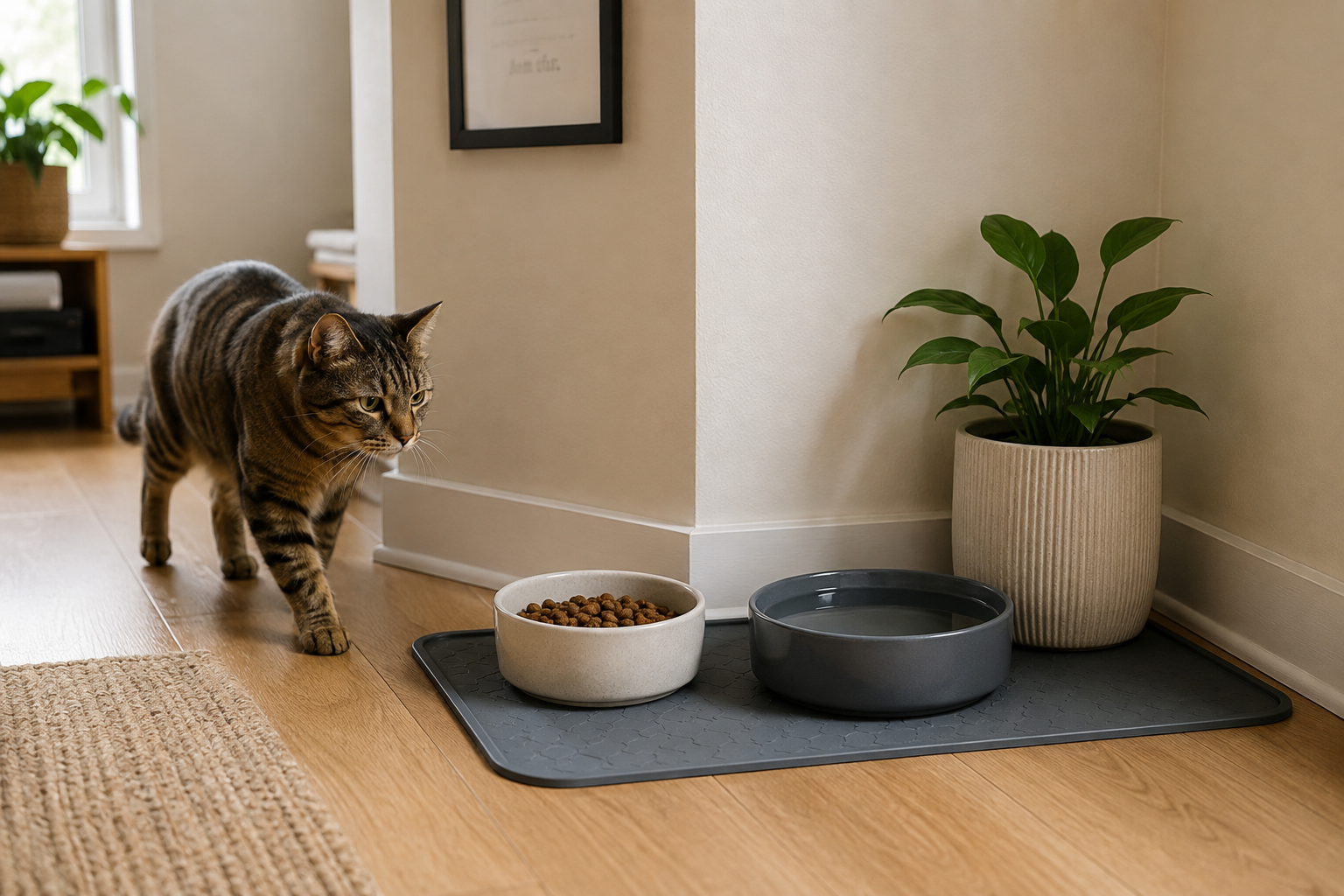
You can buy perfect bowls and still get complaints if the location is wrong, because eating leaves a cat vulnerable and they’re hardwired to care about that.
Three placement rules cover nearly everything. Never near the litter box — not the same corner, ideally not the same room. Cats won’t eat beside their toilet, and a bowl placed there gets used reluctantly or not at all. Avoid high-traffic and startling spots: a bowl squeezed beside a washing machine that spins mid-meal, or in a busy doorway, teaches a cat that eating means being ambushed. Choose a quiet corner where your cat can see the room, ideally with a clear line of retreat rather than a dead end. And keep food and water apart, as covered above.
Multi-cat homes need one extra rule: separate feeding stations, out of each other’s sightline, following the same one-per-cat-plus-one logic used for litter boxes. Two bowls side by side isn’t two stations — it’s one contested resource, and the quieter cat loses. In practice you’ll often see the slower eater walk away and the confident cat finish both portions, which is how one cat gains weight while the other quietly drops it. If you’re building a two-cat household from scratch, our guide on how to introduce a second cat covers the wider resource maths.
Common Mistakes With Cat Feeders and Bowls
1. Buying the double diner because it looks tidy
Narrow compartments, usually plastic, water directly beside food, and crumbs fouling the water within hours. It’s convenient for you and wrong on four counts for your cat. Two separate wide bowls, in different places, solve all of it — and cost less.
2. Topping up the water instead of replacing it
Adding fresh water to a bowl with an established biofilm just dilutes the problem. Empty it, scrub it — you’ll feel the slick film come off — and refill. Do that daily. Plenty of “fussy drinkers” become perfectly ordinary drinkers once the bowl is genuinely clean.
3. Assuming a full bowl means a fed cat
In multi-cat homes especially, a bowl that empties tells you food disappeared — not who ate it. Weigh your cats monthly and watch each one eat occasionally. Owners are routinely shocked to discover which cat has been eating both portions for six months.
4. Treating a raised bowl as a cure for vomiting
Elevation and slow feeders help some cats who bring food back up immediately after gulping. But regular vomiting is not normal in cats, however common it seems, and it can indicate hairballs, food sensitivities, inflammatory disease or other conditions. Try the equipment change — then, if it continues, see your vet rather than accepting it as your cat’s personality.
5. Keeping a chipped ceramic bowl for sentimental reasons
Once the glaze cracks or chips, the exposed porous ceramic underneath holds bacteria that washing won’t fully clear. Same for any scratched plastic. Bowls are consumables — retire them at the first chip and keep the pretty one for a plant pot.
“A cat pawing food onto the floor isn’t being dramatic. They’re telling you the bowl is wrong — and it’s the cheapest complaint you’ll ever fix.”
Cat Feeders and Bowls: Your Questions Answered
Fix the Bowl Before You Blame the Cat
Most of the odd behavior around mealtimes — the floor-pawing, the abandoned half-meals, the tap obsession — traces back to equipment rather than temperament, which makes cat feeders and bowls one of the cheapest problems in cat ownership to solve. Swap to wide, shallow steel or ceramic, separate the water from the food, raise things slightly, and wash everything daily. Then keep going: our products and buying guides cover the rest of the gear, and cat nutrition 101 handles what actually goes in the dish.
Ten guides · 200+ pages
Everything else your cat has been trying to tell you
Feeding routines, behavior decoding, litter problems, indoor enrichment, daily care and the symptoms worth a vet visit — The Complete Cat Owner Library covers the whole journey in one place.
Explore the Complete Cat Owner Library →
Get Decode Your Cat — free.
20 everyday behaviors translated, so you finally know what your cat is actually saying. Pop in your name and email and it's yours instantly.