


01 The Meowive Library

It's eleven at night and you're on the floor with paper towel again.

You've bought a different litter. You've moved the box. You've cleaned that corner four times. You've read a dozen articles that all said roughly the same five things. And your cat is still going on the rug.

Thank you for reading this post, don't forget to subscribe!

You are not doing the wrong things.
You are doing the right things in the wrong order.

Get the book — $24 Or keep reading. This page explains the whole method before it asks you for anything.
The Litter Box Protocol — 70-page illustrated guide
02

You've already tried most of this.

Another litter boxUnscented litterMoved it somewhere quieter Enzyme spray from the pet shopCleaning it twice a dayA covered box Shouting, once, and feeling awfulShutting the bedroom door Waiting to see if it stops

Every one of those is reasonable. Several are in this book. And done in isolation, in the wrong sequence, without knowing which was supposed to be the fix — they were never going to work.

Here is the part nobody says out loud: inappropriate elimination is one of the most common reasons cats are given up to shelters. Not because owners stop loving them, but because the problem grinds people down over months — until someone who adores their cat is standing in a hallway at midnight thinking a thought they're ashamed of.

If you've had that thought, you're not a bad owner. You're an exhausted one who was handed a list instead of a method.

The order is the whole problem.

And almost everyone runs it backwards.
03

Three traps — and you've probably fallen into all three.

01

You changed things one at a time, but too fast

New litter on Monday. New location by the weekend. A covered box a fortnight later. Each change was sensible; together they produced constant instability, and none was given long enough to show whether it worked. The most common failure isn't the wrong change — it's too many changes, too fast.
02

You cleaned the spot, and made it stronger

Cat urine isn't a stain. It's urea, salts and sulphur compounds bound into the fibres, and it matures rather than fades. Ordinary cleaners lift the visible mark and leave the signal. Worse, ammonia-based cleaners — the ones in most kitchen cupboards — are chemically related to a breakdown product of urine. Clean with one of those and, to the cat, you have just marked the spot yourself.

03

Nobody told you to rule out the medical cause first

A meaningful share of cats who stop using the box are ill. Cystitis. Crystals. Arthritis that never showed as a limp. Early kidney disease. In those cats no amount of rearranging furniture changes anything, because the cat isn't making a choice — and every week spent on behaviour work is a week that animal spends in pain.

Fix it in the right order — $24 70 pages · instant download
9setup variables decide whether a cat uses its box. Most failing setups fail on three or four at once.
3–8wksis the window in which a kitten decides what a toilet should feel like — for the rest of its life.
1.5×the cat's body length is the minimum box size. Almost every box sold fails it.

There is a version of this problem that is genuinely urgent, and it looks exactly like the behavioural one. A cat going in and out of the box, straining, producing almost nothing, crying — particularly a male cat — may have a blocked urethra. That is fatal within a day or two, and it is regularly mistaken for stubbornness.

The first thing this book does, before any advice at all, is put that on a triage page and tell you to put the book down and phone a vet.

04

Seventy pages, seven parts, worked from the front.

Every chapter runs the same four layers. You're told why something works before you're told what to do — because an owner who understands why litter depth matters gets it right in a box this book never anticipated, and an owner handed a number gets it right once.

iTheory

What the behaviour is for

iiMechanism

How it works in your cat

iiiProtocol

Exactly what to do

ivFailure cases

What it means if it doesn't work

Part I

Why cats eliminate where they do

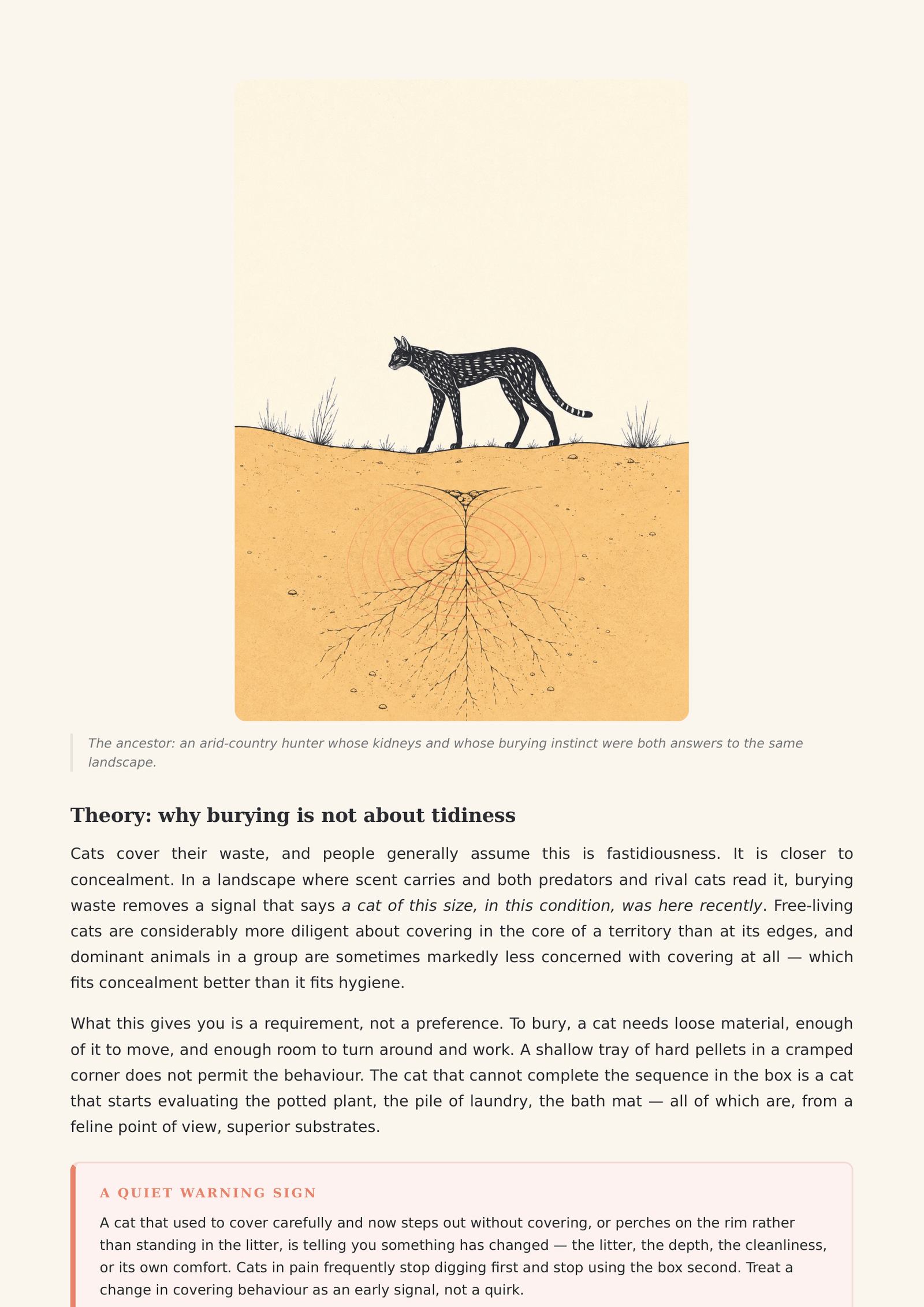
Marking and eliminating are two different problems with two different solutions — and almost every failed attempt begins by confusing them. Then: the desert physiology behind feline urine, what a kitten decides about texture at four weeks and keeps forever, why a used spot stays active long after you've cleaned it, and why eliminating is the most vulnerable ninety seconds of a cat's day.

Inside the book — the desert ancestry of the domestic cat
Part II

Medical rule-outs come first

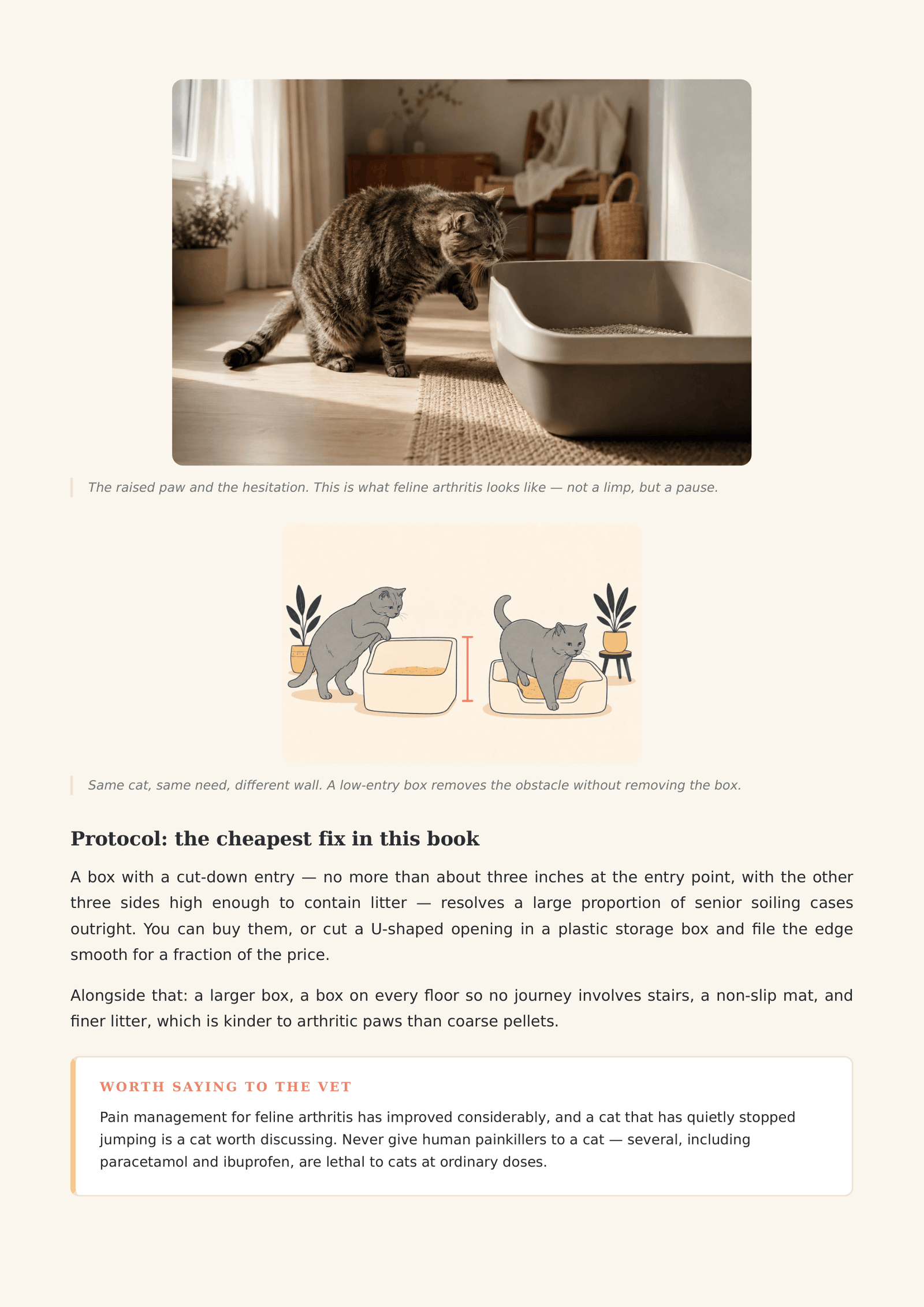
The part most owners skip, and the one that most often turns out to have been the whole answer. Cystitis and the stress–bladder loop. Arthritis and the six-inch wall. Kidney, thyroid and diabetes. Plus the exact words to say when you phone the practice, so the urgency gets triaged correctly instead of booked for next Tuesday.

Inside the book — arthritis and litter box entry height
Part III

The nine setup variables

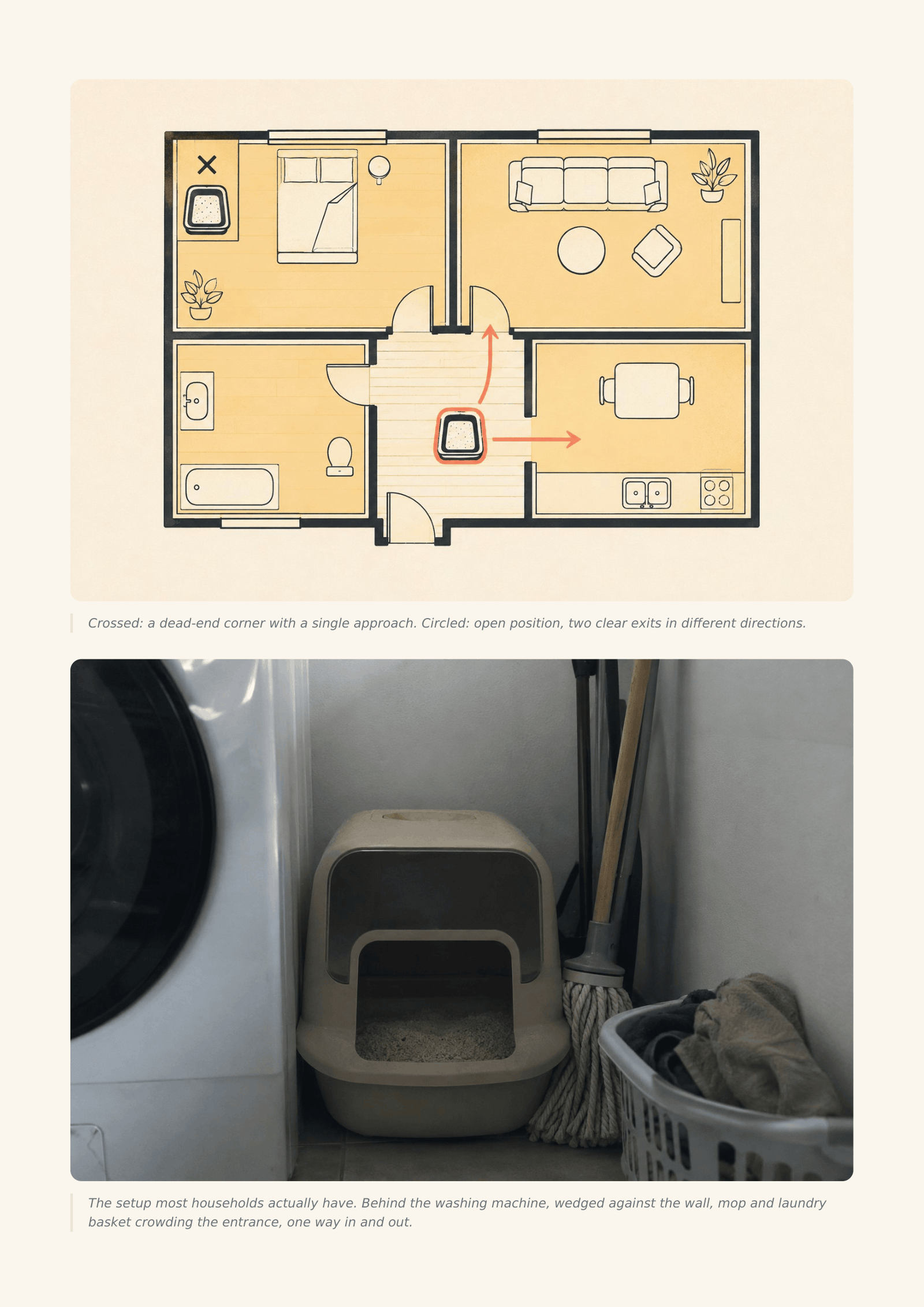
Number, size, location, depth, hoods, liners, substrate, cleaning, distance. Each with the specification, the mechanism behind it, and the mistake nearly everyone makes. The whole thing condenses onto one reference page — the page you'll photograph and keep on your phone.

Inside the book — the nine-variable specification page
Part IV

The litter preference test

Stop guessing what your cat wants and ask it directly. The five-box choice trial used in feline preference research, scaled down to your home — with a scoring sheet, how to read the result, and the five-stage ladder for switching litter without triggering a rejection.

Inside the book — box sizing and measurement
Part V

Cleaning done properly

Why ordinary cleaners fail, why ammonia ones make it worse, how enzyme cleaners actually work and how most people use them wrong. How to find the spots you can't see. And what to do when urine has gone through the carpet into the underlay — which is why some households clean diligently for months with no improvement.

Inside the book — the chemistry of cleaning cat urine
Part VI

The re-training ladder

For the cat whose habit has to be rebuilt from scratch. The reset room, progressive re-expansion room by room with timelines, what to do in the first twenty-four hours after a relapse — and a mechanical explanation of why punishment fails that will make you stop doing it tonight.

Inside the book — the re-training ladder
Part VII

Twelve case files

Twelve situations, what was actually happening in each, and what fixed it. The cat who went beside the box. The bathroom that was too clean. The second cat nobody saw blocking. The washing machine that ended a room. Find the one that resembles yours.

Inside the book — twelve case files
The Litter Box Protocol

You could start Part II tonight.

Download it in the next minute, read the triage page, and know by tomorrow morning whether you're dealing with a vet problem or a setup problem.

Get the book$24 · instant PDF
05

The six pages you'll keep coming back to.

01The 72-hour triage page

Three questions, in order. One of them decides whether this is an emergency.

02The nine-variable specification

Every setting, the correct value, and the mistake most people make — on one page.

03The vet phone script

What to say, in what order, so reception triages you correctly.

04The five-box scoring sheet

Run the preference trial properly and read what your cat told you.

05The switching ladder

Five stages for changing litter without triggering a rejection.

06The re-training timeline

Room by room, week by week, with the rule for after a relapse.

Those six pages alone are worth the price — get all seventy for $24.

06

One file. Everything in it.

70-page illustrated PDFA4, print-ready, reads properly on a phone
43 original illustrations & photographsCommissioned for this book. Nothing stock
The nine-variable specificationThe single most useful page in the book
The vet phone scriptWord for word, in order
The five-box scoring sheetAsk your cat instead of guessing
The litter switching ladderFive stages, no rejection
The re-training timelineFor habits that need rebuilding
Twelve worked case filesSituation, cause, fix, outcome
Instant download, yours to keepPhone, tablet, laptop, or printed
07

$24, against what this problem actually costs.

  • One professional carpet clean$150–$300
  • Replacing a soiled rug$200+
  • Replacing a mattress or sofa cushion$400+
  • Months of trying things that don't workwhat you're doing now

The book costs less than one bag of premium litter and one enzyme spray bought on a guess. It's designed to stop you buying the next four of each.

The Litter Box Protocol
$24one payment · yours forever
Download it now Instant PDF · all sales final
08

Be honest about which one you are.

This is for you if

  • Your cat is going outside the box and you don't know why
  • You've tried several fixes and none of them held
  • You have an older cat that has recently started
  • You have more than one cat and only one is soiling
  • You've been told "just add another box" and it didn't help
  • You want to understand the animal, not just follow steps
  • You're bringing a cat home and want the setup right first time
That's me — $24

Don't buy it if

  • Your cat is straining and producing nothing — that's an emergency. Phone a vet now, not after reading a book
  • You want a medical diagnosis. This routes you to a vet; it doesn't replace one
  • You want a one-page checklist. This is seventy pages of explanation
  • You want a fix by Friday. The protocol takes weeks and says so plainly
  • You aren't willing to change more than one thing

If you're in this column, please don't buy it. A refund isn't available and I'd rather you kept the $24.

09

Sourced, and honest about its own limits.

Every claim is drawn from published feline-medicine and applied-behaviour literature and from the clinical guidance of the American Association of Feline Practitioners, the International Society of Feline Medicine, and the Cornell Feline Health Center.

Where the evidence is strong, the book says so. Where a widely repeated recommendation actually rests on clinical consensus rather than controlled trials — and several of the most famous ones do, including the "one box per cat plus one" rule — the book says that on the page rather than rounding it into false confidence. You're entitled to know which is which.

And where a question belongs to a veterinarian, it says so early and repeatedly. Part II asks you to book an appointment before you change anything else.

10

Questions people ask before buying

How do I get it?

Instantly. You pay, you get a download link on the confirmation page and by email. It's a single PDF — open it on a phone, tablet, laptop, or print the whole thing.

Is this a vet book?

No, and it says so on page two. It's an educational book that explains the behaviour, gives you the setup specification, and routes every medical question to a veterinarian. Part II exists specifically to make sure you see one before you do anything else.

My cat has done this for two years. Is it too late?

No. Long-standing cases take longer — Part VI exists for exactly this, and it's honest that the ladder can run six to eight weeks or more. What it isn't is hopeless.

I have four cats. Does that change things?

Considerably, and the book handles it throughout. Multi-cat competition is one of the most common causes and one of the hardest to see, because feline conflict usually isn't fighting — it's one cat sitting in a doorway.

Will it work for spraying?

Chapter 1 will tell you within two pages whether you're dealing with spraying or elimination, which is the single most useful thing you can learn about this problem. If it's marking, the book tells you plainly which parts apply and which won't help.

Can I get a refund?

No — all sales are final on digital downloads. That's why this page spends so long telling you who shouldn't buy it. Read the "don't buy it if" column above and take it seriously.

Is there more coming?

Yes. This is Book One of the Meowive library. The next volumes go equally deep on behaviour, nutrition and buying decisions.

Book One · The Meowive Library

Stop guessing.
Start with the right thing.

Seventy pages. Seven parts. Worked in order, from the medical rule-outs through to the twelve case files. Download it in the next minute and read the triage page before you go to bed.

Get The Litter Box Protocol — $24

Instant PDF download · yours to keep · all sales final

Please note. This book is educational and is not veterinary advice. It cannot diagnose, treat or rule out any medical condition and is not a substitute for examining your cat. If your cat is straining in the litter box and producing little or nothing, crying while trying to go, or repeatedly visiting the box without result — particularly a male cat — contact a veterinarian immediately.

The Litter Box Protocol70-page PDF · instant download
$24 — Get it