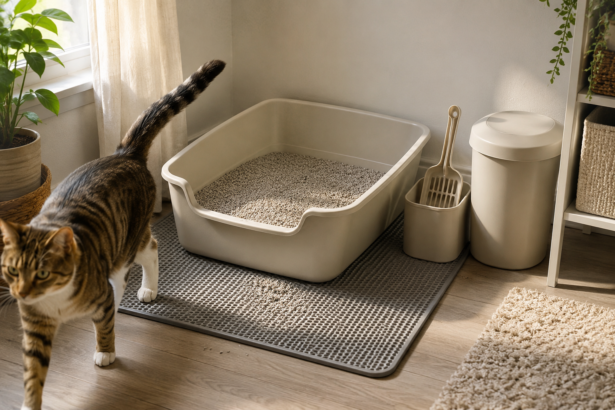



The feeder’s best trick isn’t feeding. It’s making you stop being the vending machine.
Thank you for reading this post, don't forget to subscribe!Four specs decide whether a feeder works or becomes a $90 paperweight. None of them appear in the marketing.
Your cat wakes you at 4:58 every morning, or your workday keeps stretching past dinner, and you’ve decided a machine should handle it. Then you open the listings and it’s forty devices arguing about apps, cameras and hopper litres. Choosing the best automatic cat feeder is much simpler than that: four boring specifications separate the reliable ones from the jam-prone ones, and the setup you use matters more than the model you buy.

There's a calmer way — one library that answers it all. See it for yourself.
Explore the Library →
The best automatic cat feeder for most homes is a gravity-fed hopper model with four things: accurate portioning you can verify with a scale, an anti-jam dispensing mechanism, dual power (mains plus battery backup), and a sealed hopper. Dry food only for hopper feeders; wet food needs a cooled or carousel design. Set the first meal before your cat’s usual wake-up time and stop hand-feeding breakfast entirely.
The short version, if you’re buying today
✓ Verify portions with a kitchen scale — weigh five consecutive dispenses before you trust any feeder’s “1/8 cup.”
✓ Rotating-drum mechanisms jam far less than open augers, which choke on small or oddly shaped kibble.
✓ Battery backup isn’t optional. A power cut at 3am shouldn’t cancel breakfast.
✓ Multi-cat homes with a food thief need microchip or RFID access control — a normal feeder just feeds whoever’s fastest.
✓ Three to five small meals beats two big ones for digestion, boredom and portion control.
✓ A feeder is not a cat sitter. One night alone is fine; longer needs a human checking in daily.
Why an Automatic Feeder Fixes the 5AM Problem (It’s Psychology, Not Timing)

Most people buy a feeder for convenience and are surprised when it solves a behavior problem instead. Here’s the mechanism.
Your cat isn’t waking you because they’re starving at 4:58. They’re waking you because at some point — probably a bleary morning eighteen months ago — you got up and fed them, and that recorded a rule: humans, when disturbed, produce breakfast. Cats are exceptional at learning contingencies, and food-related ones stick hardest. Every time you cave, even to make the noise stop, you reinforce it.
A feeder breaks the association at the source. When breakfast reliably arrives from a machine in the kitchen on a fixed schedule, your face stops being the button. Most food-motivated cats transfer their attention to the feeder within one to two weeks — they’ll often start sleeping near it before the dispense. Pair the feeder with a proper evening play-then-feed routine and you’ve addressed both halves of the problem; our guide to cat meowing at night covers the play side in detail.
The second reason is less romantic but arguably more valuable: portion discipline. Humans are terrible at consistent measuring, especially when a cat is performing starvation theatre. Multiple small measured meals suit feline digestion — cats evolved eating many tiny prey animals rather than two large plates — and a machine doesn’t feel guilty at 6pm.
✨ Quick win — the exact dawn setting
Set the first dispense 15–30 minutes before your cat’s habitual wake-up time — if they start at 5:00, dispense at 4:35. You’re getting ahead of the routine rather than competing with it. Then hand-feed nothing in the morning for at least three weeks. Expect two or three louder mornings first as the old strategy fails; that’s the behavior extinguishing, not the plan failing.
The Four Specs That Actually Predict Whether a Feeder Works

Feeder marketing sells cameras, voice recordings and app ecosystems. Feeder reliability lives in four unglamorous places, and every feeder horror story you’ll read online traces back to one of them.
Knowing which one you’re looking at is the whole skill.
- Call now — six signs that mean tonight, not tomorrow.
- Call today — two or more of the eleven signals, together.
- Record and watch — one change, with an ordinary explanation.
Portion accuracy you can verify
“One portion” is a target, not a promise — kibble size and shape change the throw. Weigh five consecutive dispenses on a kitchen scale when the feeder is new and after every food change. A few grams of drift per meal quietly erases an entire weight-loss plan over a month.
An anti-jam dispensing mechanism
This is the single most common failure. Rotating-drum and paddle designs handle irregular kibble far better than cheap open augers, which bridge and clog. Check the manufacturer’s stated kibble size range — usually somewhere around 2–15mm — before you commit to a food.
Dual power: mains plus battery backup
Mains-only feeders forget their schedule in an outage. Battery-only feeders die silently. You want both, and you want to replace the backup batteries on a calendar — twice a year — rather than when they fail.
A properly sealed hopper
Kibble fat oxidizes when air reaches it, and rancid fat is why cats mysteriously “go off” a feeder after a few weeks. Look for a gasket lid and ideally a desiccant compartment — and never fill a hopper with more food than your cat eats in about two weeks.
Which Feeder Type Fits Your Cat: A Straight Comparison

Feeders fall into five genuine categories, and picking the wrong category is a more expensive mistake than picking the wrong brand within one.
| Feeder type | Food | Best for | The catch |
|---|---|---|---|
| Hopper + timer | Dry | Simple schedules, no-app households | No remote changes; check jam design carefully |
| Hopper + Wi-Fi app | Dry | Most homes — remote tweaks, feeding logs, low-food alerts | Avoid any model charging a subscription for basic scheduling |
| Cooled dispenser | Wet | Wet-fed cats, hydration-focused diets | Costs more; cooling struggles in hot rooms; not for raw |
| Carousel / compartment | Wet or dry | Budgets, short absences, mixed feeding | Usually limited to 5–6 meals per load |
| Microchip / RFID | Dry (some wet) | Food thieves, prescription diets, weight plans | One unit per cat; needs a tag or registered chip |
The multi-cat case deserves special attention because it’s the one people get wrong most expensively. If one cat inhales the other’s portion, buying a bigger, smarter feeder changes nothing — you’ve just automated the injustice. You need either physically separated feeding rooms or access-controlled feeders that open for one cat only. Anything else is a buffet with extra steps. The same resource logic applies across a multi-cat household generally, which we cover in how to introduce a second cat.
📝 Note — hopper feeders are dry-food-only, always
No gravity hopper can handle wet food; it clogs, spoils and grows bacteria within hours. If your cat is on a wet-heavy diet — which has real hydration advantages, as we explain in our wet vs dry cat food comparison — you need a cooled dispenser or a carousel with ice packs, and you should plan around a 2–3 day maximum.
Beyond the hardware
A feeder handles the schedule. This handles the cat.
The Complete Cat Owner Library covers what a machine can’t — reading your cat’s demands, fixing night waking at the root, portioning by body condition, and knowing when a change in appetite means a vet visit.
See what’s inside →Setting Up the Best Automatic Cat Feeder So Your Cat Accepts It

A feeder your cat distrusts is a feeder that doesn’t work, and cats are famously suspicious of new objects that make noise. The transition takes about a week and it’s worth doing properly.
Days 1–2: place it unplugged next to the existing bowl. Let it become boring furniture before it becomes the waiter.
Day 3: trigger manual dispenses while your cat watches, two or three times. Most cats connect the whirr-and-clatter to food within a single day.
Days 4–5: move half the daily ration onto the schedule, keeping the rest by hand. Watch the first scheduled dispense in person so you catch a jam immediately.
Days 6–7: full schedule. Three to five small meals, with the earliest one placed ahead of your cat’s wake-up habit.
Ongoing: wash the bowl and chute weekly, wipe the hopper monthly, refresh desiccant, and recalibrate portions with a scale whenever you open a new bag.
Placement matters more than the manuals admit. Put the feeder on a hard, level surface away from walls a determined cat could use for leverage, and not right beside the litter box — cats strongly dislike eating near their toilet. Keep it somewhere you can hear it dispense for the first fortnight. And if your cat is a hopper-raider, a feeder with a twist-lock lid is worth the extra ten dollars; the alternative is discovering a two-week ration eaten in one sitting.
Meal Timing: How Many Dispenses, and When

Once you have a machine, you can feed the way cats are actually built to eat — small and often — rather than the way human schedules force.
Start from one number: your cat’s total daily calories, which comes from your vet based on weight, body condition and whether they’re neutered. Divide that across three to five dispenses. A schedule that works well in practice looks like an early pre-dawn meal, a mid-morning portion, a mid-afternoon one, and the largest meal in the evening close to your bedtime — because a substantial evening meal feeds directly into the hunt-eat-groom-sleep cycle that pushes a cat’s deep sleep into your night rather than your 4am.
Two adjustments worth knowing. For a cat on a weight-loss plan, more frequent, smaller dispenses reduce the between-meal begging that makes owners cheat. For a home-alone cat, a midday dispense is genuine enrichment — an event to anticipate in an otherwise empty eight hours — and pairs well with scattering part of the ration into puzzle feeders instead.
3–5
small meals a day suits feline digestion better than two large ones
5×
dispenses weighed on a scale — the only way to trust a portion setting
1
night is the maximum a feeder should cover without a human check-in
⚠️ Warning — a feeder is not a cat sitter
Machines jam, Wi-Fi drops, hoppers bridge, water bowls foul and litter boxes fill. A single overnight with a reliable feeder is reasonable; anything longer needs someone physically checking on your cat every day. And if your cat stops visiting the feeder, treat it as an appetite alarm rather than a hardware fault — cats who stop eating can develop serious liver complications within a few days, so call your veterinarian rather than waiting to see.
The Feeding Log Is a Health Monitor Nobody Uses

If your feeder tracks dispenses and, better, whether food was taken, you’re holding one of the most sensitive early-warning tools available to a cat owner — and almost everyone ignores it.
Appetite change is frequently the first observable sign that something is wrong with a cat, and cats are extraordinarily good at concealing illness. Dental pain, nausea, kidney changes and stress all show up as subtle intake shifts long before anything dramatic happens. The problem is that human memory is useless here: nobody can honestly say whether the cat ate slightly less than usual across the past nine days.
There's a calmer way — one library that answers it all. See it for yourself.
Explore the Library →So make it a habit. Once a week, glance at the log and ask one question: is intake steady? A gradual downward drift, or meals increasingly left uneaten, is information worth taking to a vet — especially alongside changes in drinking, litter box output, grooming or energy. It costs you thirty seconds and it’s the closest thing to a passive health monitor most households will ever have. For a broader sense of what warrants concern, the ultimate cat care guide maps the routine checks by life stage.
Common Mistakes That Turn a Good Feeder Into an Expensive Bowl
1. Trusting the portion label instead of a scale
Portion settings are calibrated on some reference kibble that probably isn’t yours. Weigh five dispenses, average them, adjust the setting, and repeat after every food change. On a cat that should eat 220 calories a day, a 15% overshoot is roughly a kilogram of weight gain a year.
2. Buying one feeder for two cats who don’t share fairly
A standard feeder feeds whichever cat arrives first — usually the one who least needs seconds. If one cat guards the bowl, gulps, or is on a prescription diet, you need access control or separate rooms. Watching a slow eater lose weight while a confident cat rounds out is the classic multi-cat feeder failure.
3. Filling the hopper to the brim “to save refills”
A full hopper sitting for six weeks is a fat-oxidation experiment. Kibble goes stale and unappetizing, and the “faulty feeder” your cat is boycotting is often just old food. Fill about two weeks’ worth at a time and wipe the hopper when you refill.
4. Hand-feeding “just this once” at dawn
This is the mistake that undoes the entire behavioral benefit. Intermittent rewards train harder than consistent ones — a cat who gets fed by hand one morning in ten learns to try much harder, not less. If you’re going to use a feeder to fix dawn waking, the machine has to become the only morning food source.
5. Changing kibble shape without checking the jam risk
Very small, very large or ring-shaped kibble is the classic clog. When you switch foods, check the feeder’s stated kibble size range and supervise the first day of dispenses. A jam you catch at 8pm is an inconvenience; one your cat discovers alone at 6am is a missed meal you never find out about.
“The machine isn’t replacing you. It’s replacing the argument you have with your cat every morning at five.”
Automatic Cat Feeder Questions, Answered Properly
Buy for Reliability, Set It Up for Behavior
The best automatic cat feeder is simply the one that never misses a meal — so buy for portion accuracy, jam resistance, dual power and a sealed hopper, and let the cameras and voice clips be a bonus rather than the reason. Then spend the first week doing the setup properly, because a feeder your cat trusts and a schedule that gets ahead of their habits is what actually buys back your mornings. Next, look at what the food’s landing in with our guide to cat feeders and bowls, or browse the rest of our products and buying guides.
Ten guides · 200+ pages
The rest of the answers, in one place
From feeding routines and picky eaters to night waking, litter problems, indoor enrichment and the symptoms worth a vet call — The Complete Cat Owner Library is the reference we built for exactly these questions.
Open the Library →
Get Decode Your Cat — free.
20 everyday behaviors translated, so you finally know what your cat is actually saying. Pop in your name and email and it's yours instantly.