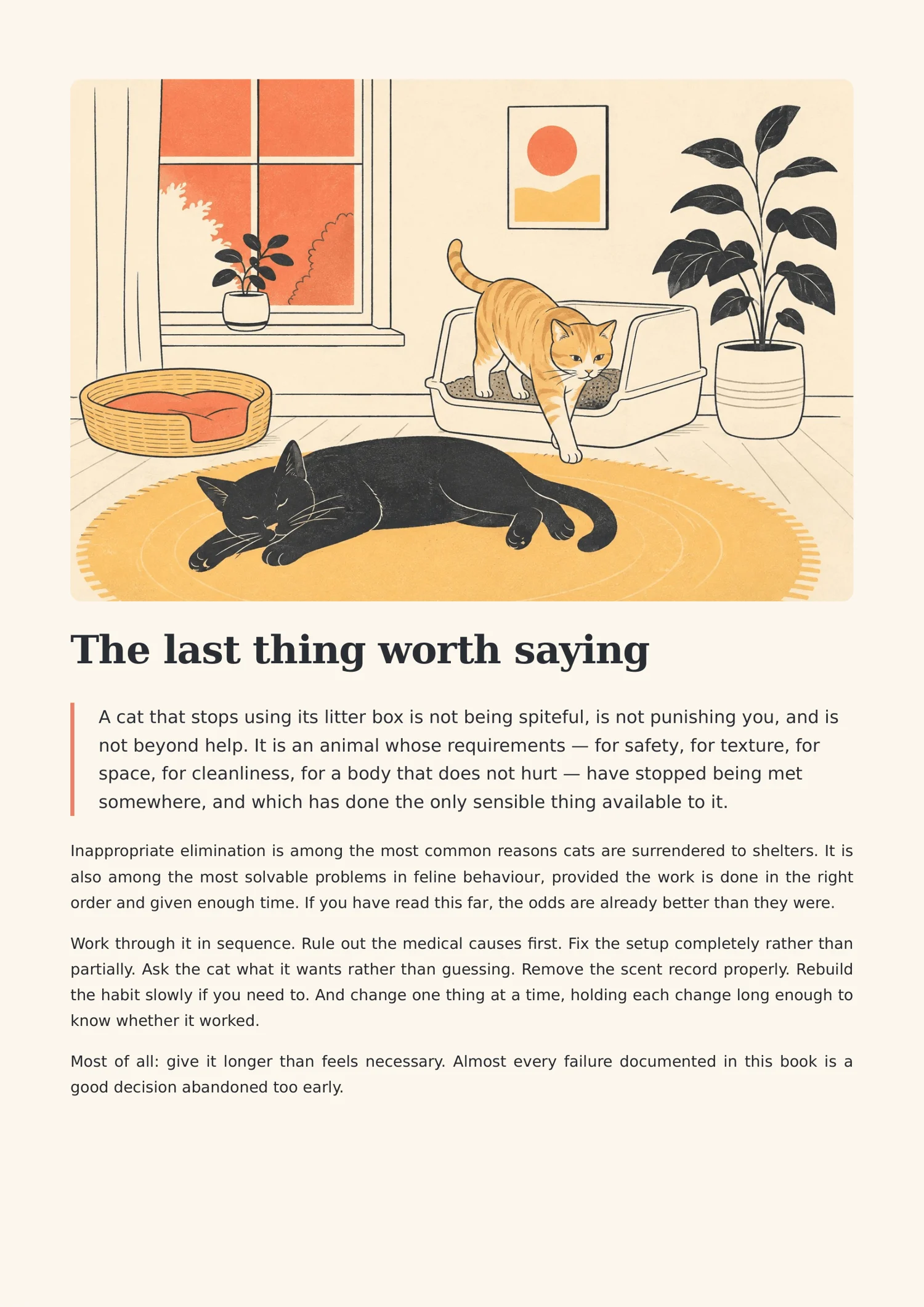
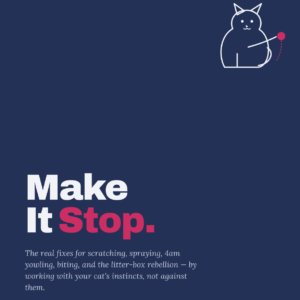
A cat that stops using its litter box is not being spiteful. It is an animal whose requirements — for safety, for texture, for space, for cleanliness, for a body that does not hurt — have stopped being met somewhere. This book finds where.
Thank you for reading this post, don't forget to subscribe!
Most advice on this subject hands you a list: add a box, change the litter, clean it properly, see a vet. Every item is correct and the list is close to useless, because a list has no order — and order is the entire problem. Change the litter while the cat has untreated cystitis and nothing happens. Fix the location while the old spot is still chemically active and the cat goes back to it. Try four things in three weeks and you will never know which one worked.
This is the order, worked from the front, with the reasoning shown at every step.
01Specification
Illustrations
43 original
Delivery
Instant download
02Contents
I
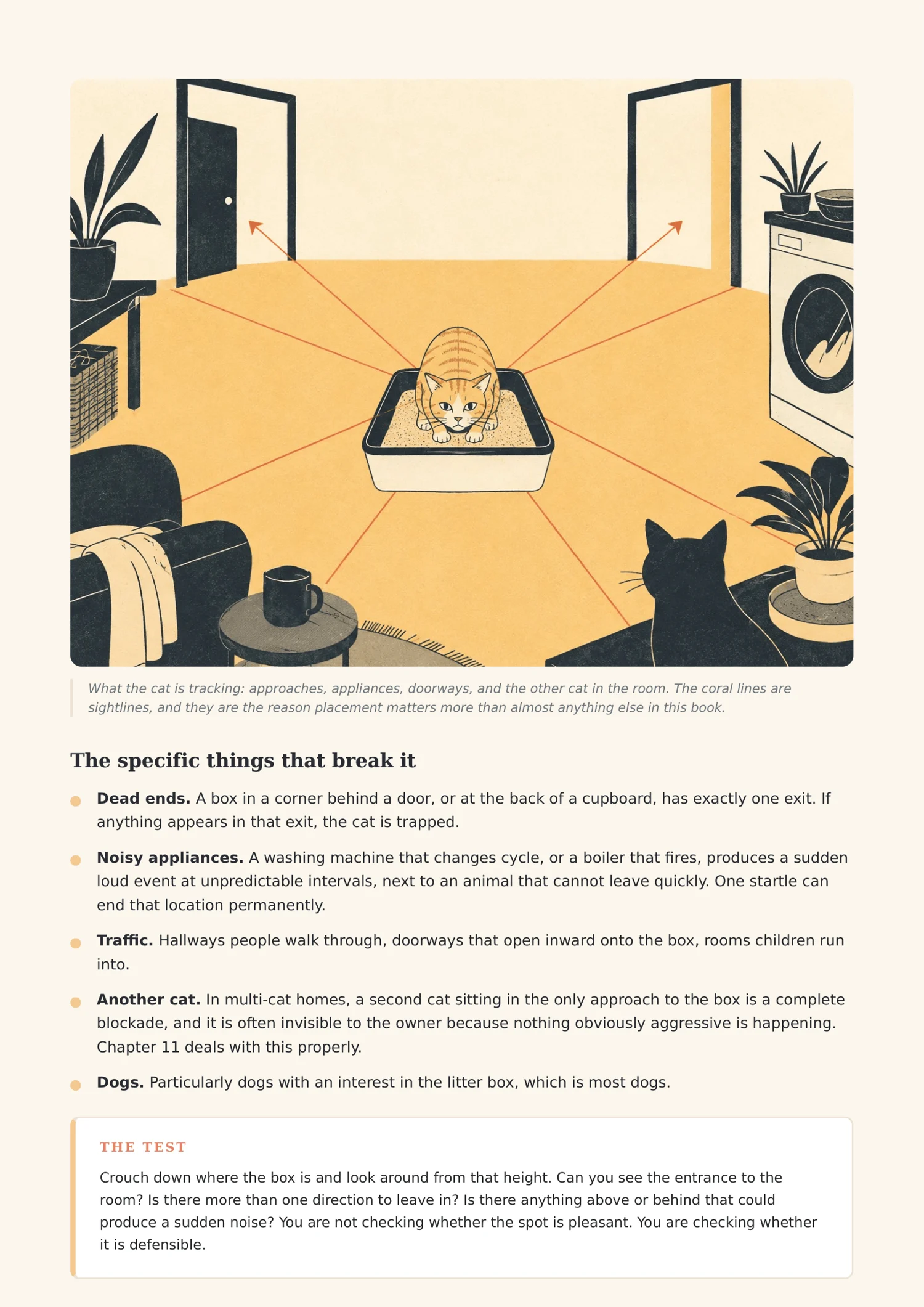
Why cats eliminate where they doMarking versus eliminating — two different problems, two different solutions. Desert physiology and why feline urine is so persistent. Substrate imprinting between three and eight weeks. Why a used spot stays active. Why elimination is the most vulnerable ninety seconds of a cat’s day.
II
Medical rule-outs come firstIdiopathic cystitis and the stress–bladder loop. Crystals, stones, and the urethral obstruction that is regularly mistaken for stubbornness. Arthritis and the six-inch wall. Kidney, thyroid and diabetes. Includes a phone script for the veterinary practice.
III
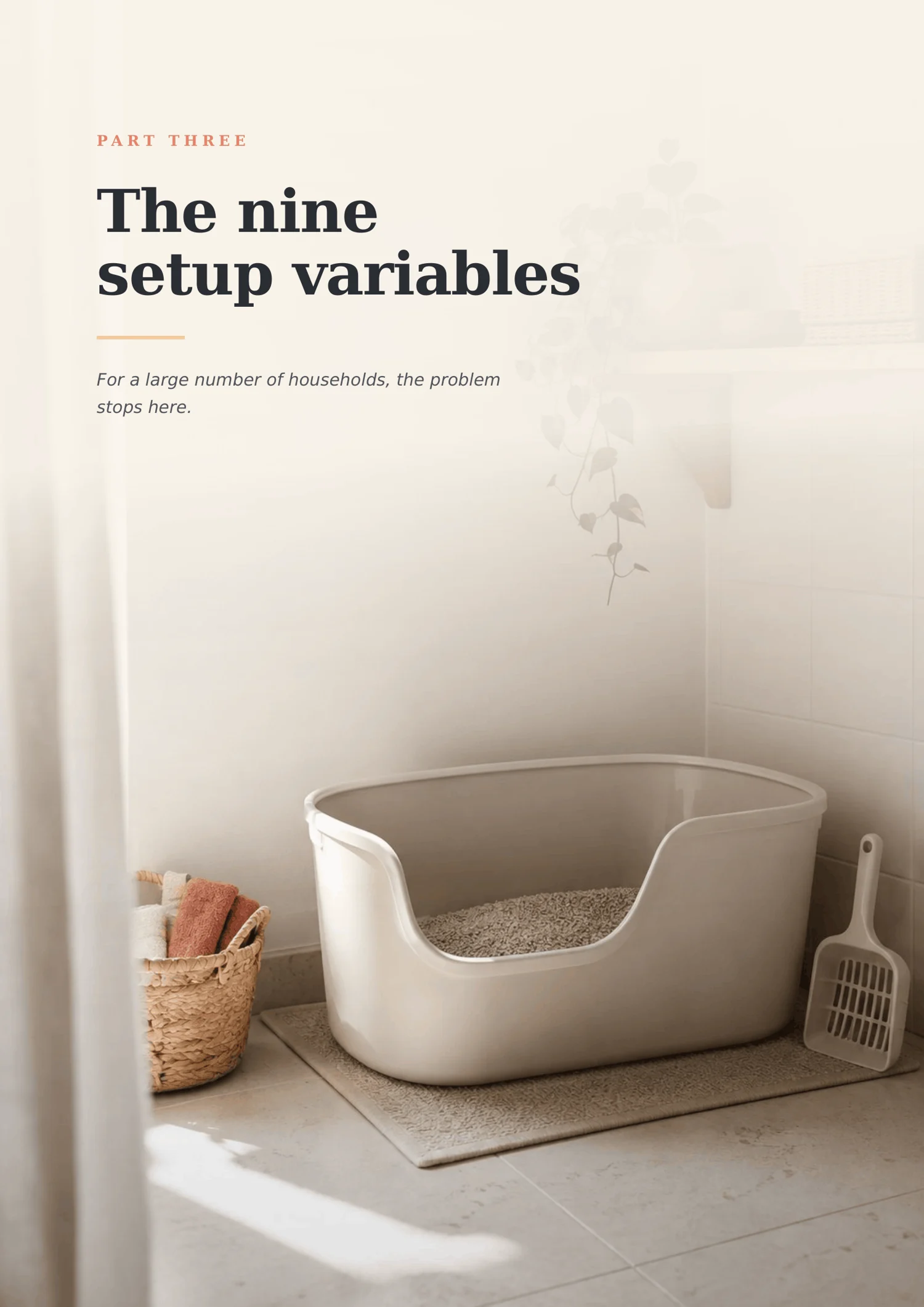
The nine setup variablesNumber, size, location, depth, hoods, liners, substrate, cleaning, distance — each with its specification, its mechanism, and the error most households make. Condensed onto a single reference page.
IV
The litter preference testThe five-box choice trial from feline preference research, scaled to a home. Scoring sheet, how to read the result, and the five-stage ladder for changing litter without triggering a rejection.
V
Cleaning done properlyWhy ordinary cleaners fail and ammonia-based ones make it worse. How enzyme cleaners work and how most people use them wrong. Finding what you cannot see. What to do when urine has reached the underlay.
VI
The re-training ladderThe reset room, progressive re-expansion with timelines, the first twenty-four hours after a relapse, and a mechanical account of why punishment fails.
VII
Twelve case filesSituation, cause, fix, outcome. Find the one that resembles yours.
03The six working pages
Six pages in this book are instruments rather than prose — the ones readers photograph and keep on their phone.
72-hour triageThree questions, in order. One decides whether this is an emergency.
Nine-variable specificationEvery setting, its correct value, its common error.
Vet phone scriptWhat to say, in what order, so the urgency is triaged correctly.
Five-box scoring sheetRun the trial properly and read what your cat told you.
Switching ladderFive stages for changing litter without a rejection.
Re-training timelineRoom by room, week by week, with the relapse rule.
04Method
Every chapter runs the same four layers, in the same sequence. You are told why before you are told what to do — because an owner who understands why litter depth matters will get it right in a box this book never anticipated, and an owner handed only a number gets it right once.
iTheoryWhat the behaviour is for
iiMechanismHow it works in your cat
iiiProtocolExactly what to do
ivFailure casesWhat it means when it doesn’t work
05Suitability
Written for
Cats going outside the box for no obvious reason
Households where several fixes have already failed
Older cats that have recently started
Multi-cat homes where only one cat is soiling
Anyone told “just add another box” without result
New owners who want the setup right first time
Not written for
Emergencies — a cat straining without producing urine needs a vet today, not a book
Readers wanting a diagnosis. This routes to a vet; it does not replace one
Readers wanting a one-page checklist
Readers wanting a result by Friday. The protocol runs in weeks
06Sourcing
Drawn from published feline-medicine and applied-behaviour literature and from the clinical guidance of the American Association of Feline Practitioners, the International Society of Feline Medicine, and the Cornell Feline Health Center. Where a widely repeated recommendation rests on clinical consensus rather than controlled trials — and several of the most famous ones do — the book says so on the page rather than rounding it into false confidence.
Please note. This book is educational and is not veterinary advice. It cannot diagnose, treat or rule out any medical condition and is not a substitute for examining your cat. If your cat is straining in the litter box and producing little or nothing, crying while trying to go, or repeatedly visiting the box without result — particularly a male cat — contact a veterinarian immediately. All sales are final on digital downloads.