


The Meowive Library

You have lived with this animal for years.Do you know what it’s been saying?

Every day your cat tells you what it wants, what it fears, whether it trusts you and whether it would like you to stop — with its tail, its ears, its pupils, its whiskers and the shape of its body. Continuously. From across the room.

Thank you for reading this post, don't forget to subscribe!

Almost nobody is ever taught to read it.
This is the decoder.

Get the book — $22 Or keep reading — this page shows you the whole method before it asks you for anything.
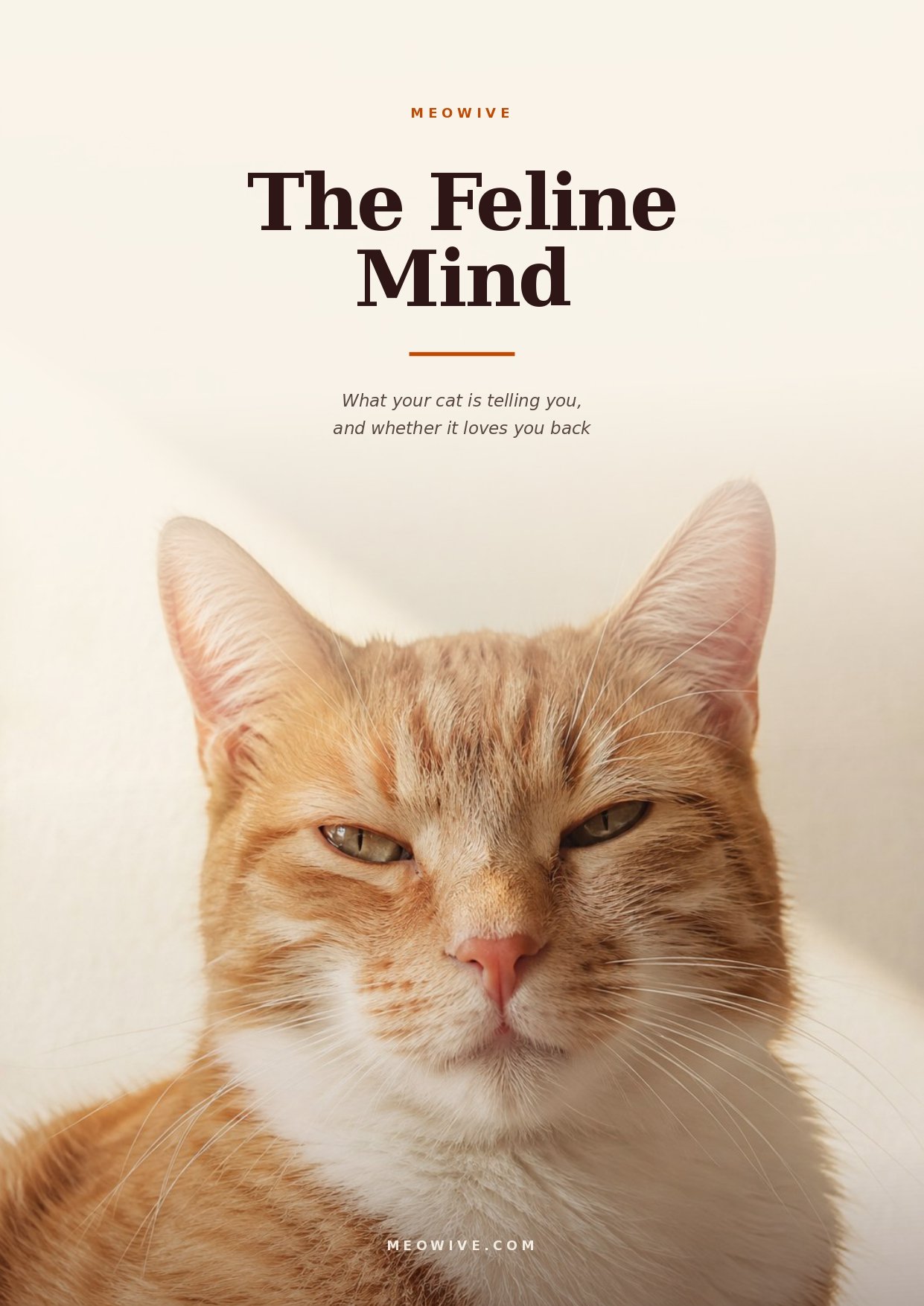
The Feline Mind — 58-page illustrated guide to cat behaviour
01

Things your cat did this week that you didn’t read.

Sat with its back to youSlow-blinked from across the room Held its tail up as it walked inFlattened one ear while being stroked Rolled over, then bit you for touching the bellyFollowed you to the bathroom Chattered at the windowGroomed suddenly, mid-conversation Rubbed its face on the doorframe

Every one is a specific, decodable statement. Several are the strongest affection signals a cat possesses. One is a warning most people miss until they are bitten.

Inside The Feline Mind — a sample page
Inside the book

Why before what

Every chapter explains what a behaviour evolved to do before it tells you what it means. An owner who understands why cats bunt will read a doorframe correctly in a house this book never anticipated. An owner handed a definition gets it right once.

Signals do not have fixed meanings. A cat can hold its tail high while flattening its ears, and both statements are true — it wants to approach and it is not sure. Read one channel and stop, and you will be confidently wrong.

This book teaches the grammar, not just the vocabulary.

The animal has been broadcasting the whole time.

You were simply never handed the frequency.
02

And underneath all of it, the question you actually want answered.

Does my cat
actually love me?

Most books dodge this or drown it in sentiment. This one answers it on page five — because it deserves answering, and because the honest answer is more interesting than either the cynical version or the greeting-card version.

01Attachment is measurable in cats

Tested with the same paradigm used on human infants and on dogs, cats produce the same categories in roughly the same proportions — a majority securely attached.

02They use you as a secure base

The signature is not clinginess. It is a cat that greets you, touches, then goes back to exploring — because your presence regulates its stress response.

03Many pick you over food

In controlled preference testing between food, scent, toys and human interaction, the largest single group chooses the human. Not all. But the popular belief does not survive the data.

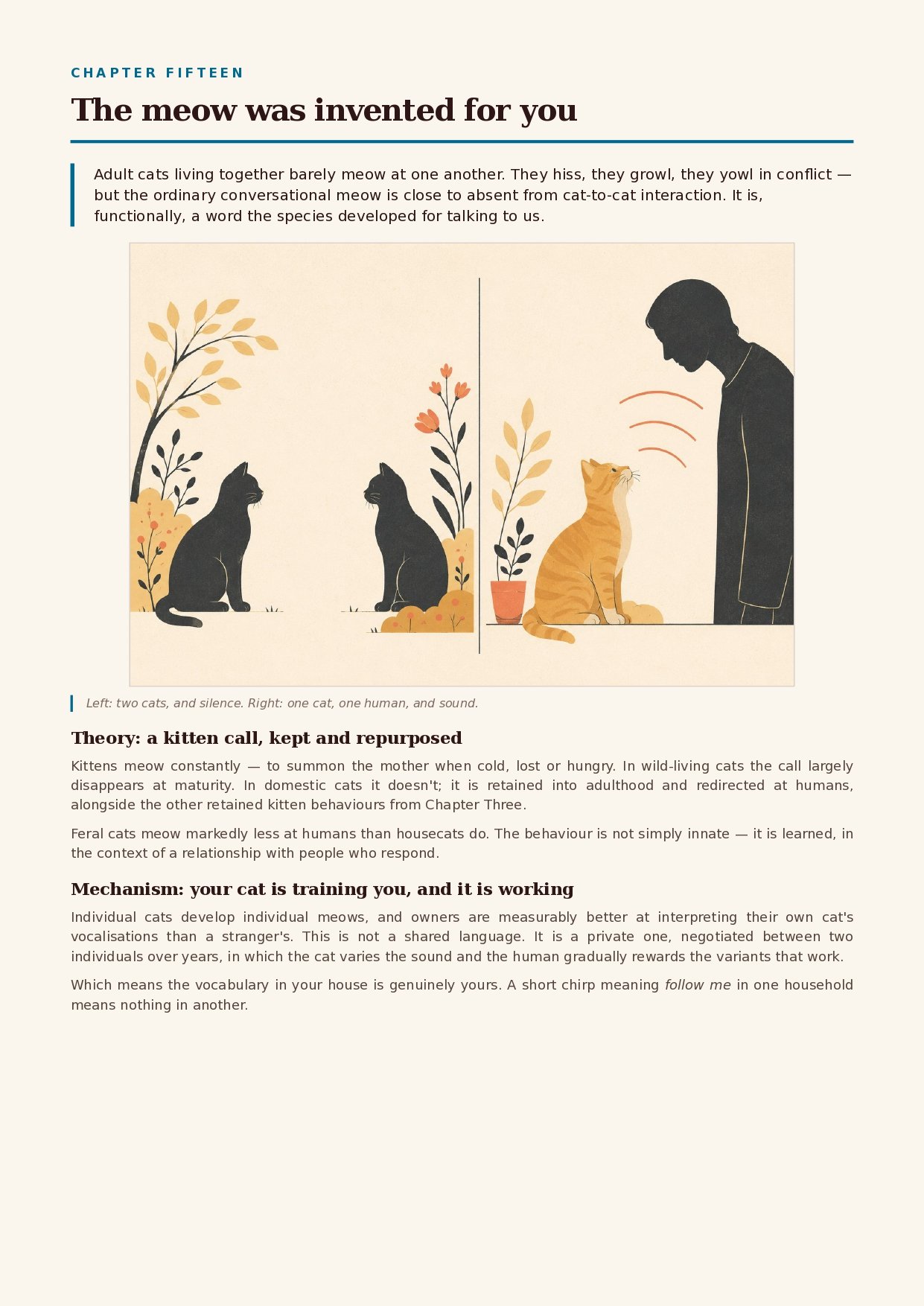
04The meow was invented for you

Adult cats barely meow at each other. It is a kitten call retained into adulthood and pointed at humans — and yours has a private vocabulary developed specifically for you.

Read the whole argument — $22 58 pages · instant download
5channels your cat signals on at once — and they routinely disagree with each other.
30muscles control each ear. They rotate independently, and they move before anything else does.
12signs that you are their person. Most owners have been receiving eight or nine for years.
The harder reason to learn this

Cats conceal illness — a legacy of being a predator that is also prey. A behavioural change is frequently the first visible symptom, arriving weeks before anything a hand can feel. Reading your cat is not a party trick. It is the only medical chart the animal can show you.

03

Fifty-eight pages, seven parts, worked from the front.

Every chapter runs the same four layers. You are told why a behaviour exists before you are told what it means — because signals only make sense once you know what the animal is for.

iTheory

What the behaviour is for

iiMechanism

How it works in your cat

iiiProtocol

What to do with it

ivFailure cases

How it gets misread

Part I

Where the cat came from

Almost every domestic animal was taken. The cat arrived — on its own terms, and it has never entirely stopped behaving like a guest. Why cats are semi-social rather than solitary, what ten thousand years actually changed, and why your cat is running near-original software on a sofa.
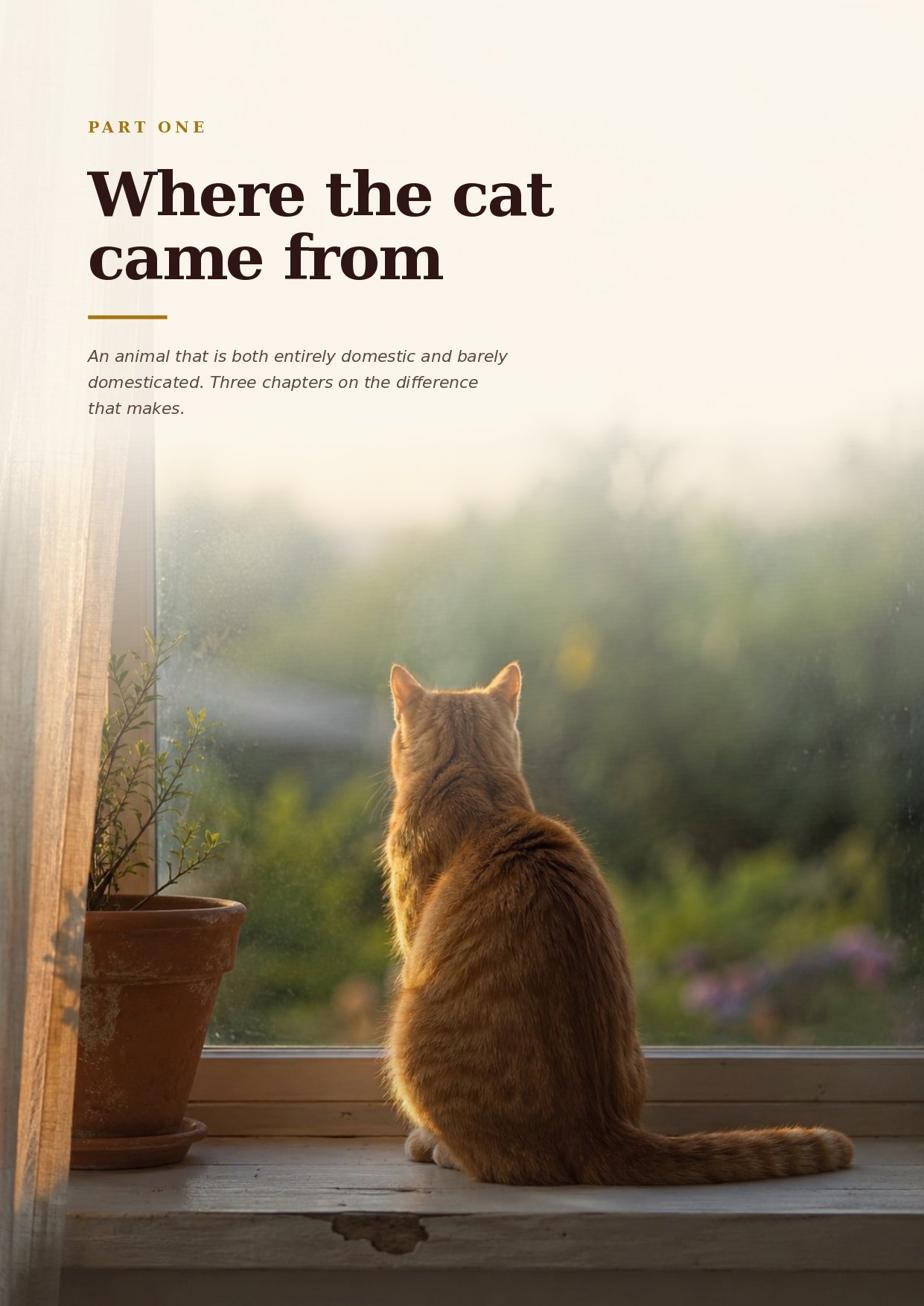
Inside the book — where the cat came from
Part II

The bond

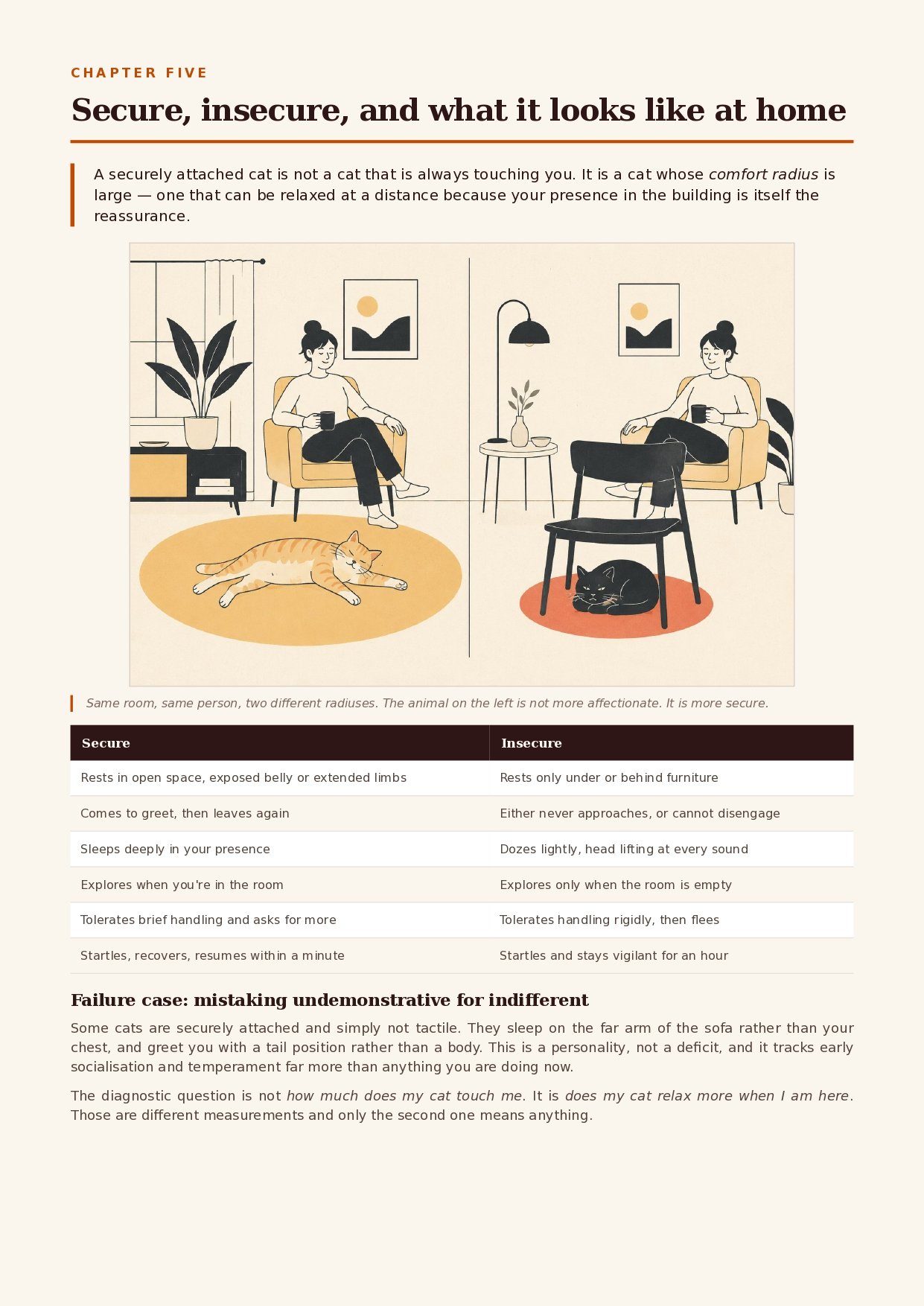
What the attachment research can actually demonstrate. Secure versus insecure, and what each looks like in a living room. The twelve signs you are their person. And why the undemonstrative cat is so consistently mistaken for an indifferent one.

Inside the book — feline attachment
Part III

The signal system

The heart of the book. Tail, ears, eyes and pupils, whiskers, posture, the slow blink — each as a full reference plate, then a chapter on reading them in combination, which is where almost everyone goes wrong. Ends with a master plate you will photograph.

Inside the book — the signal reference plates
Part IV

The voice

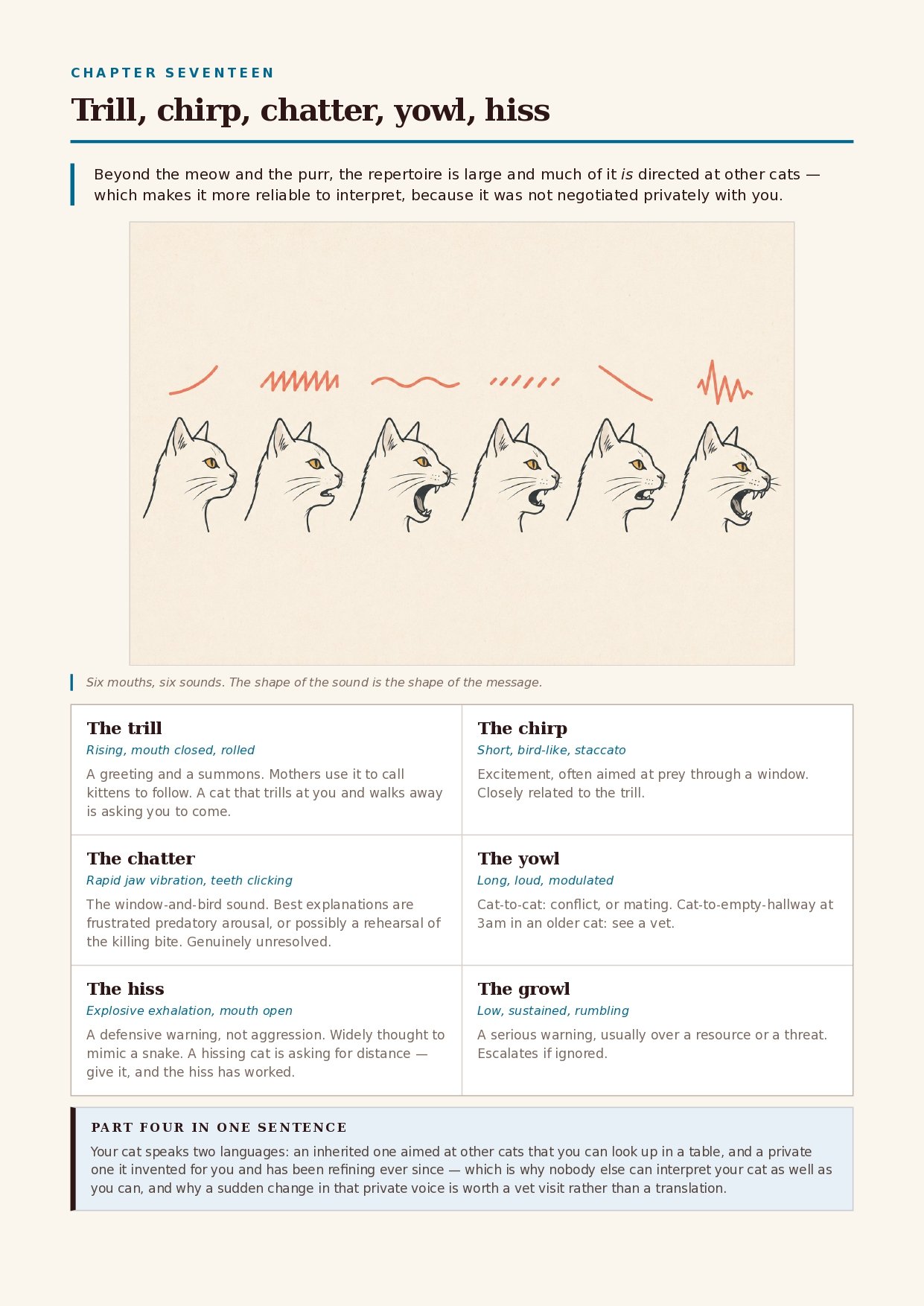
The meow was developed for humans and barely exists between cats. Purring is not what you think. Trill, chirp, chatter, yowl, hiss and growl — what each is for, and which change in voice means phoning a vet rather than interpreting.

Inside the book — feline vocalisation
Part V

The scent world

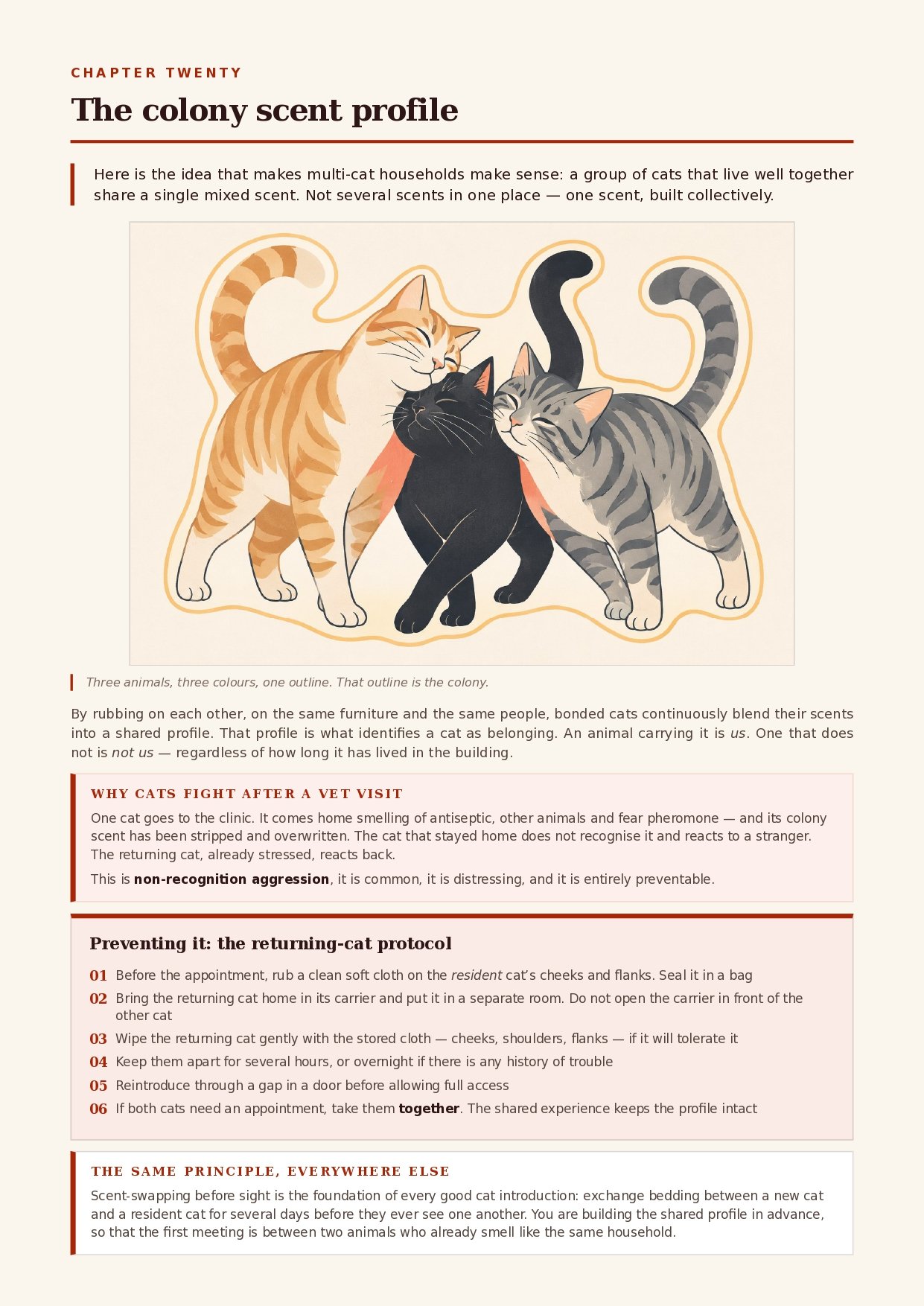
Your cat lives in a second version of your home, laid over the one you can see. Where the scent glands are and what each says. Why scratching cannot be trained away. And the colony scent profile — which explains why cats fight after a vet visit, and how to prevent it.

Inside the book — the feline scent world
Part VI

The hunter

Play is not a pastime. It is the hunting sequence running with no prey at the end of it. The five stages, why most play sessions stall at stage three, the problem with laser pointers, six rules for playing properly — and a mechanical fix for the 4am problem.

Inside the book — the hunting sequence
Part VII

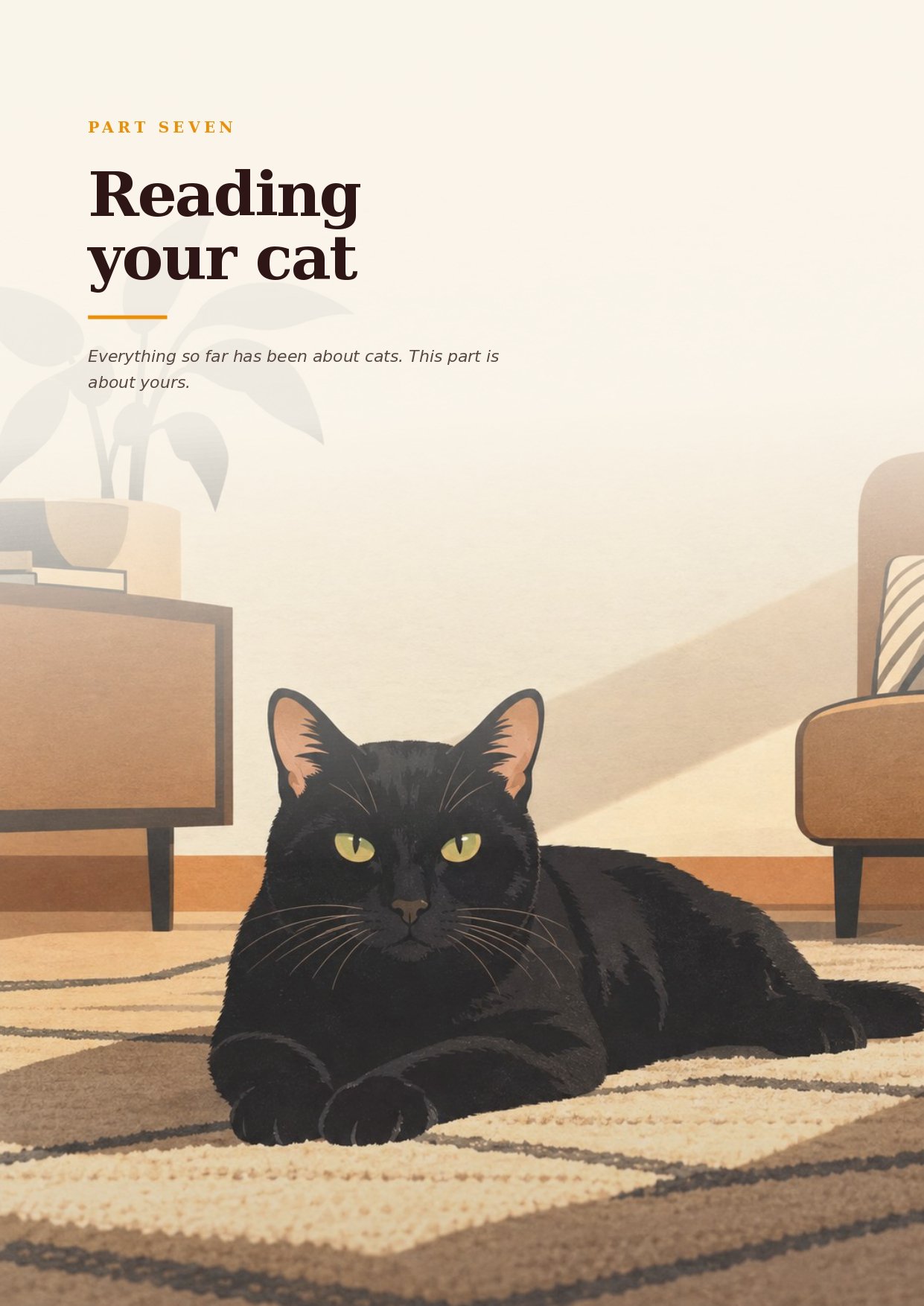
Reading your cat

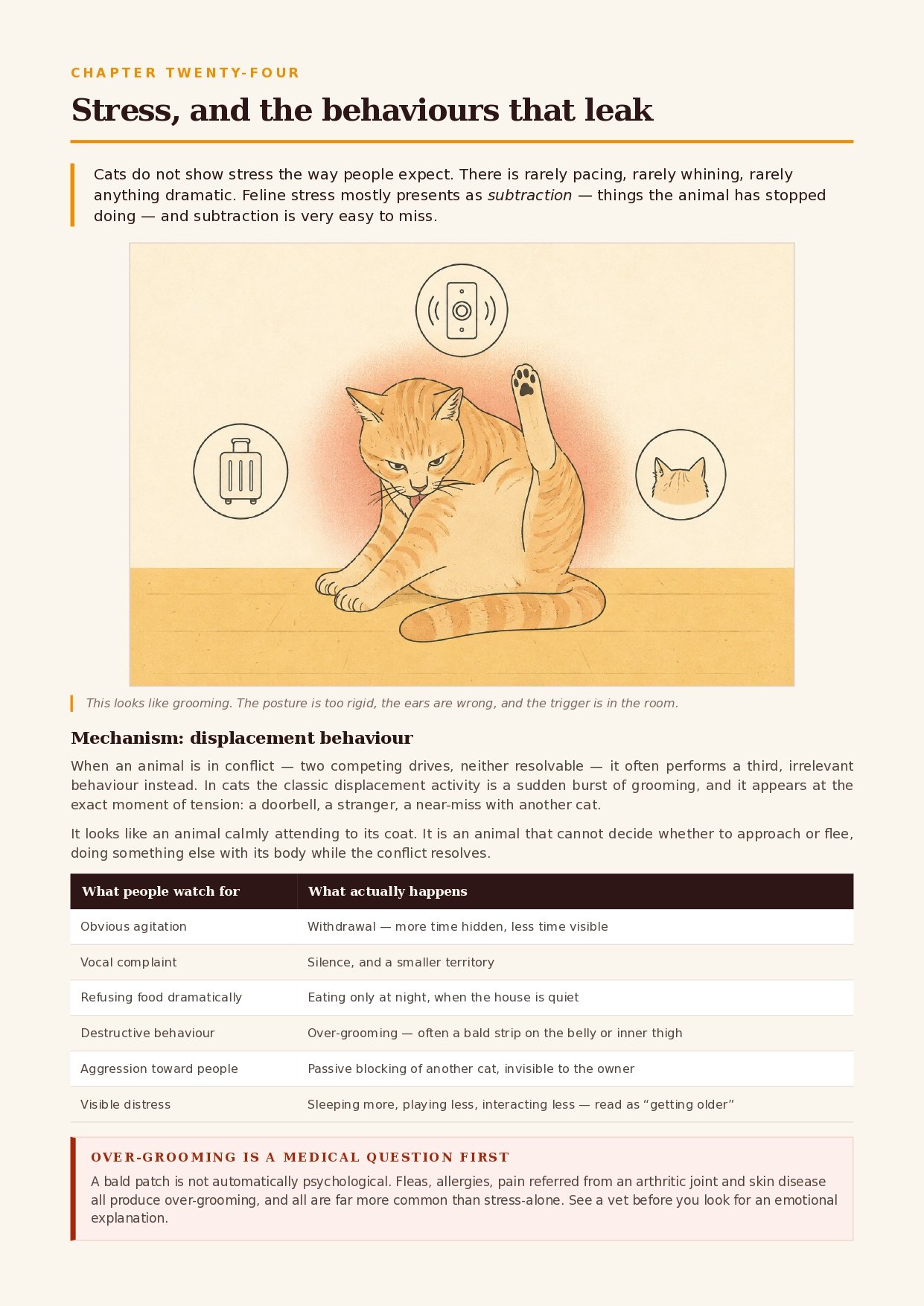
Everything before this was about cats. This part is about yours. How feline stress presents as subtraction rather than drama, a thirty-day protocol for the cat that hides, and the baseline journal — the least exciting and most valuable page in the book.

Inside the book — reading your own cat
The Feline Mind

You could try the slow blink tonight.

Four seconds, impossible to do wrong, and the one gesture in this book that works on a cat that has never met you. Chapter Thirteen.

Get the book$22 · instant PDF
04

The reference pages you’ll keep on your phone.

01The tail plate

Eight positions, what each means, what to do about it.

02The ear plate

Six positions. The fastest early warning your cat has.

03The pupil scale

Slit to full round — and why the light explains most of it.

04The posture plate

Six body shapes, from fully open to fully closed.

05The master plate

Twelve signals ringed around one animal. The page people photograph.

06The baseline journal

Twelve things to record weekly. Fifteen minutes.

The reference plates alone justify the price — get all fifty-eight pages for $22.

05

One file. Everything in it.

58-page illustrated PDFA4, print-ready, reads properly on a phone
44 original illustrations & photographsCommissioned for this book. Nothing stock
Six full reference platesTail, ears, pupils, whiskers, posture, master
The twelve signs checklistAre you their person? Find out honestly
The five-stage hunting sequenceWhy your play sessions aren’t working
The 4am protocolA mechanical fix for night-time activity
The thirty-day bond protocolFor the cat that hides
The baseline journalTwelve measures, weekly, fifteen minutes
Instant download, yours to keepPhone, tablet, laptop, or printed
06

$22, and what it actually buys you.

  • One behaviourist consultation$150–$400
  • One vet visit for a change you misread$80+
  • A cat rehomed for a solvable problemimmeasurable
  • Years of a relationship you were half readingwhat you have now

Less than two bags of premium treats — to change how you see an animal you will live with for another fifteen years.

The Feline Mind
$22one payment · yours forever
Download it now Instant PDF · all sales final
07

Be honest about which one you are.

This is for you if

  • You want to understand your cat, not just manage it
  • You’ve wondered whether the bond is real or transactional
  • You have a cat that hides, or one you’ve never quite reached
  • You have more than one cat and can’t tell if they’re actually fine
  • Your cat bites during stroking and you don’t know why
  • You want to catch illness early, and know behaviour is the first sign
  • You’d like the reference plates on your phone
That’s me — $22

Don’t buy it if

  • Your cat’s behaviour changed suddenly — see a vet first, not a book
  • You want a diagnosis. This routes you to a vet; it doesn’t replace one
  • You want to make a cat behave. This explains cats; it doesn’t obedience-train them
  • You want a listicle. This is fifty-eight pages of explanation
  • You want certainty. Feline cognition is a young field and this book says so

If you’re in this column, please don’t buy it. A refund isn’t available and I’d rather you kept the $22.

08

Sourced, and honest about what isn’t settled.

Drawn from published ethology, applied animal behaviour and feline-medicine literature, and from the clinical guidance of the American Association of Feline Practitioners, the International Society of Feline Medicine and the Cornell Feline Health Center.

Feline cognition research is roughly thirty years behind canine research — largely because cats perform poorly in laboratories, not from stupidity but from stress. Several findings here rest on single studies with modest samples, and where that is true the book says so on the page. It declines to tell you purring heals bones, because the evidence doesn’t support it.

09

Questions people ask before buying

How do I get it?

Instantly. You pay, you get a download link on the confirmation page and by email. A single PDF — open it on a phone, tablet, laptop, or print it.

Will this help with a behaviour problem?

Indirectly, and often decisively. Most behaviour problems are unmet needs, misread signals or unrecognised stress, and this book covers all three. But if your cat’s behaviour changed suddenly, see a vet before you read anything.

I have two cats who “get on fine.” Is this for me?

Especially. Feline conflict is mostly passive — a cat in a doorway, a stare held four seconds too long, one animal that has quietly stopped using the upstairs landing. Part I covers the five signs, and most owners find at least one.

My cat isn’t affectionate. Will this change that?

It may change what you count as affection — many “undemonstrative” cats turn out to be securely attached and simply not tactile. And Part VII has a thirty-day protocol for genuinely distant cats that works by removing pressure rather than adding attention.

Is this the same as The Litter Box Protocol?

No — different subject entirely. That book solves house-soiling. This one explains the animal. They’re standalone; read either first.

Can I get a refund?

No — all sales are final on digital downloads. Which is why this page spends so long telling you who shouldn’t buy it. Read the column above and take it seriously.

The Meowive Library

Your cat is telling you something
right now.

Fifty-eight pages, seven parts, six reference plates. Download it in the next minute and by tonight you will be reading an animal you thought you already knew.

Get The Feline Mind — $22

Instant PDF download · yours to keep · all sales final

Please note. This book is educational and is not veterinary advice. It cannot diagnose, treat or rule out any medical condition. Behavioural change in cats is frequently the first visible sign of illness — if your cat’s behaviour has changed and you do not know why, see a veterinarian before you look for a behavioural explanation.

The Feline Mind58-page PDF · instant download
$22 — Get it