

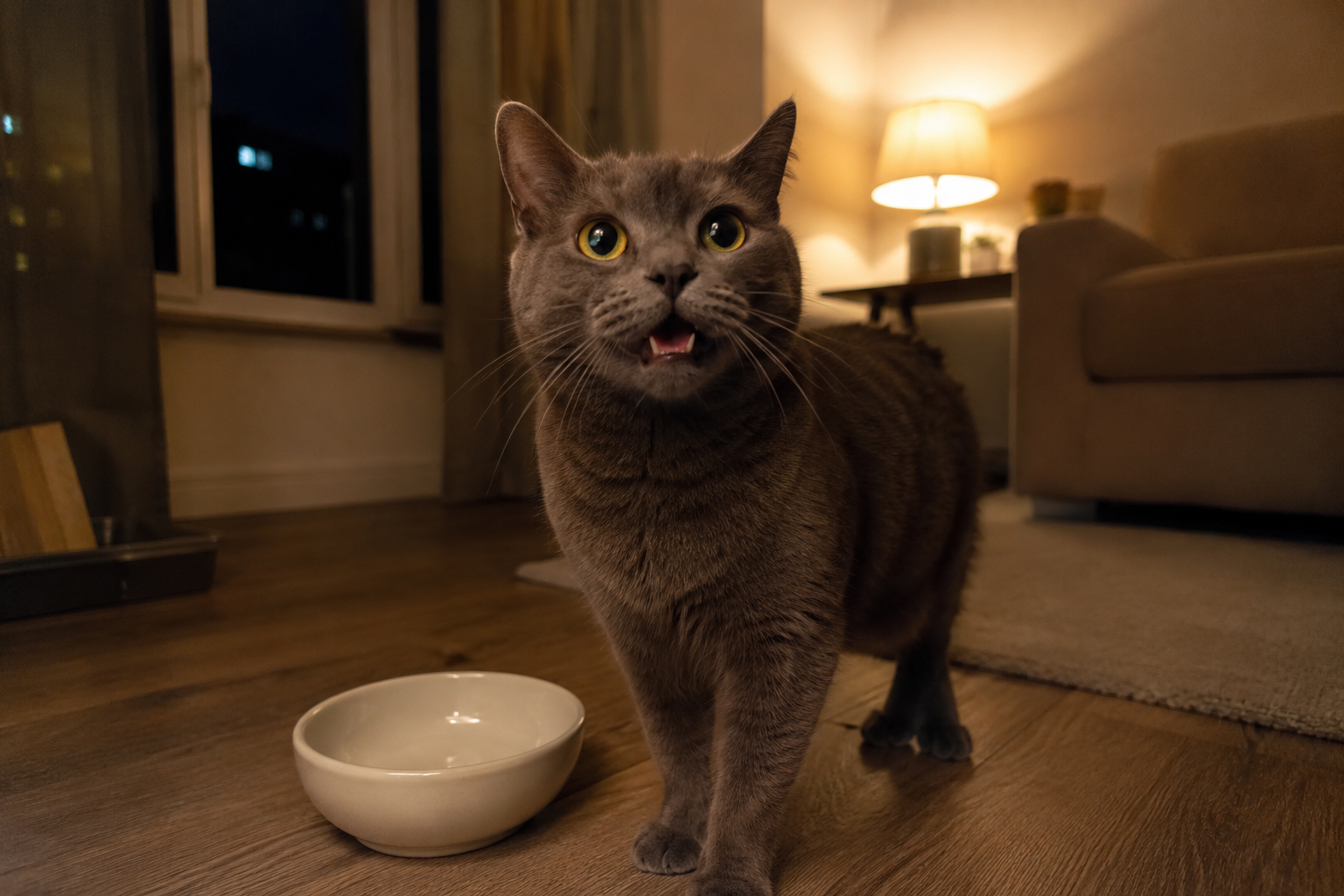
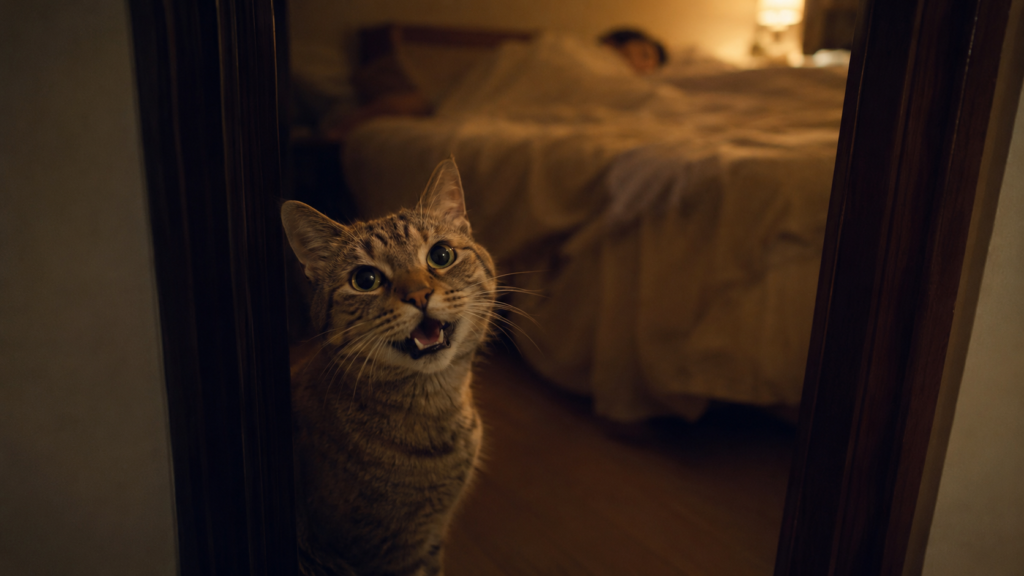
It’s 3:47 a.m. You’re awake. Not by choice — your cat is sitting outside the bedroom door delivering a one-cat opera, and no amount of pillow-over-the-head is making it stop. If you’re searching “cat meowing at night” at this hour, you don’t want a lecture on feline evolution. You want sleep. This article gives you both: the real reasons behind the nightly concert, and the routine that actually quiets it — usually within a week.

Ten focused guides, vet-reviewed, zero fluff. Loved this article? See what's inside.
See What's Inside →Cats meow at night mostly because they’re crepuscular — hardwired to be active at dawn and dusk — combined with boredom, hunger, or a bid for your attention. The fix is a consistent evening routine: a vigorous play session followed by their biggest meal right before your bedtime, which satisfies their natural hunt-eat-sleep cycle. If the meowing is sudden, intense, or your cat is older, see your vet first to rule out a medical cause.
Key Takeaways
- Cats aren’t nocturnal — they’re crepuscular, meaning their energy peaks at dawn and dusk, which is why 4 a.m. is prime meowing time.
- The single most effective fix is a “hunt, eat, sleep” routine: hard play, then their largest meal, right before you go to bed.
- Responding to night meowing — even to scold — teaches your cat that meowing works, so it gets worse before it gets better.
- Expect an “extinction burst”: the crying intensifies for 3–5 nights once you stop responding, then drops off if you stay consistent.
- Sudden night meowing in a cat over 10 is a medical red flag — hyperthyroidism, high blood pressure, and feline dementia all cause nighttime yowling.
- Boredom, hunger, loneliness, outdoor cats at the window, and being unspayed are the most common non-medical triggers.
Your Cat Isn’t Nocturnal — They’re Crepuscular (And That Changes Everything)
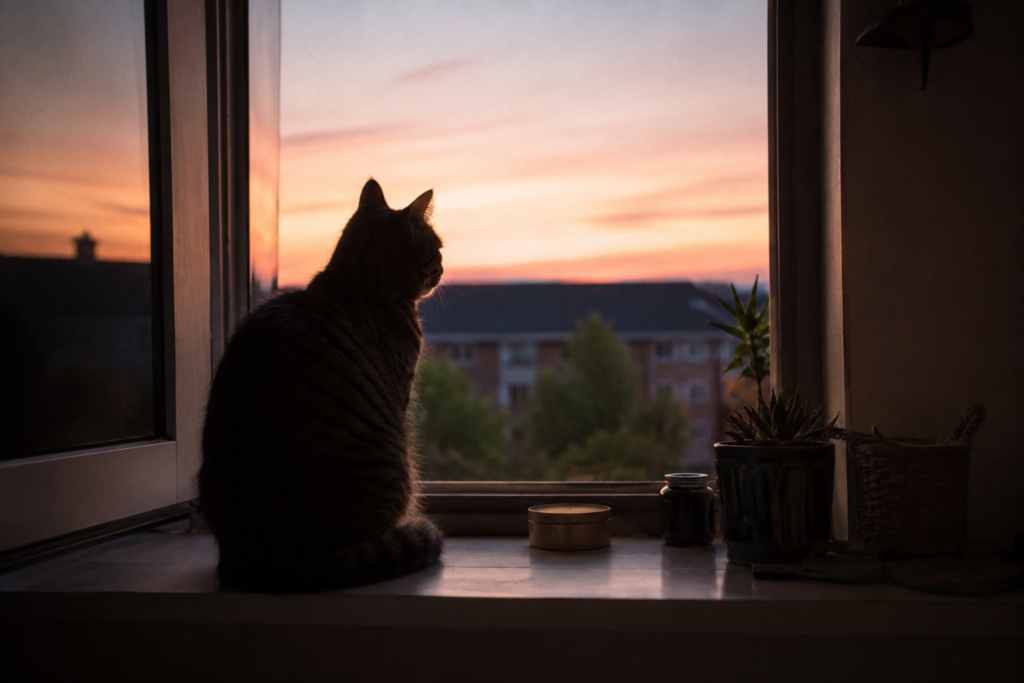
The first thing to understand is that your cat’s body clock is built differently than yours. Cats are crepuscular, which means they’re naturally most active during the twilight hours of dawn and dusk — not the dead of night, and not the middle of the day. This is a leftover from their wild ancestors, who hunted when their prey was out and the light was low.
Here’s why that matters for your sleep. Your cat’s internal “hunting clock” tends to fire right around the time you’re in your deepest sleep and again just before sunrise. A bored indoor cat with no real prey to chase has all that predatory energy and nowhere to put it — so it comes out as pacing, zoomies, and meowing at the one creature in the house who controls the food and the fun: you.
Contrary to what most owners assume, your cat shouldn’t actually be awake all night. Cats are champion nappers, racking up 12 to 16 hours of sleep across a 24-hour day in short bursts. The goal isn’t to force your cat to sleep when they’re not wired to. The goal is to shift their biggest energy spike to before your bedtime, so it burns off while you’re still awake. Once you understand that, the whole problem becomes solvable — you’re working with the biology instead of against it.
The 7 Real Reasons Your Cat Meows at Night
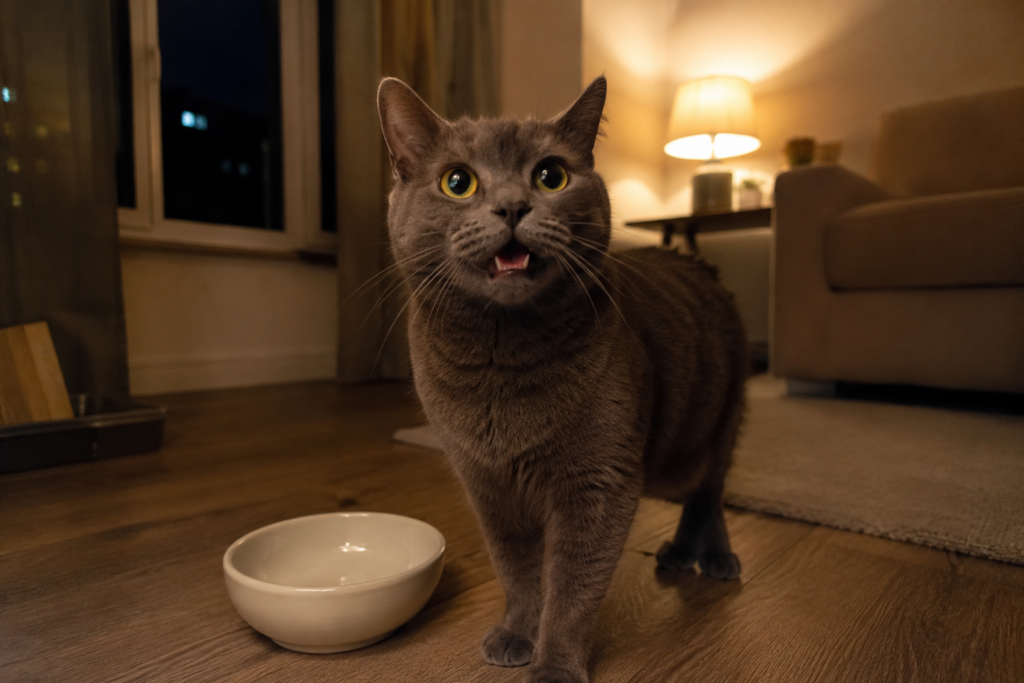
Night meowing almost always traces back to one of seven causes, and naming the right one is half the battle. Veterinary behaviorist Leslie Sinn, DVM, DACVB, puts it simply: cats are basically seeking attention, food, or play — or telling you they’re distressed, confused, or worried.
1. Pent-up energy and boredom. This is the most common cause in indoor-only cats. Without simulated hunting during the day, all that predatory drive stores up and explodes at night. Cats are built to run the full “prey sequence” — stare, stalk, chase, pounce, bite — and a cat who never gets to do that gets restless and loud.
2. Hunger. Cats do best on several small meals across the day, including one right before bed. A cat whose last meal was at 6 p.m. is running on empty by 3 a.m. — and a hangry cat is a vocal cat.
3. Attention-seeking. Cats are brilliant at learning what works. If meowing once got you out of bed — even to yell — your cat now knows the magic button. Congratulations: you’ve trained a night caller.
Ten focused guides, vet-reviewed, zero fluff. Loved this article? See what's inside.
See What's Inside →4. Loneliness and anxiety. Cats rely on routine and a stable scent map of their home. A move, a new pet, a new baby, or even a schedule change can flip the anxiety switch. A newly adopted cat meowing at night is often just calling out for security in a strange place.
5. Something outside the window. Outdoor or stray cats prowling past the house at night can trigger your indoor cat into territorial or frightened meowing — sometimes a full glass-to-glass standoff.
6. Mating behavior. An unspayed female in heat produces a repetitive, carrying yowl specifically designed to travel long distances. An unneutered male will caterwaul back. Spaying or neutering shuts this down — and brings major health benefits.
7. A medical problem. This is the one you can’t ignore (more on it below). Pain, an overactive thyroid, high blood pressure, kidney disease, and cognitive decline all drive nighttime vocalizing.
| If your cat… | The likely reason | The first thing to try |
|---|---|---|
| Has zoomies before meowing | Boredom / pent-up energy | Hard evening play session |
| Leads you to the food bowl | Hunger | Add a pre-bed meal or timed feeder |
| Stops the second you appear | Attention-seeking | Stop responding (consistently) |
| Started after a move or new pet | Anxiety | Routine + safe space + pheromones |
| Stares and yowls at the window | Outdoor cats | Blackout curtains |
| Is intact and yowling loudly | Mating instinct | Spay / neuter |
| Is over 10 and suddenly loud | Possible medical issue | Call your vet |
The “Hunt, Eat, Sleep” Routine That Actually Works
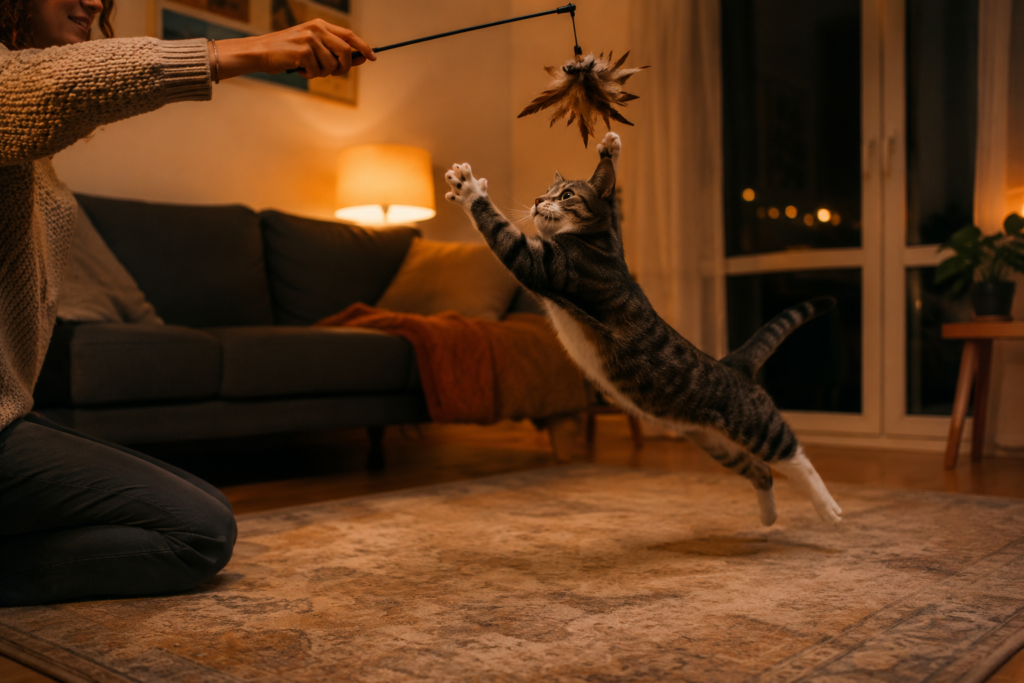
If you do only one thing from this article, do this — it’s the fix professional behaviorists reach for first. The strategy works with your cat’s hunting clock instead of fighting it, and it resets the energy spike to your schedule rather than theirs.
The sequence has three steps, performed in this order, every night. First, a vigorous play session 15 to 20 minutes before your bedtime, using a wand toy that mimics prey — let your cat stalk, chase, and “catch” it several times until they’re visibly tired and panting a little. You’re deliberately running them through the full prey sequence so the hunt drive is satisfied. Second, immediately after the hunt, serve their largest meal of the day — ideally something substantial. In the wild, a successful hunt ends in a big meal, and a full stomach triggers the next instinct automatically. Third, that big meal leads naturally into grooming and deep sleep, exactly like it would after a real kill. Hunt, eat, groom, sleep. You’ve just walked your cat through their entire natural cycle on your timeline.
Cat behaviorist Mieshelle Nagelschneider, who has spent years untangling these cases, also recommends pushing the timing of feeding later and splitting meals — for example, giving half the evening portion at 5 p.m. and the rest at 10 p.m. so your cat stays satiated deeper into the night. Give this routine a real chance: it usually takes several consistent nights before the meowing starts to fade. The cats who “don’t respond” are almost always the ones whose owners tried it twice and gave up.
How to Ignore the Meowing Without Losing Your Mind
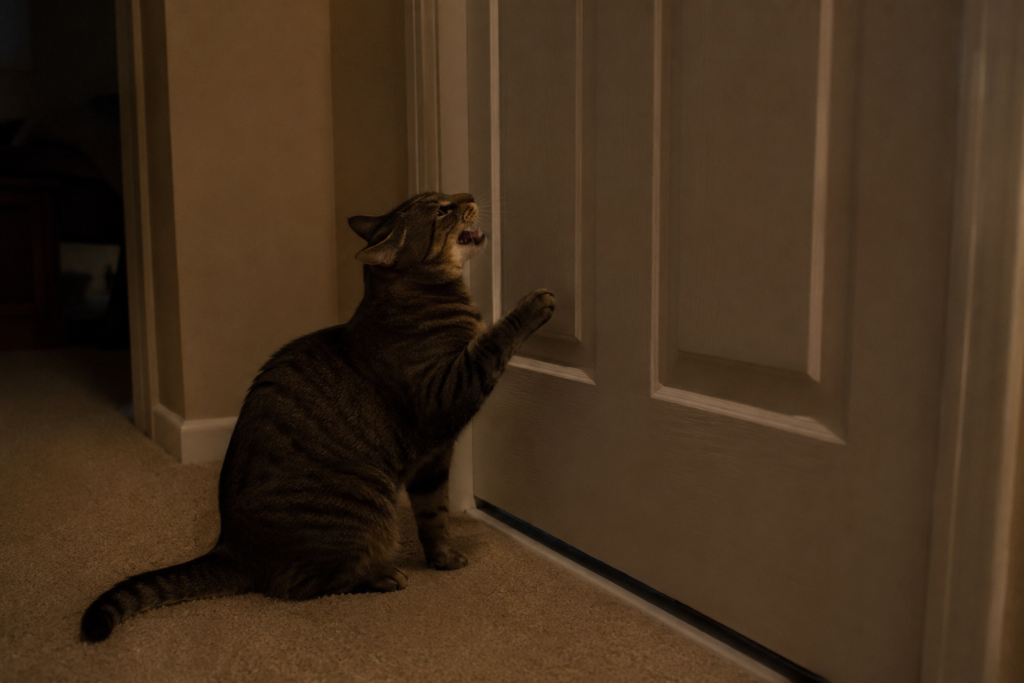
The hardest rule in cat behavior is also the most important: once you’ve ruled out a genuine need, you cannot respond to attention-meowing — not even a little. Getting up to feed them rewards it. Yelling rewards it. Opening the door to “just check” rewards it. To your cat, any reaction at all is proof that the strategy works, so they double down.
Now here’s the part nobody warns you about, and it’s why most people fail. When you stop responding, the behavior gets worse before it gets better. This is called an extinction burst — a well-documented pattern where a behavior intensifies right before it disappears, because your cat is essentially trying harder at the thing that used to work. The yowling may get louder and more frequent for roughly three to five nights. This is not failure. This is the sign it’s working. The cats whose owners cave on night three teach their cat that extra-loud meowing is what gets results — which is far worse than where you started.
A few things make the wait survivable. Earplugs or a white-noise machine for you. A firmly closed bedroom door (a cat scratching at it still doesn’t earn entry). And total consistency — if two people share the home, both have to hold the line, because one weak link resets the whole clock. The first time I fixed this with my own tabby, night four was genuinely brutal. Night six was silent. That gap is the whole game.
Environment Fixes: Feeders, Curtains, and a Clean Litter Box
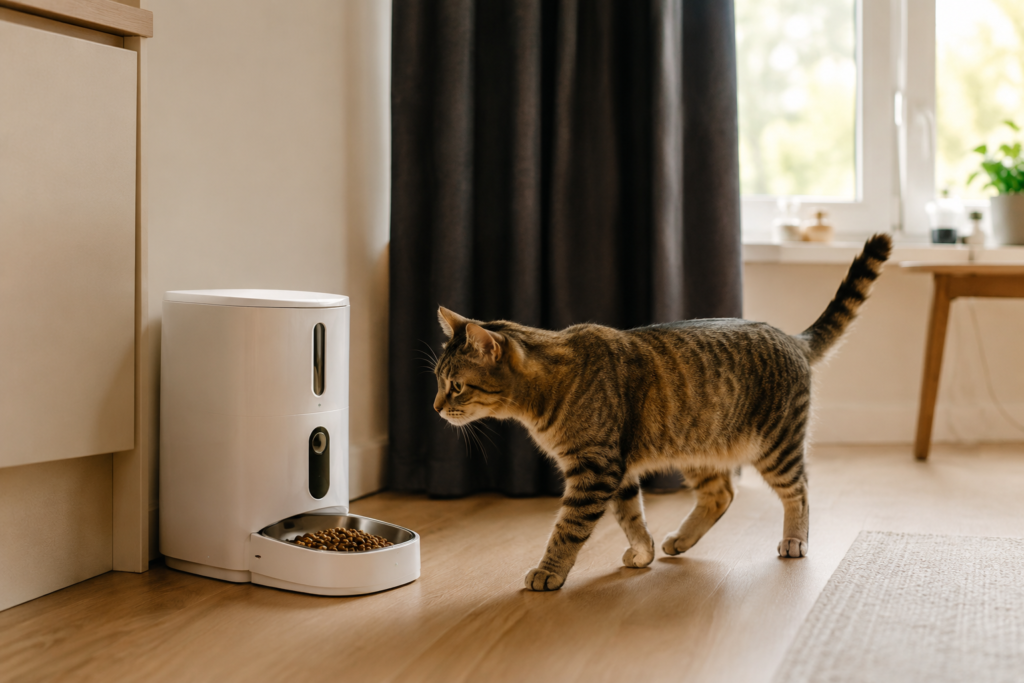
Beyond routine and consistency, a handful of environmental tweaks remove the triggers entirely — and several of them break the food-equals-human link that fuels early-morning waking. These are the quiet workhorses of a quiet night.
The most powerful tool here is an automatic feeder set for the exact hour your cat usually wakes you — say, 4 a.m. or 5 a.m. The magic is psychological: the machine becomes the food source, not you. Your cat learns that meowing at you produces nothing, while the feeder reliably delivers. It disconnects the wake-up call from your face. For multi-meal scheduling, a programmable feeder also handles those split evening portions without you setting an alarm.
A few more fixes worth making tonight. Draw blackout curtains or blinds so streetlights, headlights, and roaming neighborhood cats stop putting on a show at your cat’s favorite window. Check the litter box — a box that’s too dirty to use is a legitimate reason for a cat to wake you, and the fix is a two-minute scoop. Add a water fountain if your cat is a fussy drinker, since some cats wander and vocalize over a stale bowl. And scatter a few enrichment options for the genuine night owl: a puzzle feeder, a window perch, or a couple of toys rotated so the house isn’t boring at 2 a.m. None of these replace the hunt-eat-sleep routine — they back it up.
When Night Meowing Is a Medical Red Flag
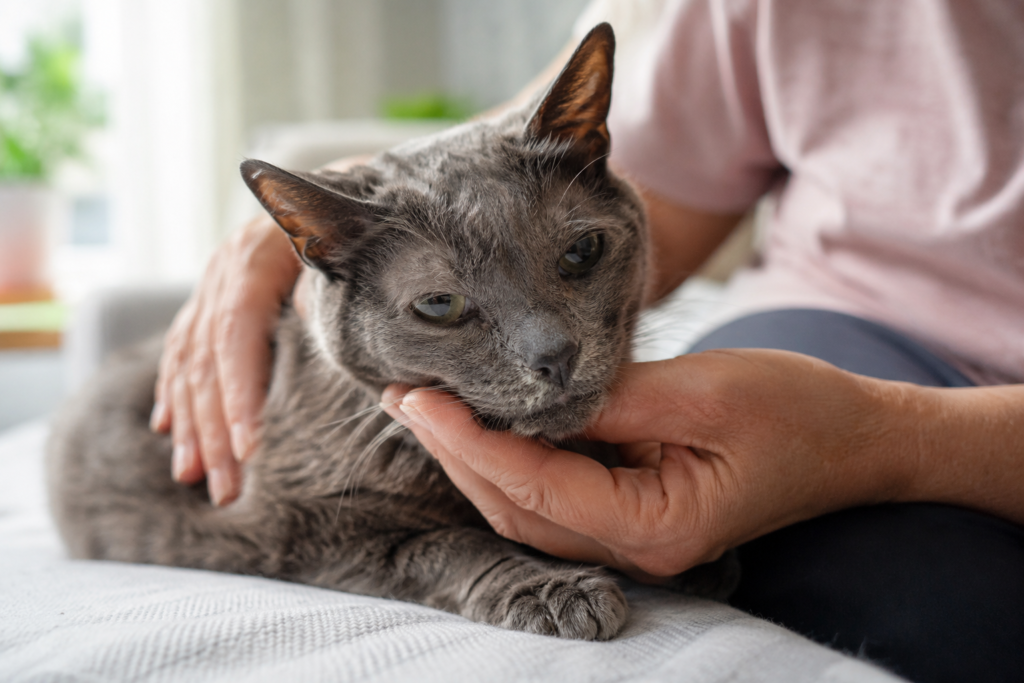
This is the section to read carefully, because it’s the one exception to “just ignore it.” Sometimes night meowing isn’t behavioral at all — it’s your cat telling you something hurts or something has changed inside their body. Dr. Sandra Mitchell, writing for PetMD, flags hypertension (high blood pressure), an overactive thyroid, and cognitive dysfunction as common medical drivers of excessive overnight vocalizing.
The clearest warning sign is newness, especially in an older cat. A cat who has been quiet for years and suddenly starts yowling at night — particularly past age 10 — needs a vet, not a behavior plan. Leslie Sinn, DVM, DACVB, is direct about this: if it’s new behavior in an older cat, get them checked to rule out painful conditions, thyroid disease, and age-related cognitive decline.
| Watch for this | Possible condition | Why it can’t wait |
|---|---|---|
| Loud appetite + weight loss + hyperactivity | Hyperthyroidism | Treatable, but progresses |
| Extra thirst, peeing more, weight loss | Kidney disease | Manageable if caught early |
| Senior cat seems “lost,” stares at walls | Cognitive dysfunction (feline dementia) | Support slows decline |
| Sudden yowls, disorientation | Hypertension | Linked to organ damage |
| Male cat crying + frequent litter trips, little urine | Possible urinary blockage | Life-threatening emergency |
That last row deserves a flashing light: a male cat straining at the litter box, crying, and producing little or no urine is a urinary blockage until proven otherwise, and it’s a same-day emergency. For everything else on this list, the message is calmer but firm — a sudden change in your cat’s nighttime voice is data, and your vet is the one to read it. We cover behavior, not medicine; when your gut says something shifted, trust it and make the call.
Common Mistakes People Make With Night Meowing
Even patient, loving owners sabotage themselves here. Avoiding these will save you weeks of lost sleep.
Mistake 1: Caving during the extinction burst. People do everything right for three nights, hit the loudest night, and break — feeding the cat to make it stop. You’ve now taught your cat that maximum volume gets the reward. If you commit to ignoring it, you have to ride out the worst night, or don’t start at all.
Mistake 2: Feeding the moment your cat wakes you. The 6 a.m. breakfast you give to buy ten more minutes of sleep is the exact thing setting tomorrow’s 5:50 a.m. alarm. Cats anchor their hunger clock to feeding time. Move food to a machine, or to a fixed schedule you control, never to “whenever they wake me.”
Mistake 3: Punishing the meowing. Spray bottles, yelling, tossing a pillow — all of it backfires. Punishment is still attention, and it adds fear to a cat who may already be anxious. It doesn’t quiet them; it makes a stressed cat more stressed.
Mistake 4: Treating a sudden change as “just a phase.” The flip side of patience is vigilance. Owners who assume a brand-new yowling habit in a senior cat will pass can miss a treatable thyroid or kidney problem. New plus older equals vet, not wait-and-see.
Mistake 5: Playing in the morning instead of at night. A vigorous play session at 7 a.m. teaches your cat that loud mornings summon fun. Front-loading the play and the big meal to bedtime is what resets the clock in your favor.
Frequently Asked Questions
Why does my cat meow at 3 or 4am specifically? Because that window lines up with your cat’s crepuscular wiring — their hunting clock fires hard in the pre-dawn hours. A bored or hungry indoor cat has stored-up energy and an empty stomach right at the moment their instincts say “hunt.” Shifting a hard play session and their biggest meal to just before your bedtime is the most reliable way to push that spike earlier.
Will ignoring my cat’s meowing at night actually work? Yes, but only if you’re completely consistent and ready for it to get worse first. When you stop responding, most cats escalate for three to five nights — an extinction burst — before the behavior fades. The catch is that any response during that window, even scolding, resets everything and teaches louder meowing. Pair ignoring with a solid daytime and bedtime routine for the best results.
Is it cruel to lock my cat out of the bedroom at night? No, as long as your cat has everything they need on the other side of the door — food, water, a clean litter box, a comfy bed, and some enrichment. A closed door is a boundary, not neglect. Expect scratching and crying at first; if you don’t open the door, most cats give up within a week or two and settle into the new arrangement.
Why is my older cat suddenly meowing at night? Sudden night vocalizing in a senior cat is a medical flag, not a behavior quirk. Common culprits include an overactive thyroid, high blood pressure, kidney disease, and feline cognitive dysfunction — a dementia-like decline where cats seem disoriented and yowl, often while staring at walls. Any new nighttime meowing in a cat over 10 warrants a vet visit to check for these before you try behavior fixes.
Does getting a second cat stop night meowing? Sometimes, but it’s a gamble, not a guaranteed fix. A companion can ease loneliness-driven meowing, but a rushed introduction can create stress, territory disputes, and more nighttime noise. If the root cause is boredom or solitude, structured play and enrichment usually solve it more reliably — and far more cheaply — than adopting a second cat you weren’t otherwise planning for.
Why does my cat meow at night but seem fine during the day? Daytime is when you’re present, active, and feeding them, so their needs are met and their energy has outlets. At night, the house goes quiet, the food stops, and their crepuscular energy peaks with nothing to do. The contrast is normal. It usually points to boredom, hunger, or attention-seeking rather than illness — though a sudden shift still deserves a vet’s eyes.
The Bottom Line
A cat meowing at night is almost never being difficult on purpose — they’re following a body clock that peaks while you sleep, and they’re telling you a need isn’t met. Run them through the hunt-eat-sleep routine, hold the line on attention through the extinction burst, and rule out medical causes if anything changed suddenly. Get those three right, and the 4 a.m. opera becomes a memory — usually within a week of staying consistent.
Get Decode Your Cat — free.
20 everyday behaviors translated, so you finally know what your cat is actually saying. Pop in your name and email and it's yours instantly.