


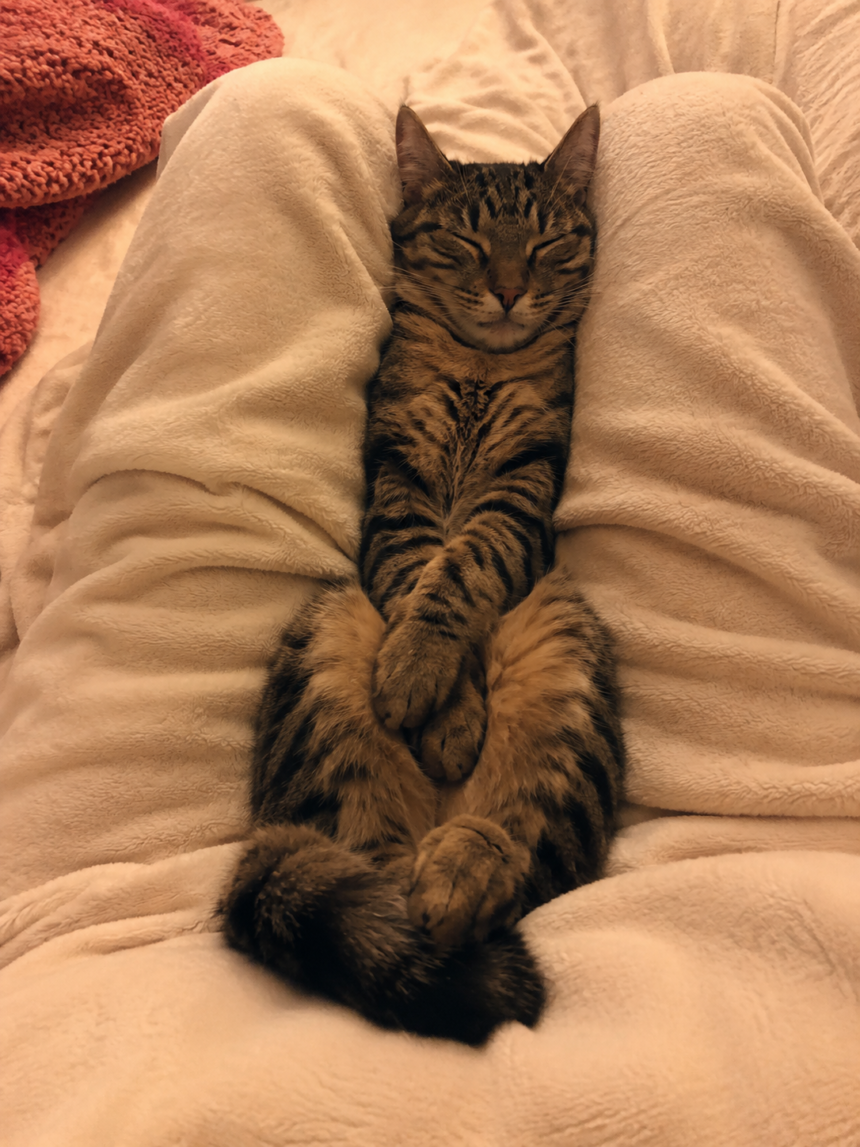
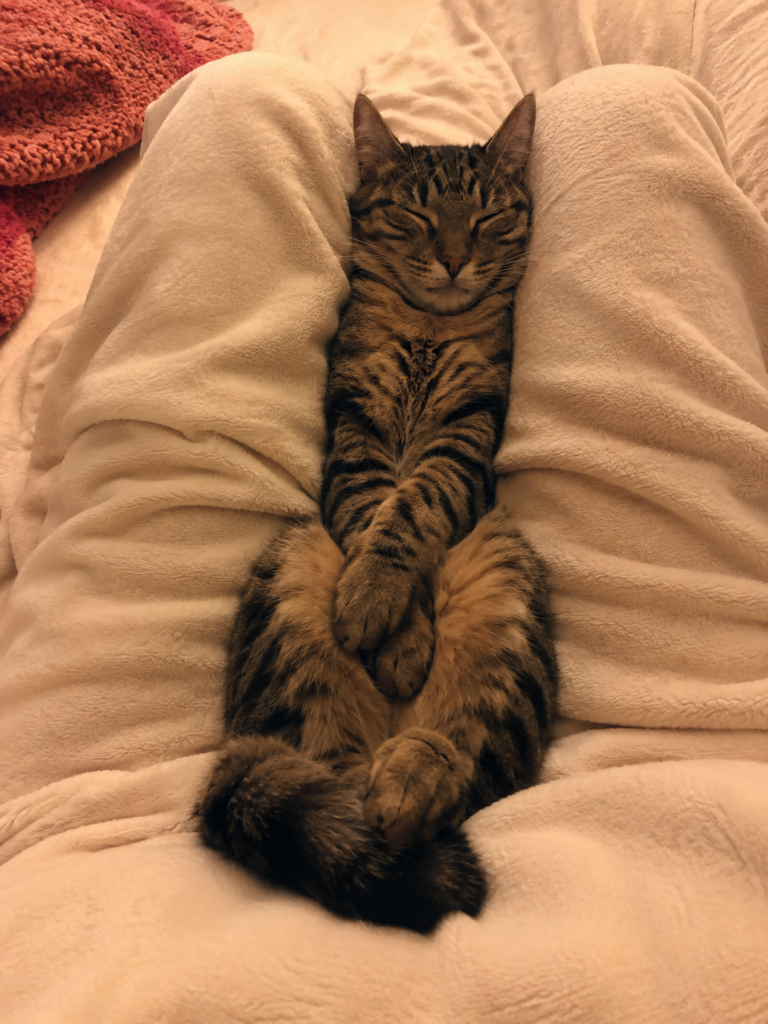
Every night, the same ritual: you get into bed, arrange yourself comfortably, and within minutes a warm weight settles into the gap between your knees — and stays there until morning, no matter how badly you need to roll over. If you’ve ever typed why does my cat sleep between my legs into your phone at 1 a.m. while lying very still, this is your answer: seven real reasons, what the spot says about your bond, and what to do if you’d occasionally like your legs back.

The complete cat-care shelf — from choosing your cat to lifelong mastery.
See What's Inside →Cats sleep between your legs because the spot solves several feline problems at once: your body heat, the security of a walled “nest,” physical closeness to their favorite person, and an easy escape route if startled. It’s a strong sign of trust and bonding — cats are most vulnerable while asleep, and yours has chosen you as the safe place. It’s completely normal, and usually a compliment.
Key takeaways
- The between-the-legs spot is a “nest with an exit”: warm, walled on both sides, close to you, and easy to leave — a cat’s dream architecture.
- Cats are at their most vulnerable during deep sleep, so sleeping against you is one of the clearest trust signals they can give.
- Warmth drives the choice more than most owners realize — cats run hotter than humans and descend from desert animals that seek heat.
- In multi-cat homes, the leg spot can also be a quiet territorial claim: this human is taken.
- Letting them stay is safe for most people; a few simple tweaks fix the “trapped legs” problem without banishing the cat.
- A sudden change — a velcro cat who never leaves, or a leg-sleeper who abruptly stops — is worth a closer look, and sometimes a vet call.
Why does my cat sleep between my legs? The 7 real reasons
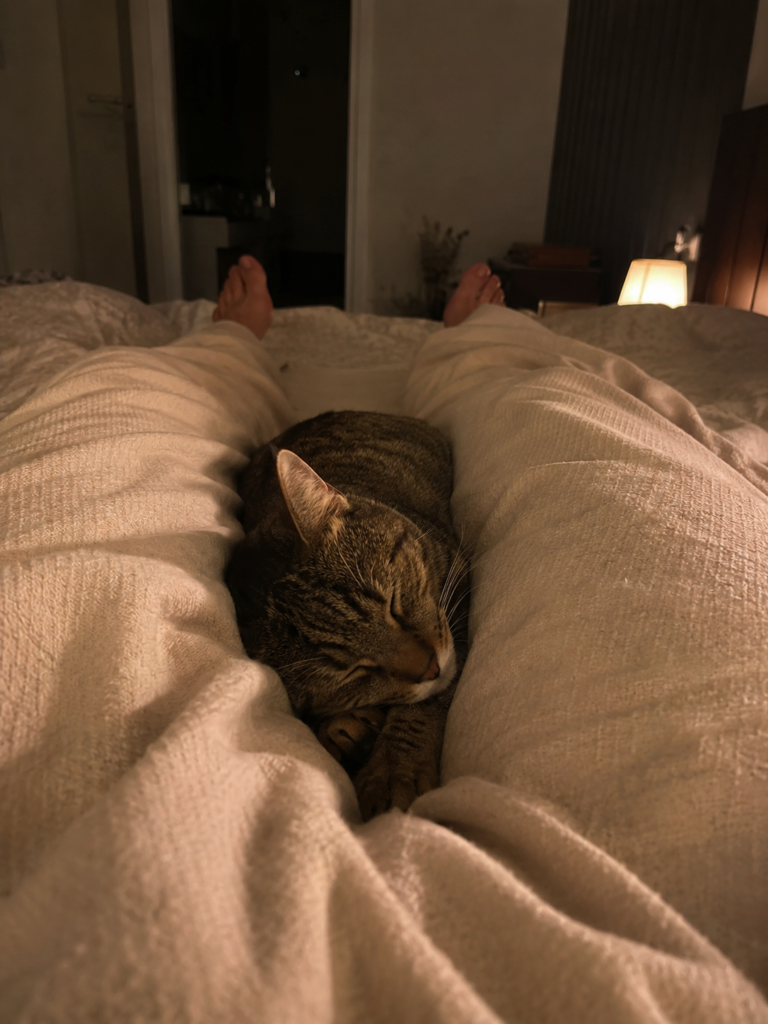
The between-the-legs position looks random, but it’s a precise choice — that spot beats every other location in the house on several feline priorities at once. Here’s what’s driving it, ranked from most to least common.
1. You are the warmest thing in the house
Start with the unromantic truth: you’re a heater. A cat’s normal body temperature runs around 101–102°F — a couple of degrees hotter than yours — and holding that temperature is easier next to a heat source. Domestic cats also descend from desert-dwelling ancestors, which is why yours gravitates to sunbeams, radiators, laptop keyboards, and you. The channel between two human legs, under a blanket, is the warmest, most stable microclimate in the home. Notice how the habit intensifies in winter and loosens in summer; for many cats, that’s the tell.
2. It’s a nest with walls — and an exit
Cats sleep best in enclosed spaces that guard their flanks — it’s why they cram into boxes, sinks, and drawers. Your legs form a perfect natural trench: protected on two sides, roofed by a blanket if they’re lucky, with sightlines out and — critically — an easy exit. Veterinary sources note this balance is the whole appeal: PetMD’s guide to cat sleeping positions describes the between-legs spot as a warm, enclosed, nest-like space that still leaves a startled cat a way out. Enclosed but not trapped is the feline gold standard, and your legs deliver it nightly.
3. It’s trust — the deepest kind cats offer
A sleeping cat is a vulnerable cat, and even a pampered indoor cat never fully forgets that they’re prey-sized. Deep sleep is the one state where they can’t watch their own back — so where a cat chooses to do it is a map of who they trust. Choosing the spot pressed against your body means you’ve been filed under “protector.” It belongs to the same family of trust behaviors as the slow blink and kneading on your lap — and many cats run the full ceremony: jump up, knead the blanket between your legs, circle twice, collapse. That whole sequence is your cat building a bed inside their safest place, which happens to be you.
4. Bonding — you’re part of the colony pile
Cats that trust each other sleep in contact — littermates pile up from birth, and bonded adult cats nap in heaps. If your cat has no feline pile available, you’re the pile. Pressing into your legs is the adult version of the kitten cuddle-puddle: warmth plus heartbeat plus the smell of family. Take it as the membership card it is.
Knowing which one you’re looking at is the whole skill.
- Call now — six signs that mean tonight, not tomorrow.
- Call today — two or more of the eleven signals, together.
- Record and watch — one change, with an ordinary explanation.
5. Your scent (and theirs) lives there
Smell is a cat’s primary comfort channel, and your bed is the strongest concentration of “you” in the house. Sleeping against you also lets your cat top up the shared scent: cats mark trusted family by rubbing cheeks and body against them. In multi-cat homes there’s often an extra layer — the cat who claims the between-legs spot may be making a quiet territorial statement to the other cat: this human is spoken for. If one cat always takes your legs and the other takes the foot of the bed, you’re watching a negotiated map, not a coincidence.
6. Security when the house goes quiet
Night is when a home’s sounds change and a cat’s alertness rises. Anxious cats, recently adopted cats, and cats in changing households (new pet, new baby, a move) often become nighttime leg-sleepers first — your steady breathing and heartbeat are a live “all clear” signal they can monitor with their eyes closed. For a mildly anxious cat, you are white noise, security camera, and heated blanket in one.
7. Simple habit — the ritual is the point
Cats are ritual animals. Once “between the legs at 11 p.m.” enters the routine, the routine itself becomes comforting, independent of the original reason. If your cat beats you to bed and sits in position waiting, you’re no longer looking at a temperature calculation — you’re looking at a tradition. Cats sleep 12–16 hours a day, so they take their sleeping arrangements seriously; our guide on why cats sleep so much covers what all those hours are actually doing.
Between your legs vs. your feet, chest, or pillow: what each spot says
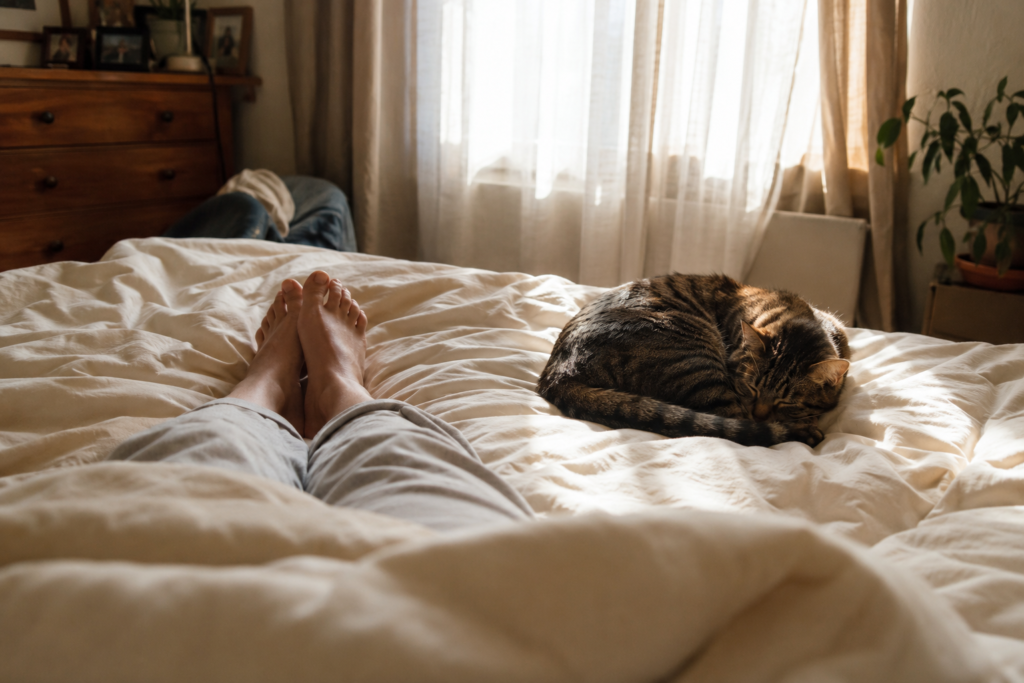
Where your cat lands on the bed isn’t interchangeable — each position trades off closeness, warmth, and escape options differently. None of these is “better”; they’re dialects of the same trust.
One reassurance worth spelling out: a cat who sleeps near you but not on you is not a cat that loves you less. Position preferences track personality, temperature, and even how much you move at night. Restless sleepers tend to get foot-of-the-bed cats; still sleepers get leg-sleepers. Your cat has done the research.
Should you let your cat sleep between your legs?
For most people, yes — and the arrangement gives back. Owners commonly report falling asleep faster with a purring weight anchored to the bed, and the nightly contact genuinely deepens the bond. The costs are practical rather than serious: restricted movement (the famous “I can’t roll over, the cat is asleep” paralysis), lighter sleep for sensitive sleepers, and allergy load in the bedding. Keep parasite prevention current — a cat in the bed should be a treated cat — and people with cat allergies or immune concerns should keep the bedroom cat-free and offer a heated bed nearby instead.
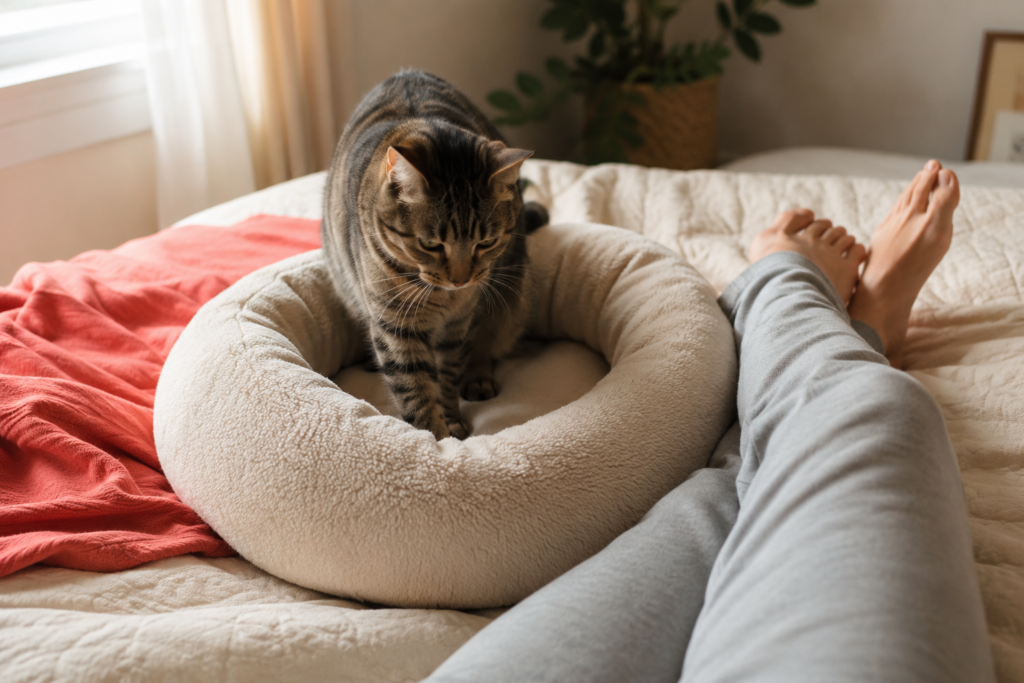
If you love the company but not the leg-lock, don’t banish — redirect. Place a plush cat bed or folded fleece on the bed beside your legs and warm it (a safe microwavable heat pad works wonders); most cats accept the upgrade within a couple of weeks because it keeps everything they wanted — warmth, enclosure, you — minus the human turbulence. Reward them for settling there, be boring when they reclaim your knees, and never shove a sleeping cat off; you’re negotiating with a roommate, not evicting one. And if your cat responds to bedtime changes by protesting at the door, our guide to cat meowing at night is the companion piece.
Common mistakes owners make with bed-sharing cats
1. Shoving the cat off mid-sleep
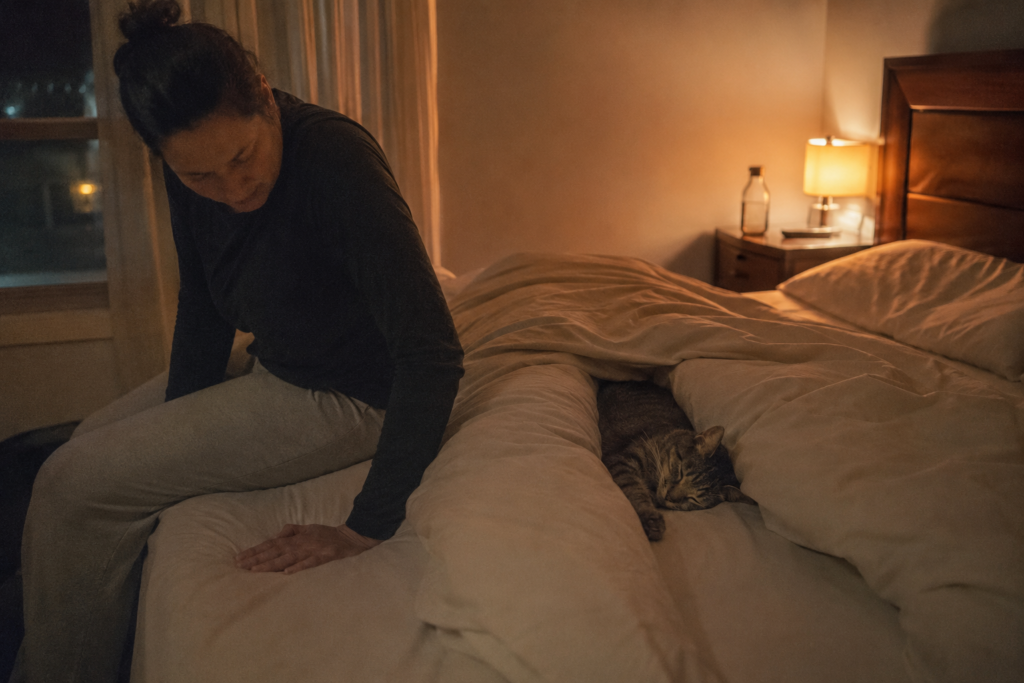
Being dumped out of deep sleep in their safest spot teaches a cat that your bed is unpredictable — the opposite of what the spot meant to them. If you need to move, slide your legs out slowly or gently lift and re-place them. Smooth exits preserve the trust the habit represents.
2. Reading a position change as lost love
Cats rotate favorite sleeping spots seasonally and by temperature — the winter leg-sleeper often becomes a summer floor-sprawler. A gradual drift with no other changes is climate control, not heartbreak. It’s the sudden, total shifts (paired with hiding or appetite change) that mean something.
Ten beautifully designed cat guides — behavior, feeding, health, the tricky days and more.
See What's Inside →3. Rewarding 3 a.m. wake-ups from inside the bed
A bed-sharing cat has direct access to your face, and if patting or feeding follows the dawn tap-tap-tap, you’ve trained an alarm clock with claws. Keep night interactions boring and handle food with a schedule or feeder — bed privileges and breakfast negotiations must stay separate.
FAQ: cats sleeping between your legs

Why does my cat sleep between my legs every night?
Because the spot reliably delivers everything a cat wants from sleep: warmth from your body, a walled nest-like shape, closeness to their trusted person, and an easy exit. Once it works a few times, it becomes ritual — and cats are deeply ritual animals. Nightly repetition is a sign the arrangement is working, not a problem.
Should I let my cat sleep with me?
For most healthy adults, yes — it’s bonding for both of you, and many people sleep better with the company. Keep flea and parasite prevention current, wash bedding regularly, and skip bed-sharing if you have significant allergies or a compromised immune system. Light sleepers can compromise: a warmed cat bed on the mattress beside you.
What does it mean when a cat sleeps touching you?
Contact-sleeping is trust made physical. Cats are most vulnerable in deep sleep, so they only do it against beings they’ve classified as completely safe — it’s the same instinct behind bonded cats sleeping in piles. Touching you also keeps them warm and lets them monitor your movements and heartbeat, a live “all clear” they can feel with their eyes shut.
Why does my cat sleep at my feet instead of between my legs?
Foot-of-the-bed cats have chosen independence with proximity: near you, but out of the turbulence zone where legs shift all night. It’s common with restless sleepers and warmer climates, and it’s the same affection in a different dialect. If you move a lot at night, your cat did the math and picked the stable seat.
Why did my cat suddenly stop sleeping with me?
Gradual seasonal drift is normal — warmth-seeking fades in summer. A sudden stop is different, especially paired with hiding, odd sleeping places, appetite shifts, or litter changes: cats often withdraw from contact when something hurts. Rule out household stressors (new pet, schedule change), and if the withdrawal persists or comes with other changes, call your vet.
The bottom line on the between-the-legs cat
So — why does my cat sleep between my legs? Because you’re warm, you’re walled, you’re safe, and you’re theirs: the spot is a nightly trust statement dressed up as a heat grab. Let it happen when you can, redirect gently when you can’t, and treat sudden changes as information. Tonight, when the weight settles between your knees, you’ll know exactly what’s being said. For more of the language, browse our behavior and training guides — the leg spot is just the opening line.

Get Decode Your Cat — free.
20 everyday behaviors translated, so you finally know what your cat is actually saying. Pop in your name and email and it's yours instantly.