Your cat has been talking to you since the day it arrived. Tail, ears, pupils, whiskers, posture — a continuous broadcast almost nobody is ever taught to read.
Thank you for reading this post, don't forget to subscribe!
Most cat-behaviour writing hands you a list: tail up means happy, ears back means angry. That approach produces confident wrong answers, because signals do not have fixed meanings. A cat can hold its tail high while flattening its ears — and both statements are true. It wants to approach and it is not sure.
This book teaches the grammar, not just the vocabulary.
01Specification
Illustrations
44 original
Delivery
Instant download
02Contents
I
Where the cat came fromAlmost every domestic animal was taken. The cat arrived — on its own terms, and it has never entirely stopped behaving like a guest. Why cats are semi-social rather than solitary, what ten thousand years actually changed, and the five signs of passive conflict in a multi-cat home.
II
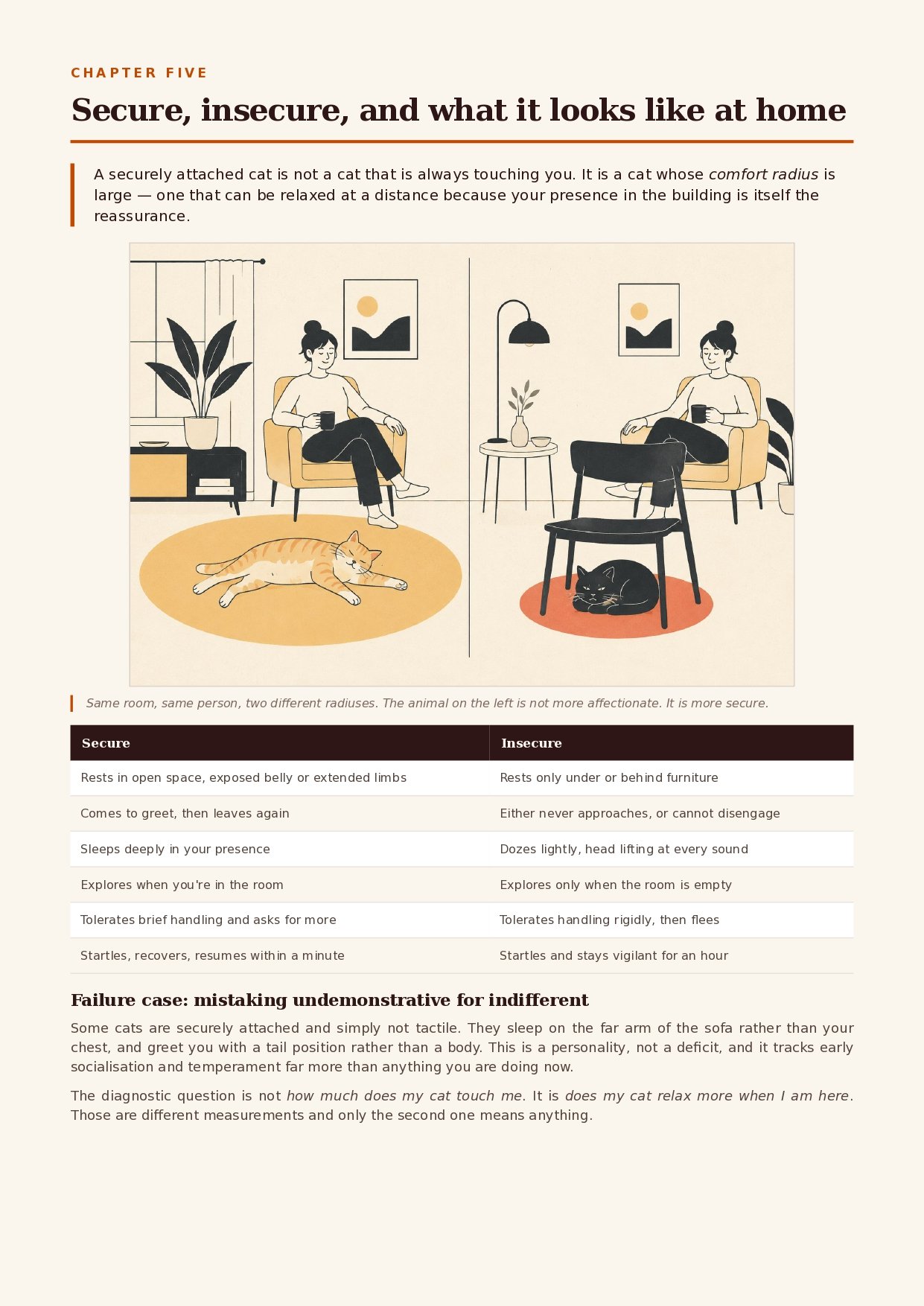
The bondWhat the attachment research can genuinely demonstrate. Secure versus insecure and what each looks like at home. The twelve signs you are their person. And why the undemonstrative cat is so consistently mistaken for an indifferent one.
III
The signal systemTail, ears, eyes and pupils, whiskers, posture, the slow blink — each as a full reference plate, then a chapter on reading them in combination, which is where almost everyone goes wrong. Ends with a master plate: twelve signals ringed around one animal.
IV
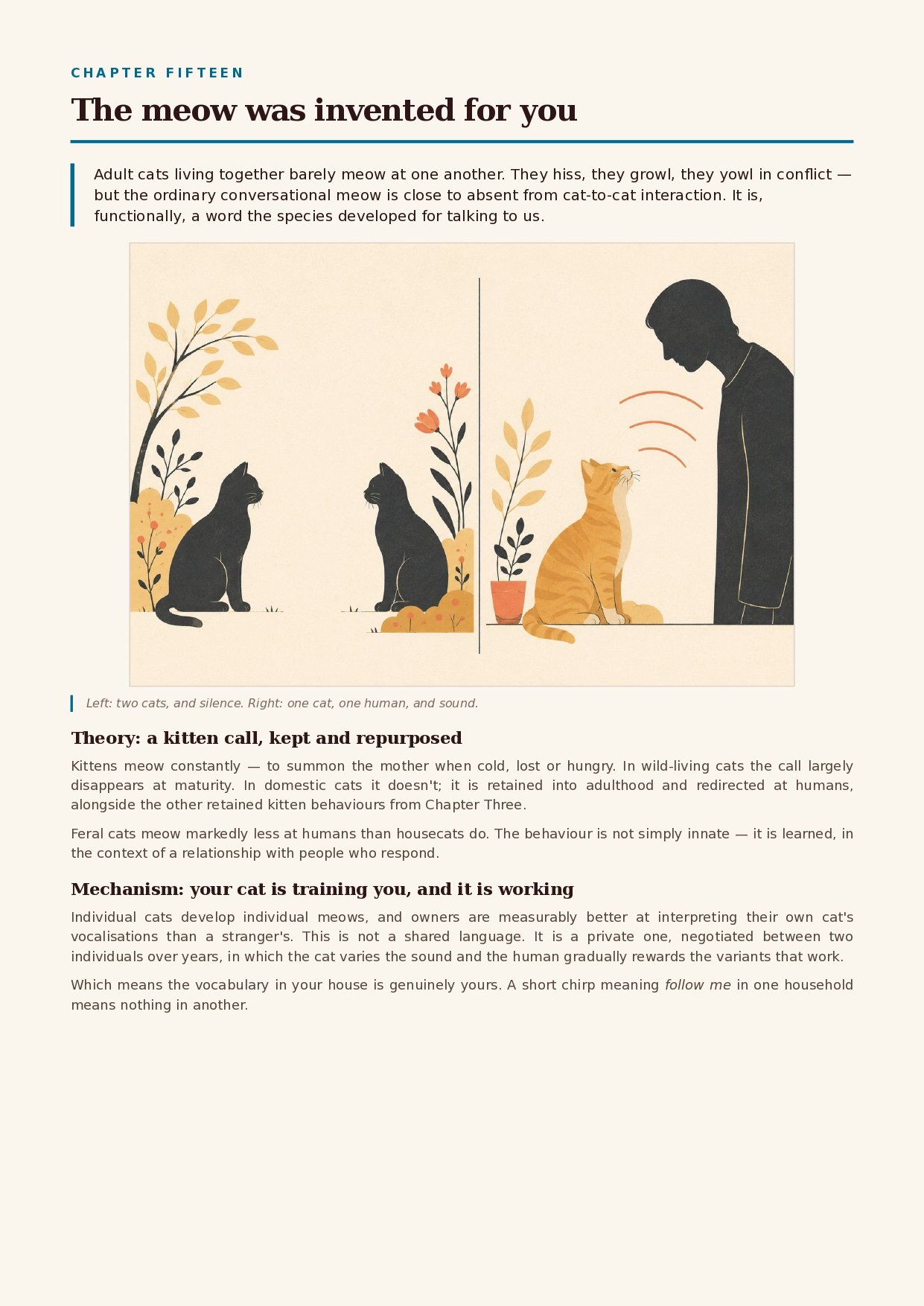
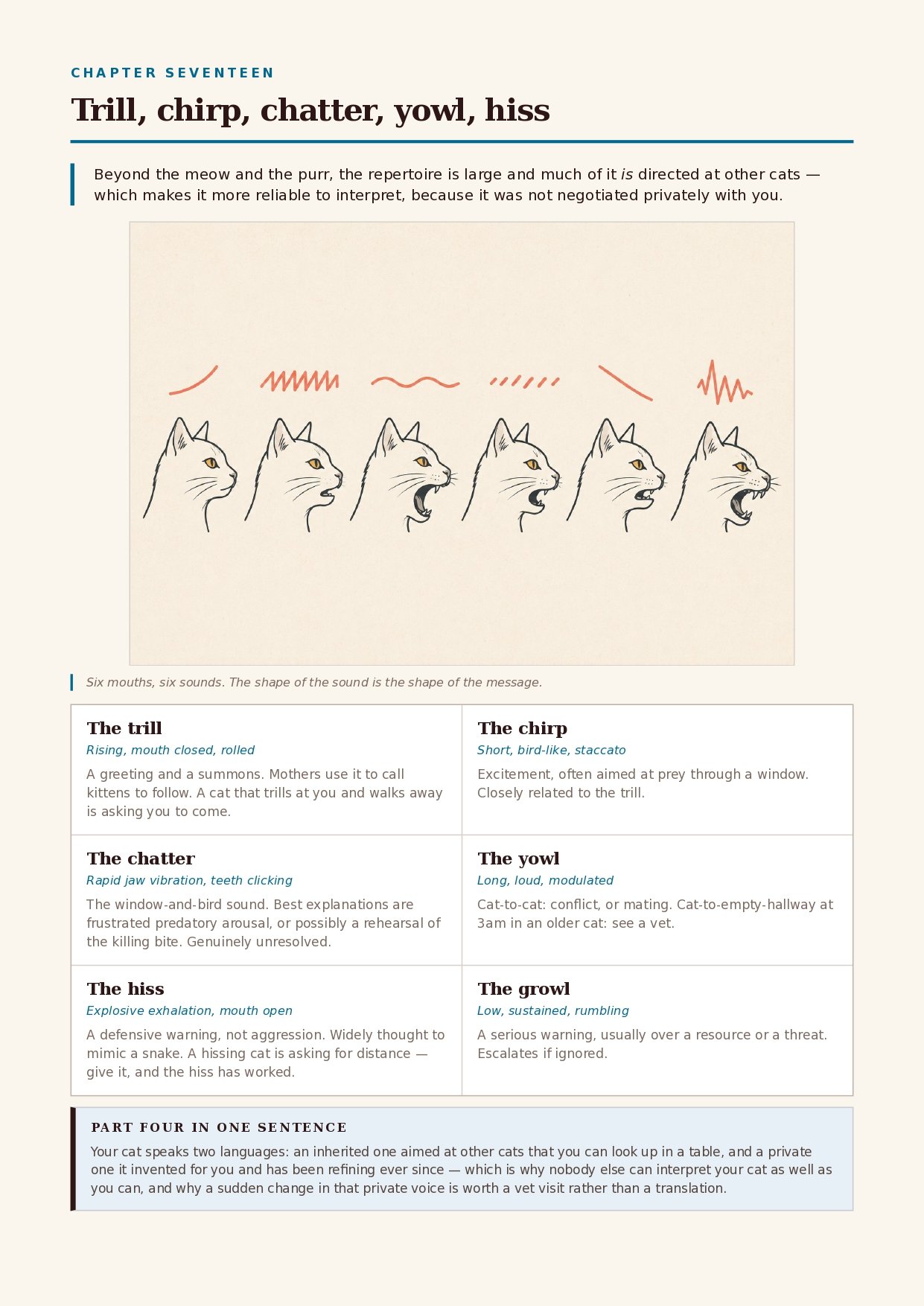
The voiceThe meow was developed for humans and barely exists between cats. Purring is not what you think. Trill, chirp, chatter, yowl, hiss and growl — what each is for, and which change in voice means phoning a vet rather than interpreting.
V
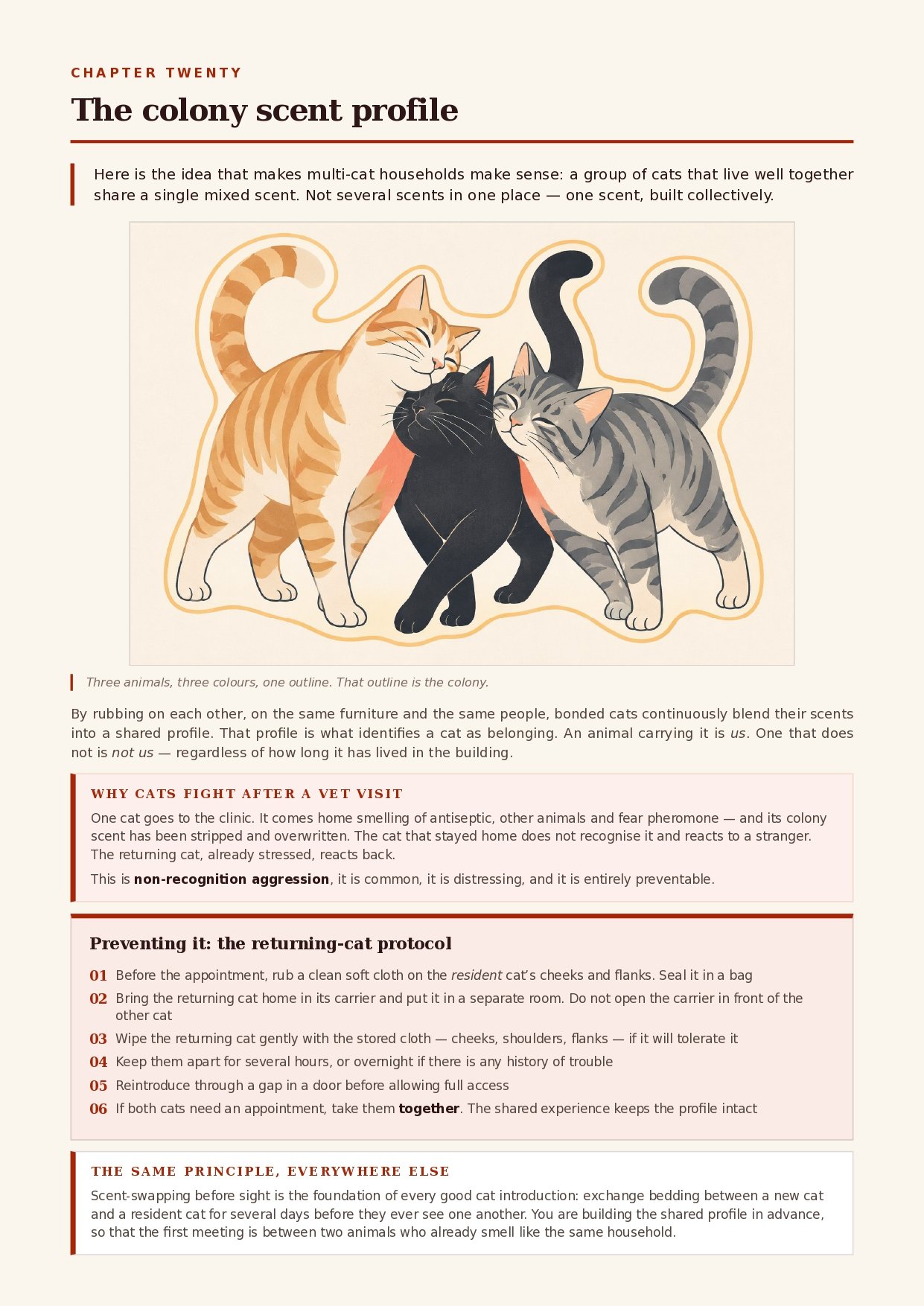
The scent worldYour cat lives in a second version of your home, laid over the one you can see. Where the scent glands are and what each says. Why scratching cannot be trained away. And the colony scent profile — which explains why cats fight after a vet visit, and how to prevent it.
VI
The hunterPlay is the hunting sequence running with no prey at the end of it. The five stages, why most play sessions stall at stage three, the problem with laser pointers, six rules for playing properly — and a mechanical fix for the 4am problem.
VII
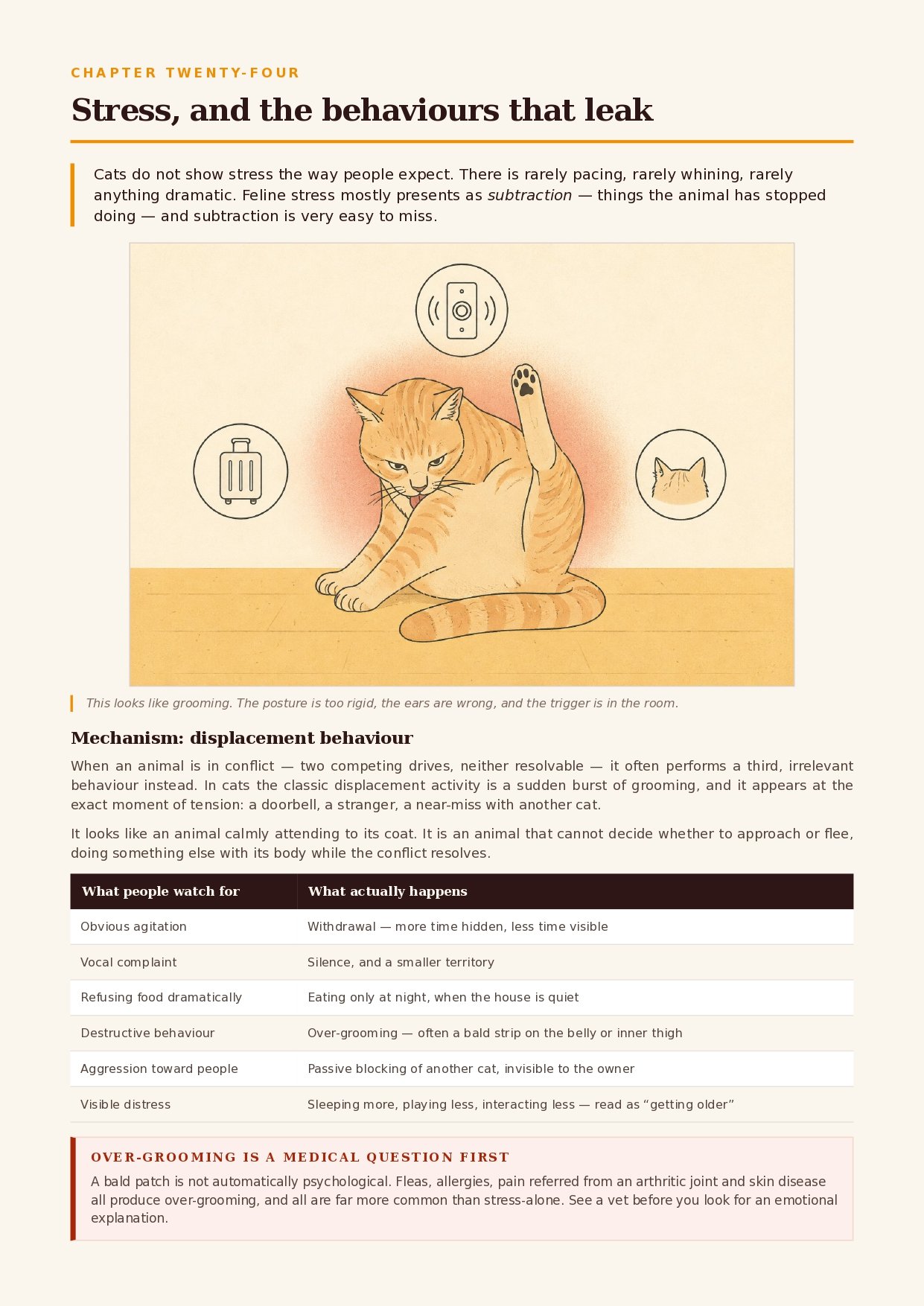
Reading your catHow feline stress presents as subtraction rather than drama, a thirty-day protocol for the cat that hides, and the baseline journal — the least exciting and most valuable page in the book.
03The question underneath all of it
Does my cat actually love me?
Most people who buy a book like this are, underneath the curiosity about tail positions, asking one thing. It deserves answering on page five rather than page sixty.
The book answers it with the attachment research, the preference testing, and an honest account of where the evidence is strong and where it isn’t. Short version: attachment in cats is measurable, mostly secure, and expressed in tail positions and sleeping locations rather than in anything a person would recognise as affection.
04The six reference plates
Six pages in this book are instruments rather than prose — the ones readers photograph and keep on their phone.
The tail plateEight positions, what each means, what to do about it.
The ear plateSix positions. The fastest early warning your cat has.
The pupil scaleSlit to full round — and why the light explains most of it.
The posture plateSix body shapes, from fully open to fully closed.
The master plateTwelve signals ringed around one animal. The page people photograph.
The baseline journalTwelve things to record weekly. Fifteen minutes.
05Method
Every chapter runs the same four layers, in the same sequence. You are told why a behaviour exists before you are told what it means — because signals only make sense once you know what the animal is for.
iTheoryWhat the behaviour is for
iiMechanismHow it works in your cat
iiiProtocolWhat to do with it
ivFailure casesHow it gets misread
06Suitability
Written for
Owners who want to understand their cat, not just manage it
Anyone wondering whether the bond is real or transactional
A cat that hides, or one you have never quite reached
Multi-cat homes where you cannot tell if they are actually fine
Cats that bite during stroking, for reasons nobody explained
Owners who want to catch illness early, via behaviour
Not written for
A cat whose behaviour changed suddenly — that needs a vet, not a book
Readers wanting a diagnosis. This routes to a vet; it does not replace one
Readers wanting to make a cat obey. This explains cats; it does not train them
Readers wanting a one-page listicle
Readers wanting certainty. Feline cognition is a young field
07Sourcing
Drawn from published ethology, applied animal behaviour and feline-medicine literature, and from the clinical guidance of the American Association of Feline Practitioners, the International Society of Feline Medicine and the Cornell Feline Health Center.
Feline cognition research is roughly thirty years behind canine research — largely because cats perform poorly in laboratories, not from stupidity but from stress. Several findings here rest on single studies with modest samples, and where that is true the book says so on the page. It declines to tell you that purring heals bones, because the evidence does not support that.
Please note. This book is educational and is not veterinary advice. It cannot diagnose, treat or rule out any medical condition. Behavioural change in cats is frequently the first visible sign of illness — if your cat’s behaviour has changed and you do not know why, see a veterinarian before you look for a behavioural explanation. All sales are final on digital downloads.