

You’re sitting on the couch, your cat climbs into your lap, and suddenly those little paws start pressing into your thigh like you’re a ball of dough. So why does my cat knead me — and is it a compliment or a sign something’s off? This article breaks down every real reason behind the behavior, what the purring, biting, and drooling that comes with it actually means, and how to survive the claws without making your cat stop. By the end, you’ll read your cat’s biscuit-making like a second language.

The complete cat-care shelf — from choosing your cat to lifelong mastery.
See What's Inside →Cats knead you because the motion is hardwired comfort. As kittens, they push their paws against their mother to stimulate milk flow, and that rhythm gets permanently linked to feeling safe, warm, and content. When an adult cat kneads you, they’re recreating that contentment — and often marking you as theirs using scent glands in their paws. It’s affection, relaxation, and a little bit of “you belong to me,” all in one gesture.
Key Takeaways
- Kneading is a leftover nursing instinct — kittens do it to trigger milk flow, and the comfort association sticks for life.
- When your cat kneads you specifically, it usually means they feel safe with you and are claiming you with the scent glands in their paw pads.
- Purring, drooling, and half-closed eyes during kneading are all signs of a deeply relaxed, happy cat — not a problem.
- The old “your cat was weaned too early” theory is mostly a myth; most cats knead regardless of how long they stayed with their mother.
- Never punish kneading — redirect it to a thick blanket and keep claws trimmed instead.
- A sudden, dramatic change in kneading (way more, way less, or paired with distress) is the one version worth mentioning to your vet.
What Kneading Actually Is (And Why It’s Called “Making Biscuits”)
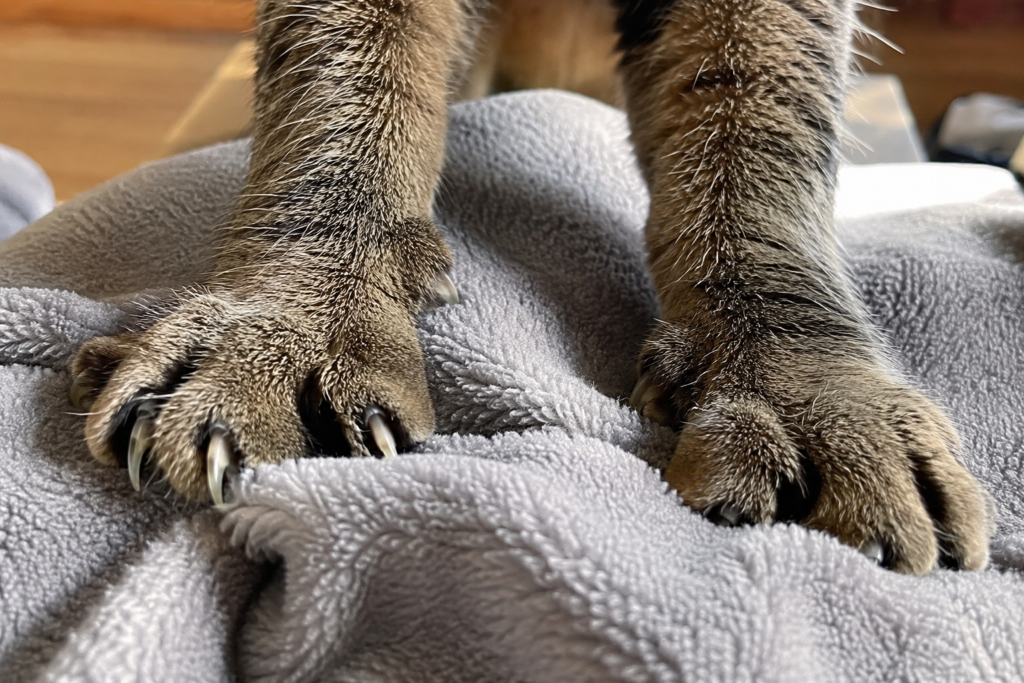
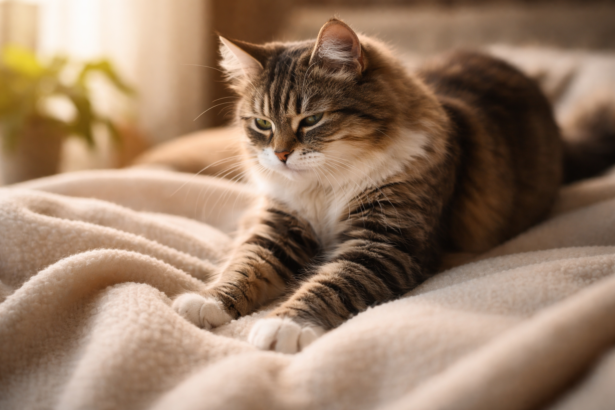
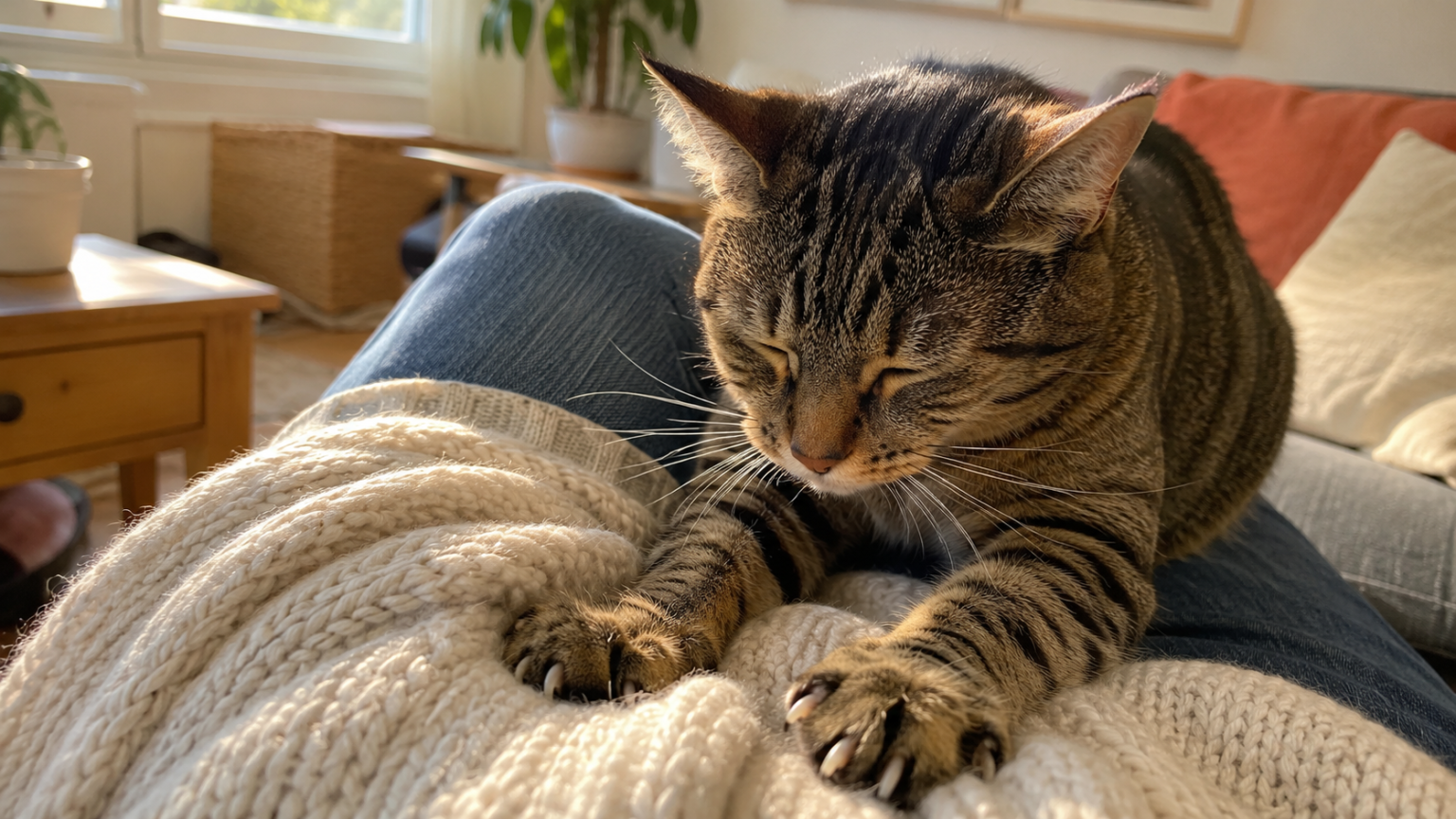
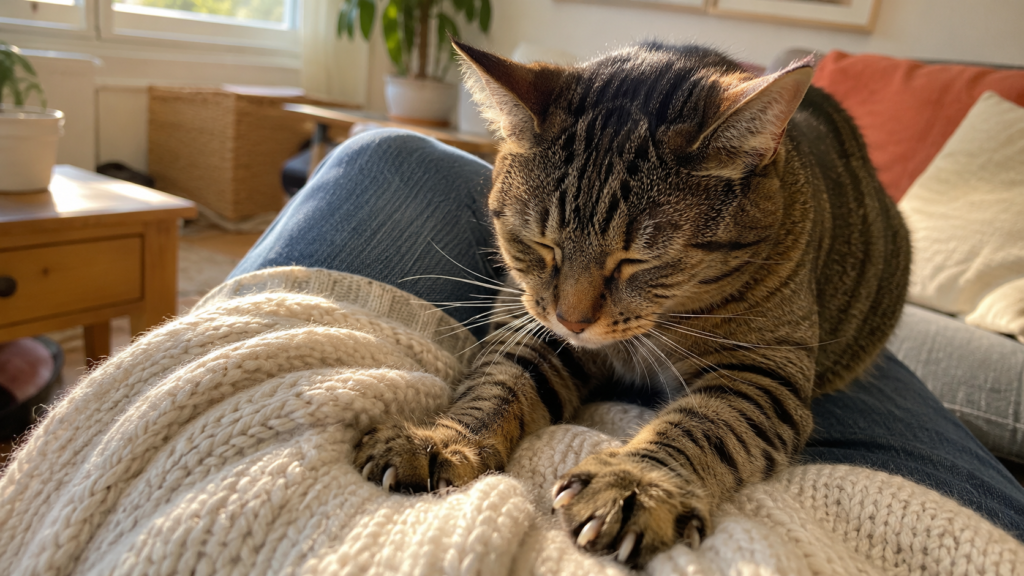
Kneading is the rhythmic motion where a cat alternates pressing their front paws into a soft surface — your lap, a blanket, a pillow, occasionally another pet who isn’t paying attention. The push-pull looks exactly like a baker working dough, which is why cat owners affectionately call it “making biscuits.” Some cats use only their front paws. Others bring all four into it and go full gymnast, back legs lifting into a little V.
The variations are huge, and they’re all normal. Some cats keep their claws politely retracted. Others extend them with every press (this is the version your jeans will remember). Some purr loudly the whole time, some are silent, and a happy few drool with their eyes half-shut in what can only be described as a trance. If your cat drools while kneading, you haven’t done anything wrong — that’s a cat so relaxed they’ve stopped managing their own face.
You’ll also hear it called other names: padding, milk-treading, or “making bread.” Different households, same behavior. What matters is that it’s instinctive, not learned. No one teaches a kitten to knead — they’re doing it within hours of being born.
Why Does My Cat Knead Me? The 6 Real Reasons
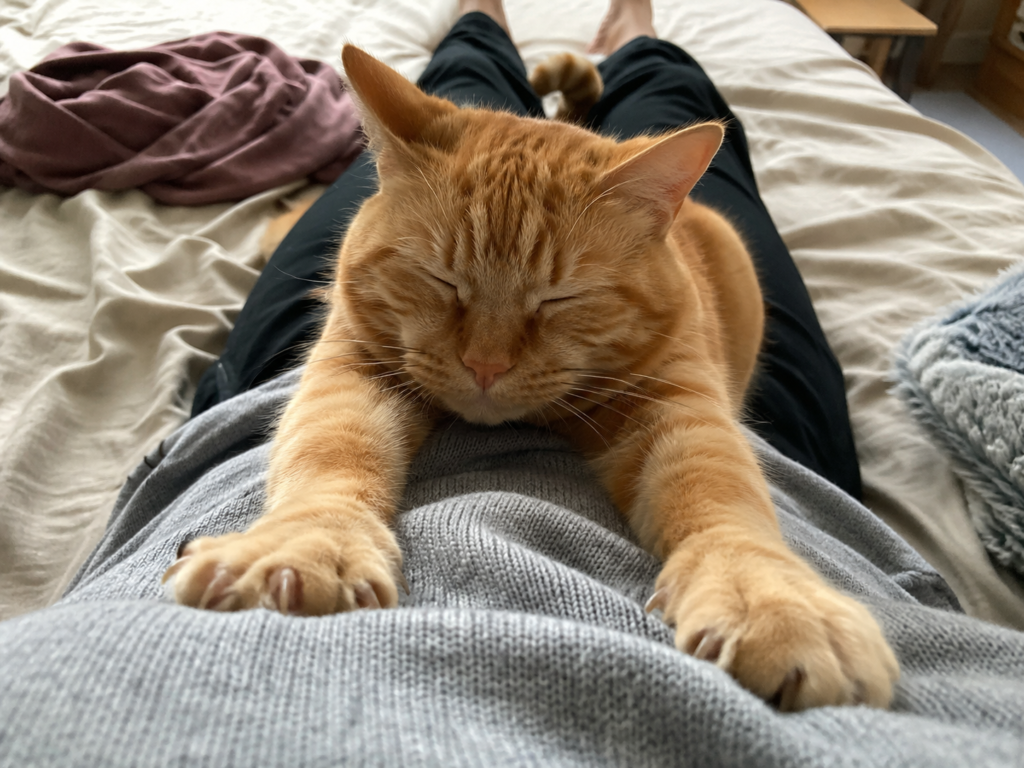
When you ask why does my cat knead me, the honest answer is that several instincts are firing at once. Here are the six that behaviorists actually agree on, ranked from most to least likely.
1. It’s a leftover nursing instinct. This is the big one. Newborn kittens push their paws against their mother’s belly to stimulate milk let-down. Dr. Susan Krebsbach, a veterinarian with behavioral expertise quoted by Preventive Vet, calls this the most widely-held explanation — the motion gets so tightly bound to the comfort of nursing that cats carry it into adulthood. Your cat isn’t confused about being a kitten. The action just feels good, the way a certain song can drop you straight back into being fourteen.
2. It’s self-soothing. Kneading releases feel-good signals in the brain and helps cats relax. You’ll most often see it right before a nap, because they’re winding down. The same motion can also surface when a cat is mildly anxious — after you’ve moved furniture, brought home a new pet, or changed the routine. So kneading mostly means “I’m content,” but occasionally means “I’m settling myself down.”
3. They’re claiming you. Cats have scent glands in the soft pads of their paws. According to the Cornell Feline Health Center, cats deposit scent from glands in their cheeks and paws when they rub and press against surfaces. When your cat kneads you, they’re stamping you with their personal signature — telling every other animal in the home that you’re spoken for. It’s possessive and affectionate at the same time. You’re not a person to them in that moment. You’re prime real estate.
Ten beautifully designed cat guides — behavior, feeding, health, the tricky days and more.
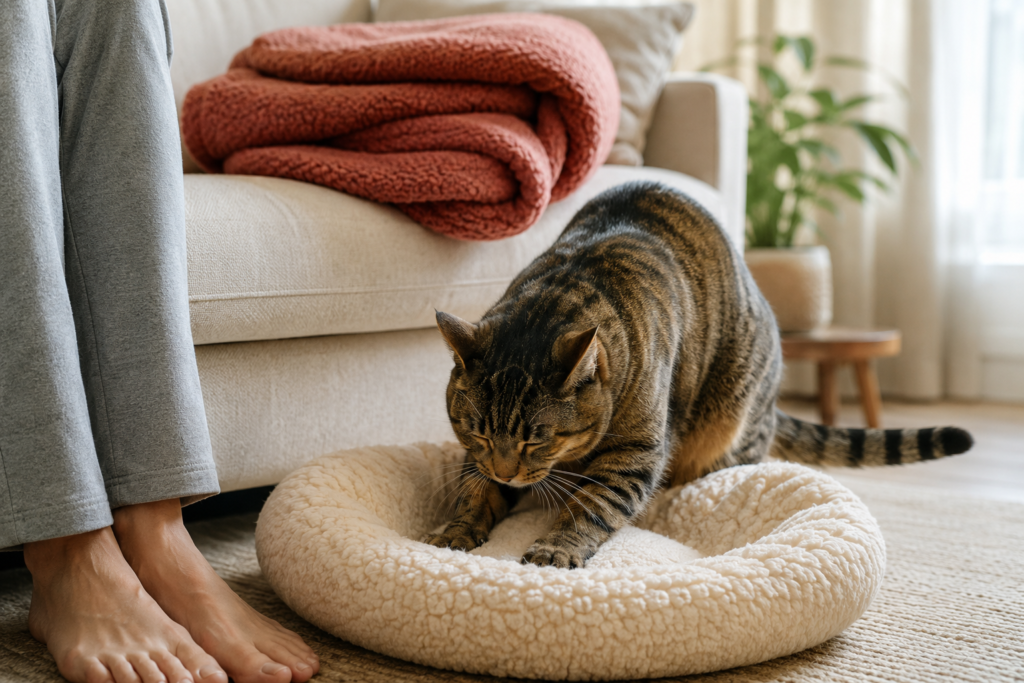
See What's Inside →4. It’s an ancient nest-building reflex. Wild cats knead grass and leaves to flatten a soft, safe spot before sleeping or giving birth. Your indoor cat has a memory-foam bed and zero predators, but the instinct didn’t get the memo. Kneading a blanket before lying down is your cat “building” a nest that was already perfectly comfortable.
5. They’re stretching. Some behaviorists think part of kneading is simply a way to stretch the muscles and tendons in the paws, legs, and back — the feline equivalent of you cracking your knuckles after a long day. This is why you often catch a cat kneading right after they wake up.
6. It’s pure affection. Sometimes the simplest answer is right. Cats bond through grooming, head-bumping, slow blinking, and kneading. If your cat chooses to make biscuits on you rather than the cushion six inches away, read it as a love letter written in paws.
| What your cat is “saying” | The instinct behind it | How to read it |
|---|---|---|
| “You feel like home.” | Nursing comfort association | Pure contentment — relax and enjoy it |
| “I’m winding down.” | Self-soothing | Often pre-nap; let them settle |
| “You’re mine.” | Scent-marking with paw glands | Affectionate ownership |
| “Building my bed.” | Wild nest-making reflex | Normal pre-sleep ritual |
| “Just stretching.” | Muscle and tendon release | Common right after waking |
Why Your Cat Kneads You But Not Everyone Else
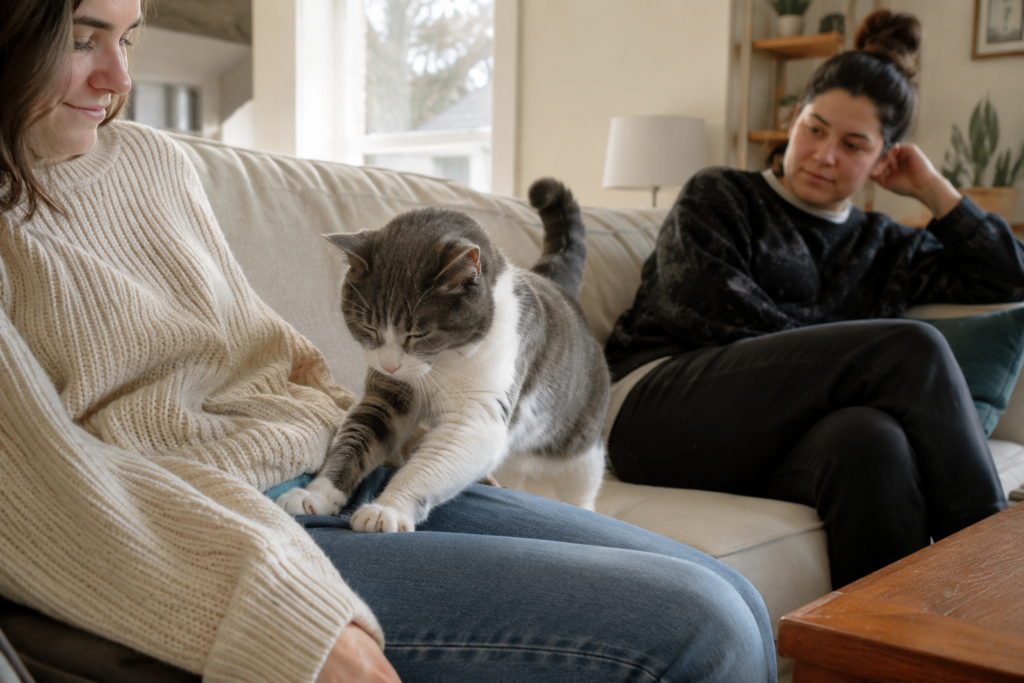
If your cat makes biscuits on you and ignores your partner, your roommate, or the guest on the other end of the couch, the explanation is flattering and a little brutal: you’re the safe one. Cats knead where they feel most secure, and that security is earned, not given out evenly.
A few things make you the chosen kneading surface. You might smell like home — your scent is on your clothes and your skin, and cats gravitate toward familiar scent. You might be the person who feeds them, or the one whose lap runs warm. Or you might simply be the human who has never once startled them. Cats keep a running ledger of who is calm and who is chaos, and the calm person gets the biscuits.
This is also why a newly adopted cat might not knead you for weeks or months. Kneading is a trust behavior. The day your rescue cat first kneads your leg is, in cat terms, the day they signed the lease. My tabby took almost three months before she’d do it — and then one ordinary Tuesday she climbed up, started padding my arm, and looked genuinely surprised at herself. That’s the milestone you’re waiting for.
If your cat never kneads anyone, that’s fine too. Not every cat is a kneader, and it says nothing about how much they love you. Some cats show affection by sleeping on your chest, blinking slowly at you across the room, or trilling when you walk in. Plenty of deeply bonded cats simply express it in other dialects.
Kneading, Biting, Purring, and Drooling — Decoding the Combo
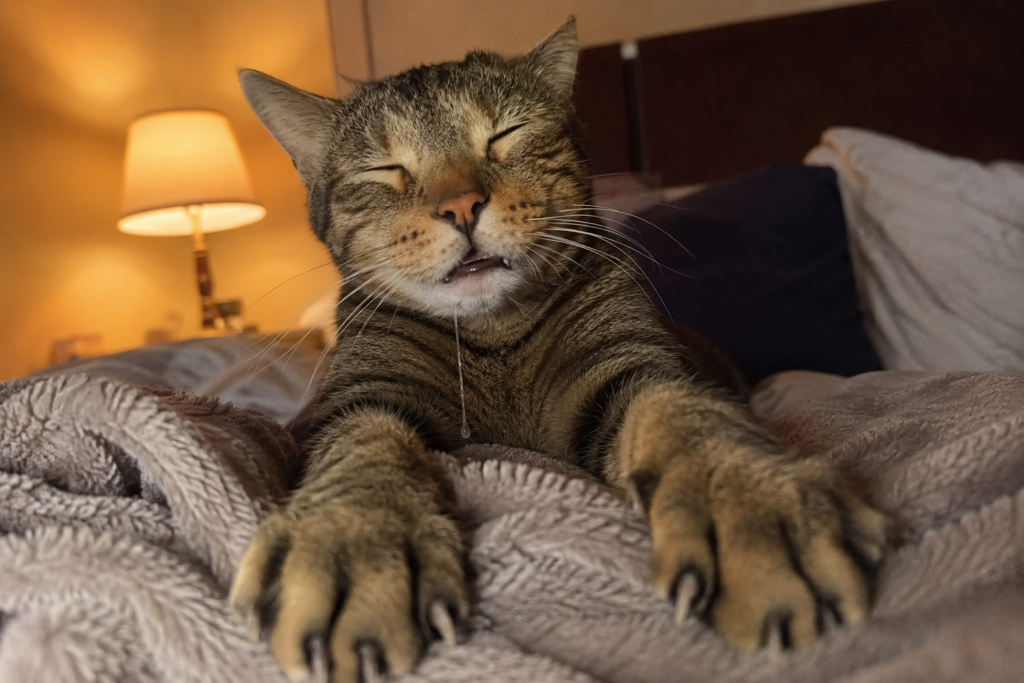
Kneading rarely arrives alone. It comes packaged with other behaviors, and learning to read the full combo tells you exactly how your cat is feeling.
Kneading plus purring is the gold standard — a cat that’s both pawing and rumbling is about as content as cats get. Kneading plus drooling plus half-closed eyes is that same contentment turned up to the maximum; this is your cat fully checked out into bliss.
Kneading plus gentle biting or suckling confuses a lot of owners, but it usually traces back to the same nursing memory. Some cats will knead and softly mouth a blanket — or your sleeve — as if nursing. As long as the bites are gentle and the cat seems relaxed, this is comfort behavior, not aggression.
The version to actually watch is kneading that suddenly turns into a real bite. This is usually overstimulation, not malice. Your cat was enjoying the petting, hit their limit, and the only tool they had to say “that’s enough” was their mouth. Cats almost always warn you first — a flattening ear, a twitching tail, skin that ripples, a pause in the purr. Learn those early cues and you’ll catch the “I’m done” signal before it reaches teeth. The fix isn’t punishment. It’s reading the warning and easing off the petting.
When Kneading Is Normal vs. When to Pay Attention
Here’s the reassuring part: in the overwhelming majority of cases, kneading is completely normal and needs zero intervention. A cat that has kneaded happily their whole life and keeps doing it the same way is just being a cat. You don’t fix what isn’t broken.
The one thing worth tracking is change. A sudden, marked shift in kneading — a cat who never kneaded now doing it compulsively, or a lifelong kneader who abruptly stops, especially if it lines up with a stressful event — can be a cat telling you something is off emotionally or physically. The Merck Veterinary Manual notes that early life experiences and stress can shape feline behavior, and behaviorists flag that obsessive kneading paired with signs of distress can point to anxiety. Cats also sometimes ramp up self-soothing behaviors when they’re in pain.
| Normal kneading (relax) | Worth a vet conversation |
|---|---|
| Consistent, lifelong, calm | Sudden dramatic increase or stop |
| Paired with purring and relaxed posture | Paired with restlessness, hiding, or distress |
| Happens before naps and cuddles | Looks compulsive or self-injurious |
| Cat seems content throughout | Lines up with a new health or behavior change |
To be clear: a single weird kneading session is not an emergency. You’re looking for a pattern shift, not a one-off. And because we cover behavior — not medicine — if your gut says something changed in your cat, that’s a call to your vet, not a Google rabbit hole.
How to Survive the Claws Without Killing the Behavior
The number one mistake owners make is trying to stop kneading because it hurts. Don’t. Kneading is a healthy, instinctive comfort behavior, and shutting it down can stress your cat and damage the trust the kneading represents. Redirect instead of forbid.
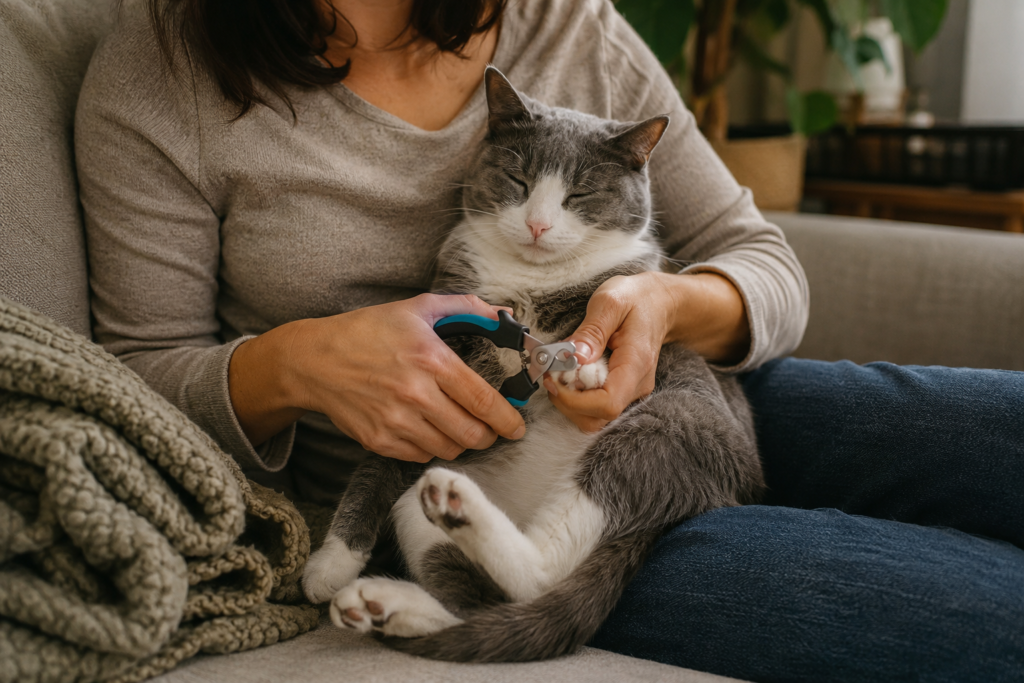
Three things solve almost every kneading-claw problem. First, keep the claws trimmed — a regular nail trim is the single biggest fix, turning needle-claws into blunt little nubs that barely register through a blanket. If trimming feels like wrestling an octopus, a groomer or vet tech can do it in two minutes. Second, keep a dedicated “biscuit blanket” on your lap. A thick folded throw between you and your cat absorbs the pressure, and over time many cats learn that this is the kneading spot, sparing your actual jeans and the couch. Third, give them a kneading-worthy surface of their own — a plush bed or a folded fleece in their favorite nap spot, ideally something that smells like you.
A quick warning on what not to do: never yell, never spray a water bottle, and never punish kneading. Veterinary sources are unanimous here — punishment doesn’t stop the behavior, it just teaches your cat that your lap is now a scary, unpredictable place. And declawing is never the answer to kneading; it’s an amputation that creates far more problems than a few snagged threads ever will.
If you want the full field guide to this and the other hundred things your cat is trying to tell you — the 3am meowing, the slow blinks, the tail that won’t sit still — that’s exactly what we built The Behavior Decoder for. It’s the cheat sheet we wish we’d had with our first cats.
Common Mistakes People Make About Cat Kneading
Even experienced cat owners get these wrong. Avoiding them will save you a lot of unnecessary worry — and protect your relationship with your cat.
Mistake 1: Assuming kneading means your cat was weaned too early. This myth is everywhere, and it’s mostly wrong. WebMD points to research showing that cats knead regardless of how long they stayed with their mother. Early weaning may make some cats knead more intensely, but the behavior itself is universal. If your cat kneads, it doesn’t mean they were taken from mom too soon. It means they’re a cat.
Mistake 2: Punishing or “correcting” the behavior. Spraying water, pushing the cat off, or scolding mid-knead reads to your cat as a random act of hostility from their safest person. It won’t stop the kneading, but it will chip away at trust and can actually increase anxiety-driven kneading. Redirect with a blanket; never punish.
Mistake 3: Yanking the cat off the moment it hurts. Suddenly grabbing and dropping a kneading cat startles them out of a happy, vulnerable state. Instead, gently slide a blanket underneath or calmly lift them while supporting their whole body. Smooth exits keep the trust intact.
Mistake 4: Ignoring a genuine change in the pattern. The flip side of “don’t overreact” is “don’t ignore real shifts.” If your cat’s kneading suddenly doubles, vanishes, or comes with hiding and restlessness, that’s data. Most of the time it’s stress from a household change. Occasionally it’s worth a vet’s eyes. Track the pattern instead of dismissing it.
Mistake 5: Reaching for declawing. It still has to be said. Declawing to stop kneading (or scratching) removes bone, not just claws, and is linked to chronic pain and behavior problems. Trimmed nails and a biscuit blanket solve the actual issue without surgery.
Frequently Asked Questions
Why does my cat knead me and then bite me? Usually it’s overstimulation, not aggression. Your cat was enjoying the petting and kneading, hit their tolerance limit, and used a nip to say “that’s enough.” Watch for warning signs — twitching tail, flattened ears, rippling skin — and ease off before it reaches teeth. Gentle biting or suckling during kneading is often just leftover nursing comfort and nothing to worry about.
Is it bad if my cat doesn’t knead me? Not at all. Plenty of affectionate, well-adjusted cats never knead. Kneading is just one love language out of many. If your cat sleeps near you, slow-blinks at you, headbutts you, or follows you around, you’re getting the same message through a different channel. A non-kneading cat is not a cat that loves you less.
Why does my cat knead me but not my partner? Because you’re the one they feel safest with right now. Cats knead where they feel most secure, and that trust is earned through calm, predictable interactions — and helped along by familiar scent and a warm lap. It’s not a verdict on your partner. Trust can shift, and the kneading often spreads as your cat settles in.
Why does my cat knead and purr at the same time? That combination is the clearest “I’m completely content” signal a cat can send. Both behaviors trace back to nursing and to feeling safe, so a cat that’s kneading and purring together is deeply relaxed and happy in your presence. If they add drooling and half-shut eyes, they’ve reached peak bliss — take it as the compliment it is.
Why does my cat knead my blanket instead of me? Often it’s about scent and texture. A soft, familiar blanket that smells like home is the perfect surface for nest-building and self-soothing. Some cats simply prefer fabric to skin, especially if your blanket already carries your scent. They’re still doing it near you for the same reason — comfort and security — just with a softer landing pad.
Should I stop my cat from kneading? No. Kneading is a normal, healthy comfort behavior, and stopping it can stress your cat. If the claws hurt, manage the symptom, not the behavior: trim the nails, slip a thick blanket between you and your cat, and offer a dedicated kneading spot. The only time to act differently is if the kneading suddenly changes dramatically — then it’s a vet conversation, not a correction.
The Bottom Line
So the next time you ask why does my cat knead me, you can stop wondering and start enjoying it — those pressing paws are the highest compliment a cat knows how to give, a mix of trust, comfort, and “you’re mine.” Manage the claws, never punish the instinct, and pay attention only when the pattern suddenly changes. Once you can read kneading, you’ll start noticing all the other quiet things your cat has been telling you this whole time.
Get Decode Your Cat — free.
20 everyday behaviors translated, so you finally know what your cat is actually saying. Pop in your name and email and it's yours instantly.