

Meowive Reference · Behaviour
Thank you for reading this post, don't forget to subscribe!Tail, ears, pupils, whiskers, posture, voice — a continuous broadcast almost nobody is ever taught to read. Eighty-eight signals decoded, with the mistake each one usually causes.
88
Signals decoded
5
Channels
6
Reference charts
2026
Last verified
Last verified: August 2026 · Edited by the Meowive editorial team · Sources cited below
Your cat has been talking to you since the day it arrived. Not in meows — those are mostly for your benefit — but in a continuous stream of tail angles, ear rotations, pupil widths and postural shifts that carries almost everything it has to say. This is a complete reference to cat body language and vocalization: 88 individual signals across five channels, each with what it means, what people usually mistake it for, and what to actually do about it.
The short answer
Read three channels at once — ears, eyes and tail — and never one on its own. A tail moving fast means agitation, not happiness. Flattened ears mean fear before they mean anger. Wide pupils in a bright room mean something is wrong. And a cat rolling onto its back is showing trust, not asking for a belly rub. Get those four right and you have solved most of the misunderstandings people have with cats.
What to take away from this page
This is the single most useful idea on the page, and everything below depends on it. A cat is never sending one signal. It is sending several simultaneously, and any one of them read in isolation will mislead you roughly half the time.
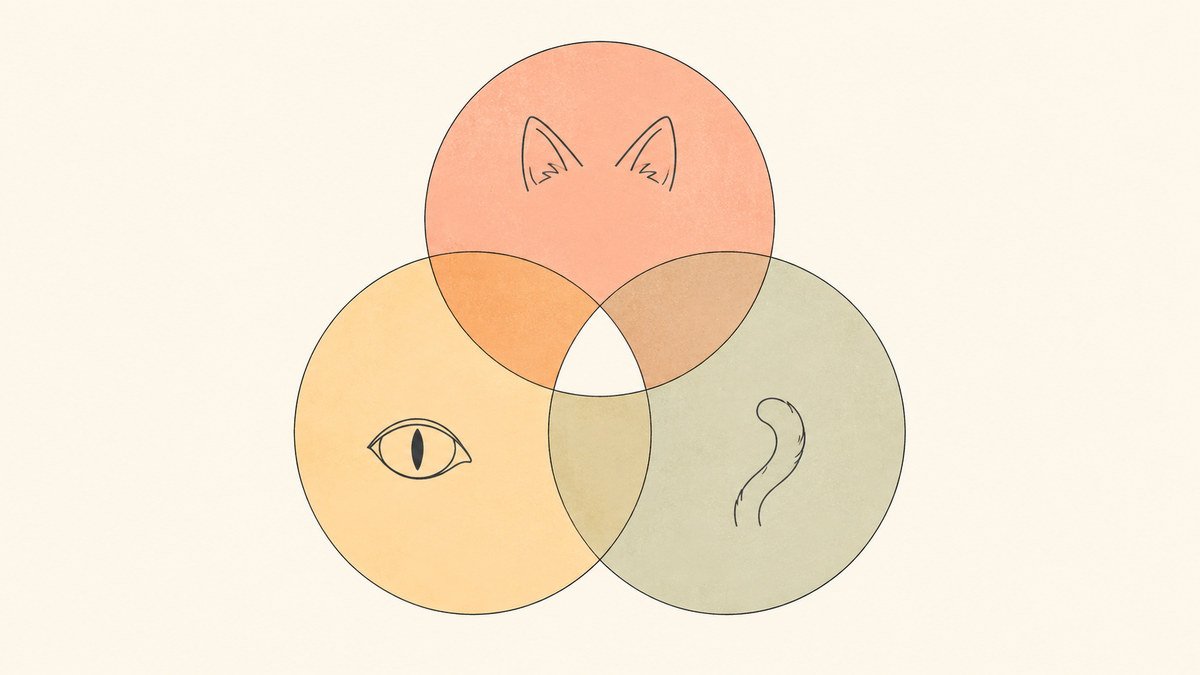
Take the classic example. A cat lying on its side with the tail swishing might be relaxed and playing, or it might be seconds from a swat. The tail alone cannot tell you. Add the ears — forward means play, flattened means stop. Add the pupils — wide in dim light means play, wide in bright light means arousal. Three channels resolve almost every ambiguity that one channel leaves open.
Important
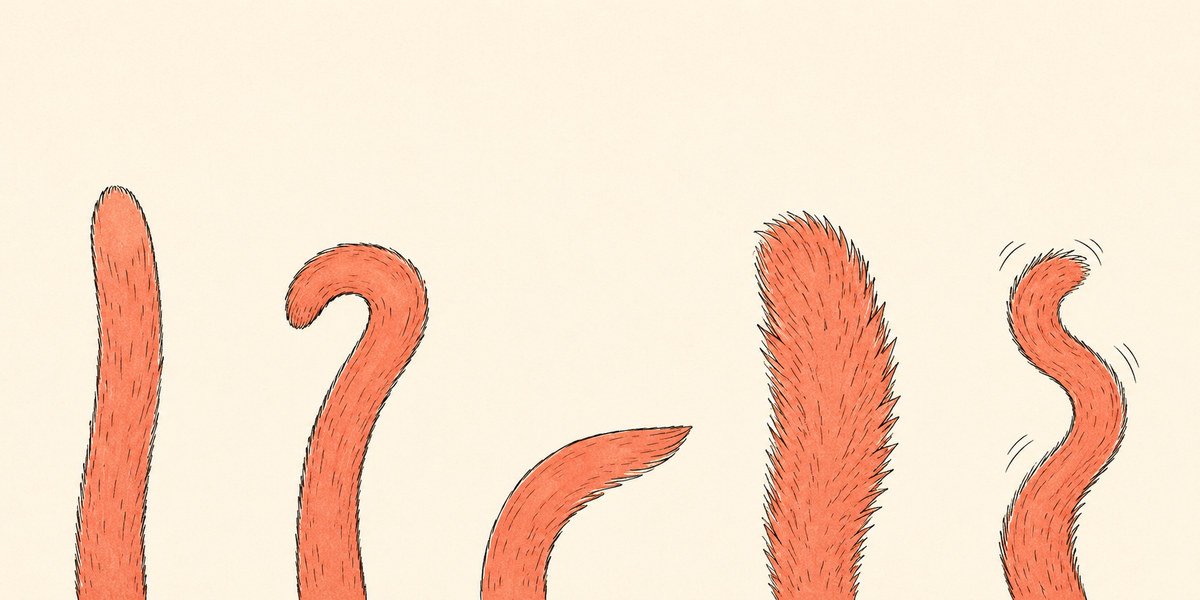
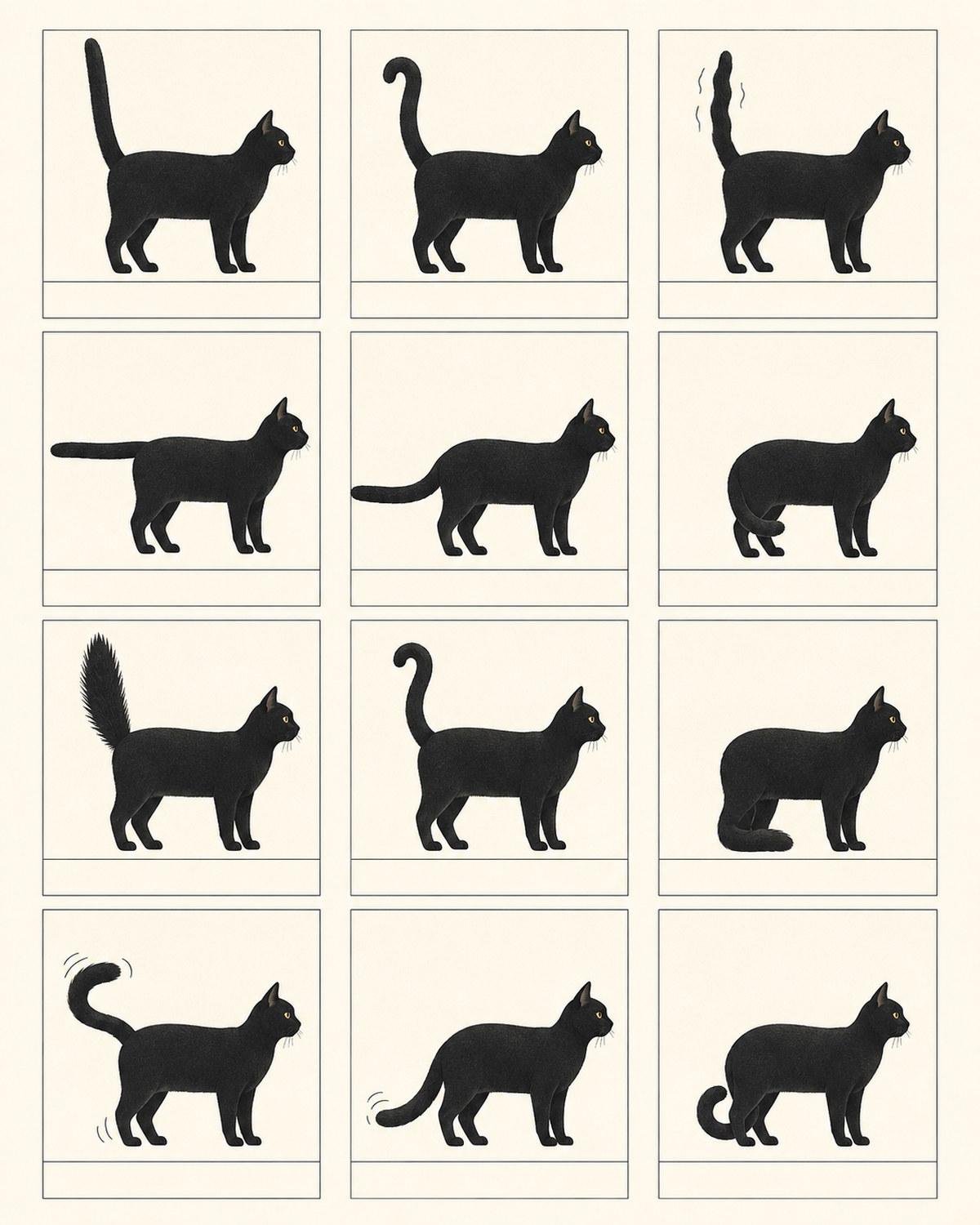
The tail is the loudest single channel a cat has, and the one people get wrong most often. Almost all of that error comes from importing dog grammar: in dogs a moving tail is generally good news, and in cats a moving tail generally is not.
| The signal | What it means | Commonly misread as | What to do |
|---|---|---|---|
| Straight up, tip still | Confident, friendly greeting. This is the posture a cat uses approaching someone it trusts. | Rarely misread — but people often miss that it is an invitation, not just a walk-past. | Greet back. Offer a hand at nose height and let your cat close the distance. |
| Straight up with a hooked tip | The question mark. Friendly with a playful edge — the most sociable tail signal a cat has. | Read as ordinary walking. It is actually a specific social offer. | Good moment to initiate play or a short interaction. |
| Straight up and quivering | Intense excitement, usually a greeting. In an unneutered cat near a vertical surface it can precede spray-marking. | Assumed to be about to urinate. In a neutered cat greeting you at the door, it is pure enthusiasm. | Enjoy it. If it happens repeatedly against furniture, that is a marking issue, not a greeting. |
| Horizontal, level with the back | Neutral. Your cat is going somewhere and feels no particular way about it. | Read as unfriendly. It is simply baseline. | Nothing needed. This is a cat at rest with the world. |
| Held low, below the line of the back | Wary or uncertain. Something in the environment is not right yet. | Mistaken for sadness. It is caution, not mood. | Look for what changed — a visitor, a new object, a smell. Let your cat process it. |
| Tucked tightly under the body | Fear or appeasement. The cat is making itself small. | Read as guilt after a mess. Cats do not feel guilt; they read your tone and shrink. | Lower your voice, stop approaching, give space and let the cat re-emerge on its own. |
| Fully puffed, bottlebrush | Startle or fear. Piloerection is involuntary — it makes the cat look larger. | Assumed to be aggression. It is almost always fear first. | Do not reach for the cat. Remove the trigger if you can and wait it out. |
| Puffed with the body arched sideways | Defensive threat. The cat is displaying to avoid a fight, not start one. | Read as an attack about to happen. It is a request for the threat to leave. | Back away. Never corner a cat in this posture. |
| Thrashing fast, side to side | Agitation or overstimulation. The energy has to go somewhere. | The single most misread signal in cats. It is not a dog's happy wag. | Stop petting immediately. This is the last warning before a swat. |
| Only the tip twitching | Mild irritation, or concentration on something interesting. | Read as contentment. It is closer to a drumming finger. | If you are petting, pause. If your cat is watching a bird, leave it be. |
| Swishing slowly and deliberately | Focused attention. Classic hunting concentration. | Read as annoyance. Context is the difference — a toy or a bird nearby means focus. | Let it play out, or throw the toy. This is engagement, not irritation. |
| Wrapped around its own body while sitting | Self-containment. Often mild insecurity, sometimes just cold. | Read as sulking. | Neutral signal. Worth noting if it becomes constant in a previously open cat. |
| Wrapped around your leg or another cat | Affiliative bonding. The feline equivalent of an arm around a shoulder. | Frequently missed altogether. | Enjoy it — this is a strong social signal and worth reinforcing with calm attention. |
| Curled neatly around the front paws | Contentment and self-containment. A settled cat. | None common. | Leave your cat alone. It is exactly where it wants to be. |
| Thumping the floor while lying down | Irritation. The cat is aware of you and is not pleased. | Very often read as happy tail-wagging, borrowed from dogs. | Stop whatever prompted it. This is a clear no. |
| Held stiffly straight out behind | Alert and tense. The cat has locked onto something. | Read as neutral because the tail is not moving. | Follow the gaze rather than the tail. Something has its attention. |
| Slow lazy wave while resting | Acknowledgment. Your cat has registered you and is choosing to stay put. | Read as an invitation to approach. | Say something, but do not necessarily go over. Being acknowledged is the whole exchange. |
| Held to one side while standing, rear raised | Mating receptivity in an unspayed female. | Mistaken for a greeting posture. | If your cat is not spayed, this is the point to book that conversation with your vet. |
Scroll sideways on mobile to see every column. 18 signals in this section.
Twelve tail positions on one plate, drawn on an identical cat so the only variable is the tail. This is the chart worth screenshotting.
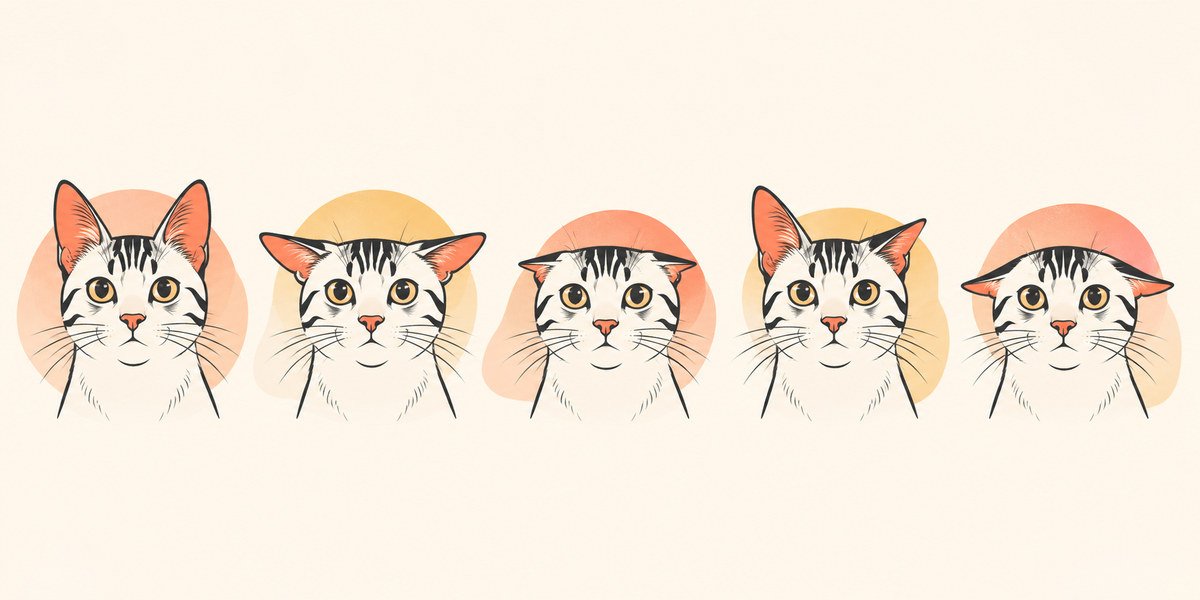
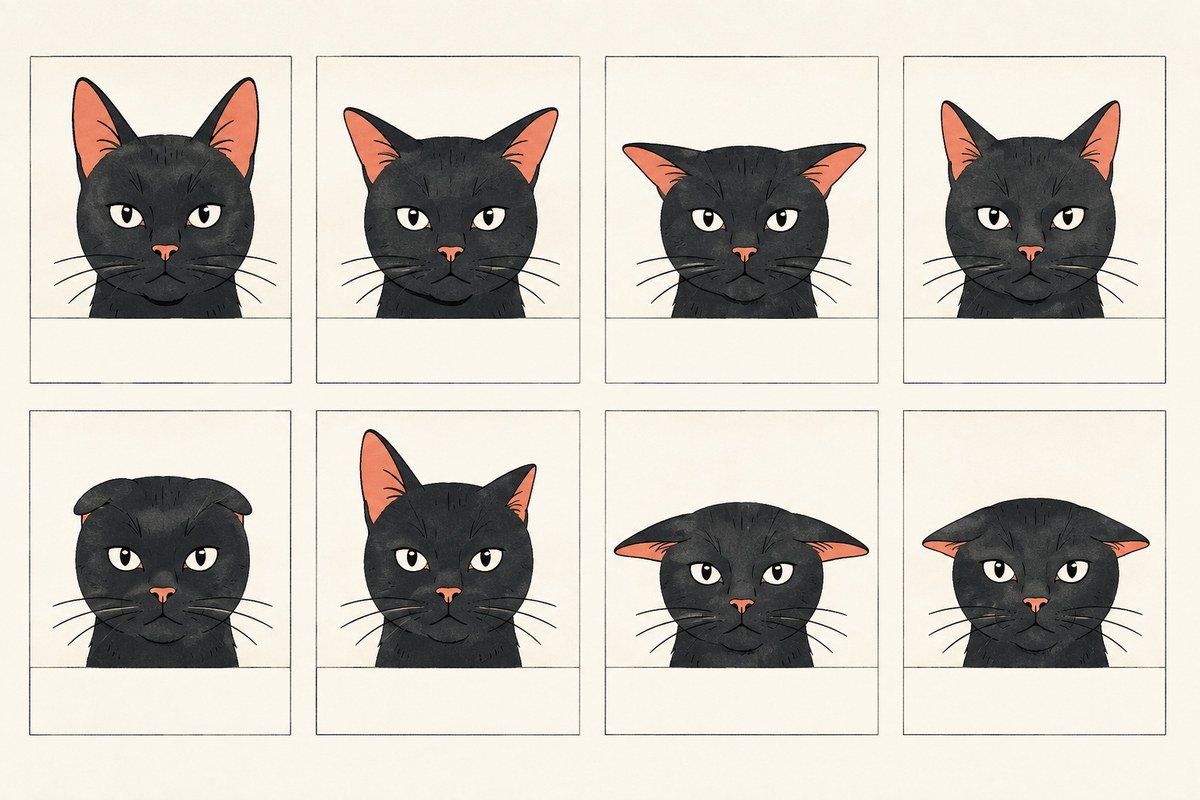
Cats have around thirty muscles in each ear and rotate them independently through nearly 180 degrees. Ears move faster than any other signal, which makes them the earliest warning you will get — usually a second or two before the tail catches up.
| The signal | What it means | Commonly misread as | What to do |
|---|---|---|---|
| Both forward and upright | Alert and interested. The default engaged position. | None common. | Normal. Your cat is paying attention to something it does not mind. |
| Relaxed and slightly outward | Calm, neutral. Muscles are not doing anything. | Read as sleepy disinterest. | This is a settled cat. Good moment for gentle interaction. |
| Swivelled out to the sides | Uneasy. Something is being monitored that the cat is not comfortable with. | Read as relaxed because the ears are not flat. | Check what is happening behind or beside your cat before approaching. |
| Airplane ears — flat out sideways | Fear or agitation, one step short of pinned. | Often thought to be cute. It is a distress signal. | Stop and give space. Something is wrong from your cat's point of view. |
| Flat back against the skull | Fear, or defence about to escalate. | Read as anger. It is a cat protecting its ears in an expected fight. | Do not approach or reach. Remove the trigger and wait. |
| Back but still upright | Irritation and warning. Different from flat-pinned fear. | Read as the same as flattened ears. This one is annoyance, not terror. | Whatever you are doing, stop doing it. |
| One forward, one rotated back | Split attention — interested in you, monitoring something else. | Read as a quirk. It is genuine multitasking. | Nothing needed. Cats rotate each ear independently by design. |
| Rotating rapidly and repeatedly | Scanning. In an otherwise still cat, often anxious hypervigilance. | Read as playfulness. | If it persists in a quiet room, look for a stressor — a new pet, a noise, a smell. |
| Held low and forward, head lowered | Stalking. Predatory focus. | Read as fear because the head is down. | Leave the cat to it, or redirect onto a wand toy. |
| Twitching during sleep | Normal. Cats monitor sound even in light sleep. | Read as dreaming distress. | Nothing needed. This is standard feline sleep architecture. |
| Pricked toward something you cannot hear | Normal acuity. Cats hear roughly two octaves above human range. | Read as spooky or unexplained. | Nothing needed. It is almost always a pipe, a bird or a neighbour. |
| Held slightly asymmetrically at rest | Normal low-effort monitoring while relaxed. | Read as an ear problem. | Only a concern if paired with head shaking, scratching or discharge. |
Scroll sideways on mobile to see every column. 12 signals in this section.
Eight ear positions on an identical head. Ears move first, so this is the chart that buys you the most reaction time.
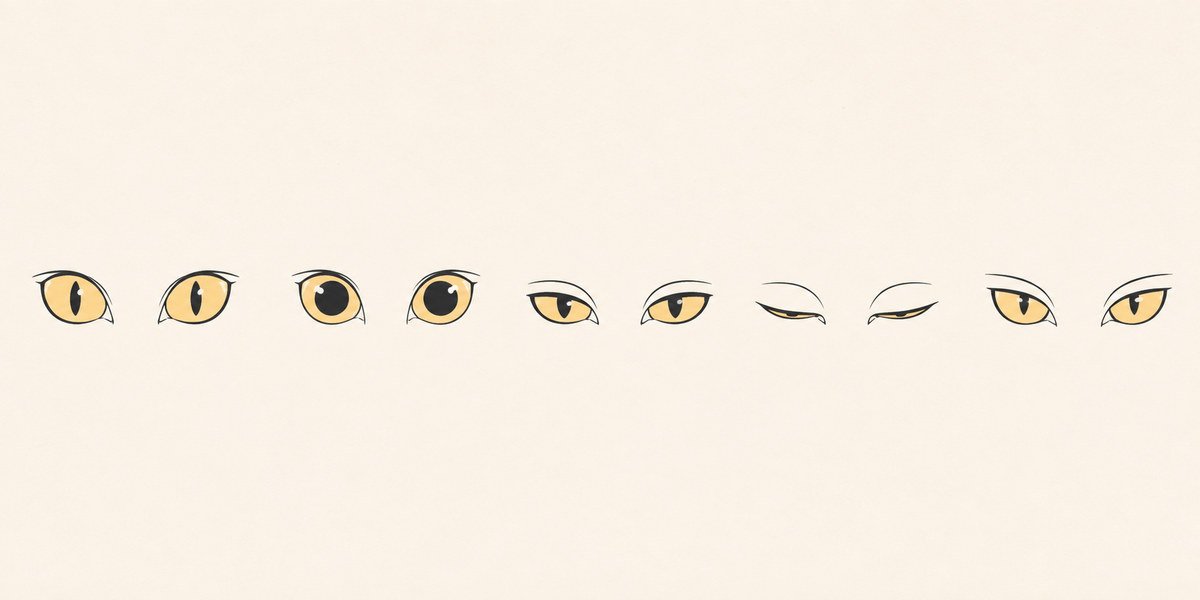
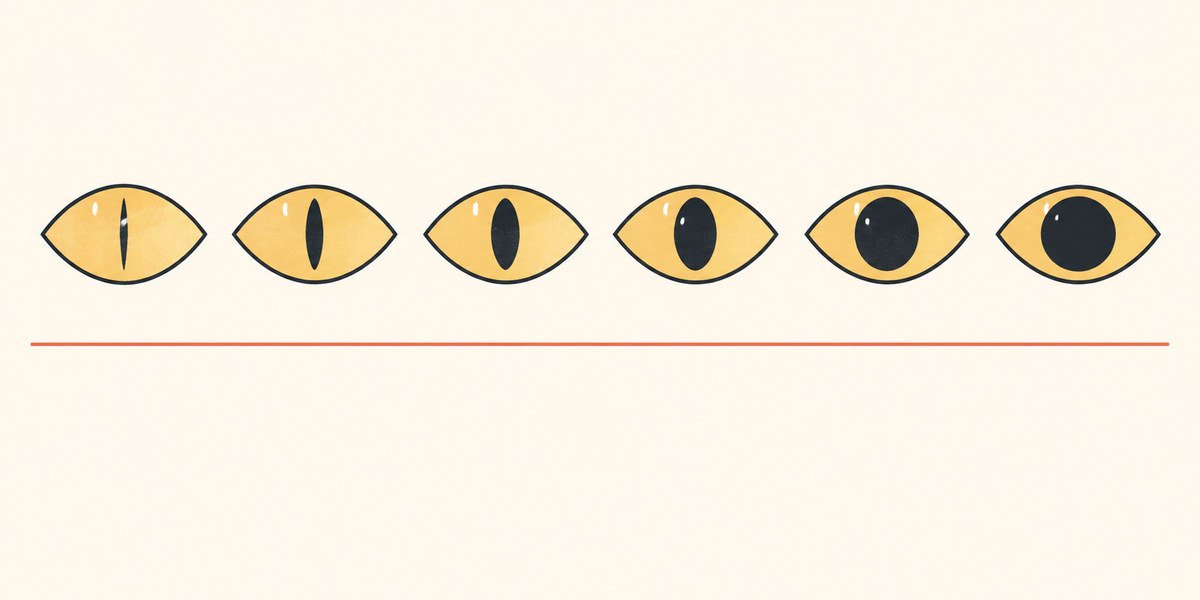
Pupil size is the key, and the trick is to judge it against the light in the room rather than on its own. Wide pupils in bright light and narrow pupils in dim light both mean the pupil is responding to emotion rather than illumination.
| The signal | What it means | Commonly misread as | What to do |
|---|---|---|---|
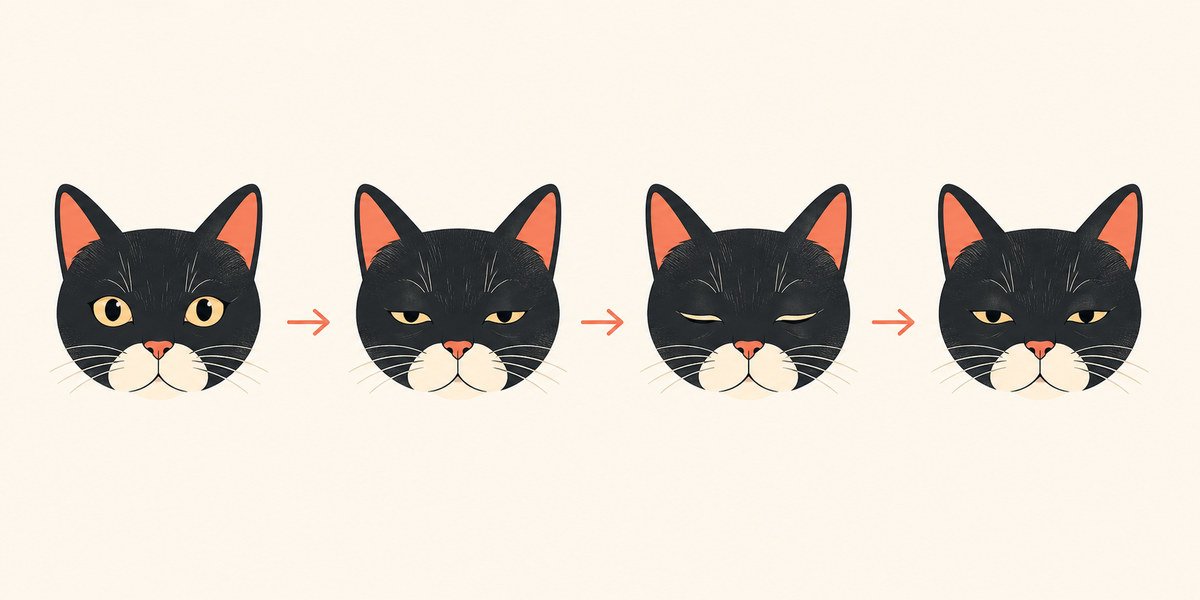
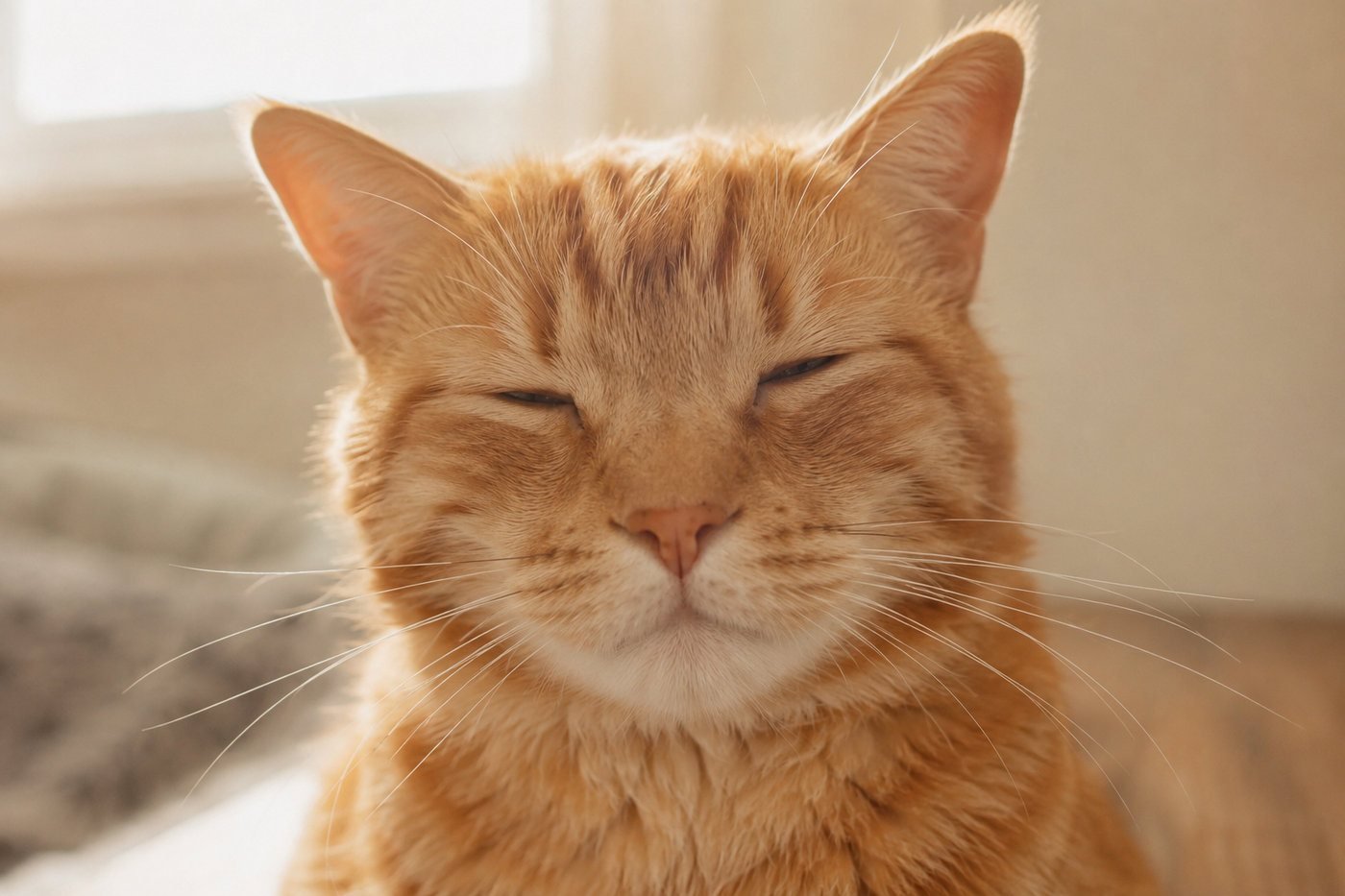
| Slow blink | Trust. A cat closing its eyes near you is saying it does not expect trouble. | Read as sleepiness. | Slow blink back. It genuinely works and is the easiest bridge to a nervous cat. |
| Half-lidded and soft | Relaxed contentment. | Read as disinterest. | This is a cat at ease. Quiet company is welcome. |
| Wide open with round pupils in bright light | Fear or high arousal. Pupil size in good light is not about seeing better. | Read as curiosity, because wide eyes look interested. | Check the context. In bright light, round pupils mean something is wrong. |
| Pupils constricted to narrow slits in dim light | Tension or arousal. Again, the light does not explain it. | Read as sleepy. | Look for a trigger. This often precedes a swat or a chase. |
| Dilated pupils during play | Normal excitement and predatory arousal. | Read as fear. | Fine in play. Watch that arousal does not tip into overstimulation. |
| Hard, unblinking stare | Threat or challenge, particularly between cats. | Read as affection or attention-seeking. | Break the stare and look away. Staring back escalates it. |
| Direct eye contact from an unfamiliar cat | Confrontation. Among cats, staring is rude. | Read as friendliness, because that is what it means between people. | Blink slowly and turn your head slightly. Do not hold the gaze. |
| Deliberately avoiding eye contact | Appeasement. Your cat is defusing rather than ignoring you. | Read as rejection or sulking. | Respect it. This is polite feline behaviour, not a snub. |
| Third eyelid visible across the eye | A medical sign — illness, pain, dehydration or eye problems. | Dismissed as a quirk or sleepiness. | Book a vet appointment. This is not a behavioural signal. |
| Squinting one eye only | Pain or irritation in that eye — ulcer, foreign body, infection. | Read as winking. | Vet, promptly. Eye problems in cats escalate quickly. |
| Whites of the eyes showing at the edges | Stress. The cat is tracking something without turning its head. | Read as a funny expression. | Reduce whatever is causing it. Something in the room is unwelcome. |
| Rapid repeated blinking | Discomfort or irritation, sometimes environmental — smoke, aerosol, dust. | Read as a slow blink. | Slow blinks are long and deliberate. Fast blinking means check the air quality and the eye. |
| Sitting upright with both eyes fully closed | Deep relaxation and trust. Sleeping upright means feeling safe. | Read as ill or odd. | Nothing needed. This is a strong compliment. |
| Staring at an apparently blank wall | Usually normal — sound or scent behind the plaster. | Assumed to be supernatural. | Only worth investigating if it is prolonged, repetitive and paired with disorientation, especially in a senior cat. |
Scroll sideways on mobile to see every column. 14 signals in this section.
The slow blink is the one piece of cat language you can speak back. Hold your gaze soft, close your eyes for roughly a second, then open them slowly. Many cats will return it within a few attempts, and it is the fastest way to lower the temperature with a nervous or unfamiliar cat.
The Meowive Library
Your cat has been talking to you since the day it arrived.
This page covers the vocabulary. The Feline Mind covers the grammar — 58 pages and 44 illustrated plates on why cats signal the way they do, how the channels combine, and what changes when a cat stops trusting you.
See what’s inside →58 pages · 7 parts · 44 illustrated plates · PDF, instant download
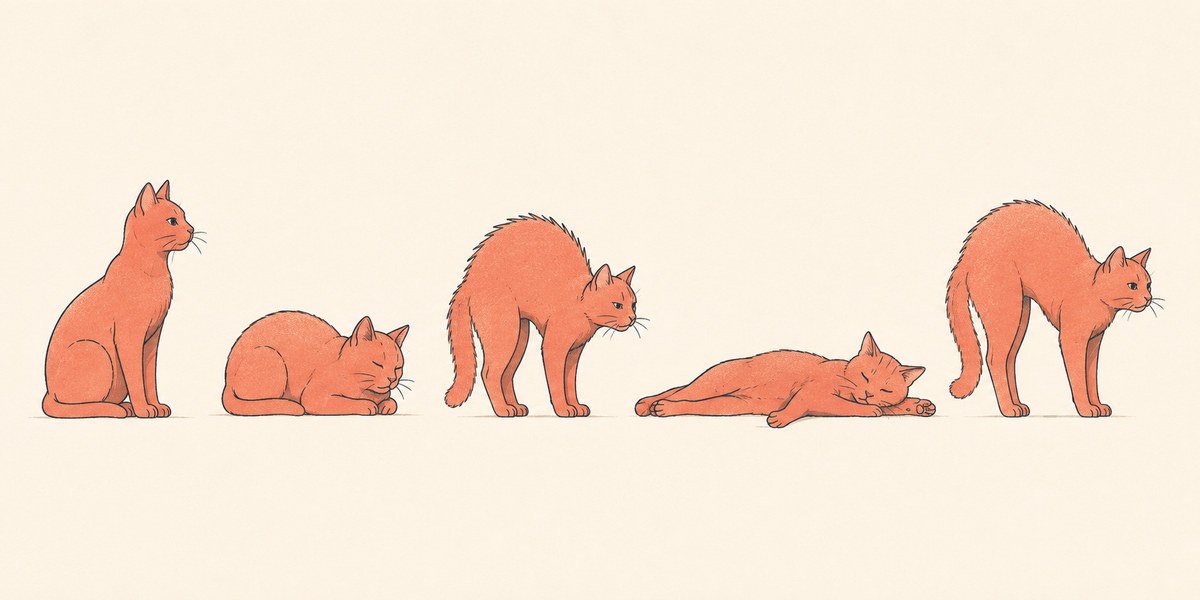
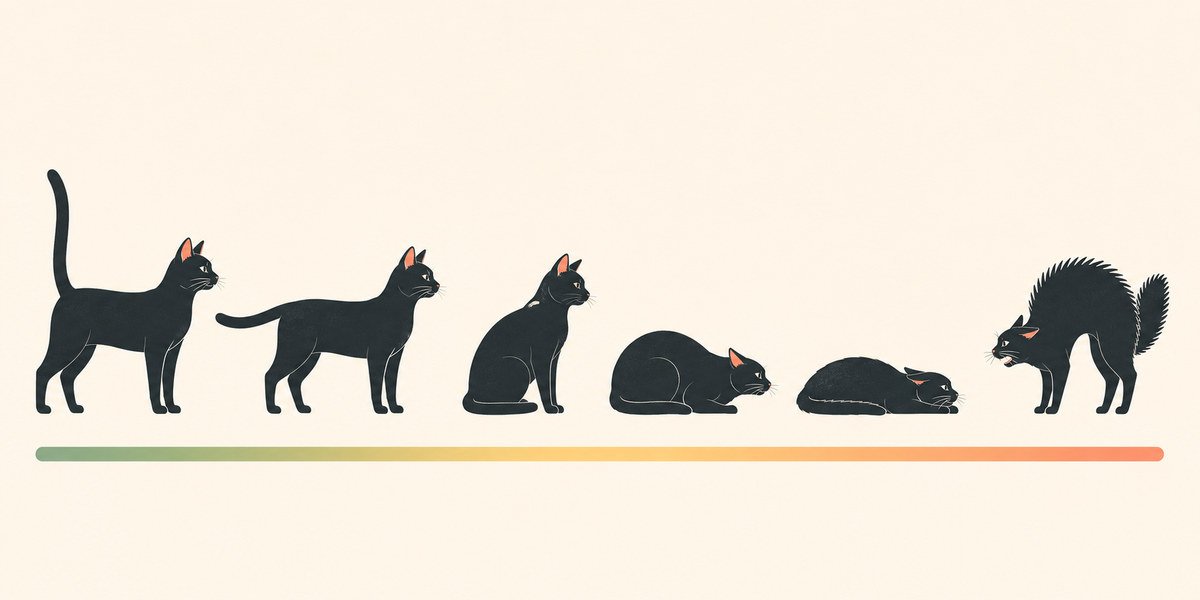
Posture tells you how much distance a cat wants. Nearly every entry below is a statement about space — closing it, holding it, or asking for more of it. Cats are extremely consistent about this, and most bites happen when a distance request was missed.
| The signal | What it means | Commonly misread as | What to do |
|---|---|---|---|
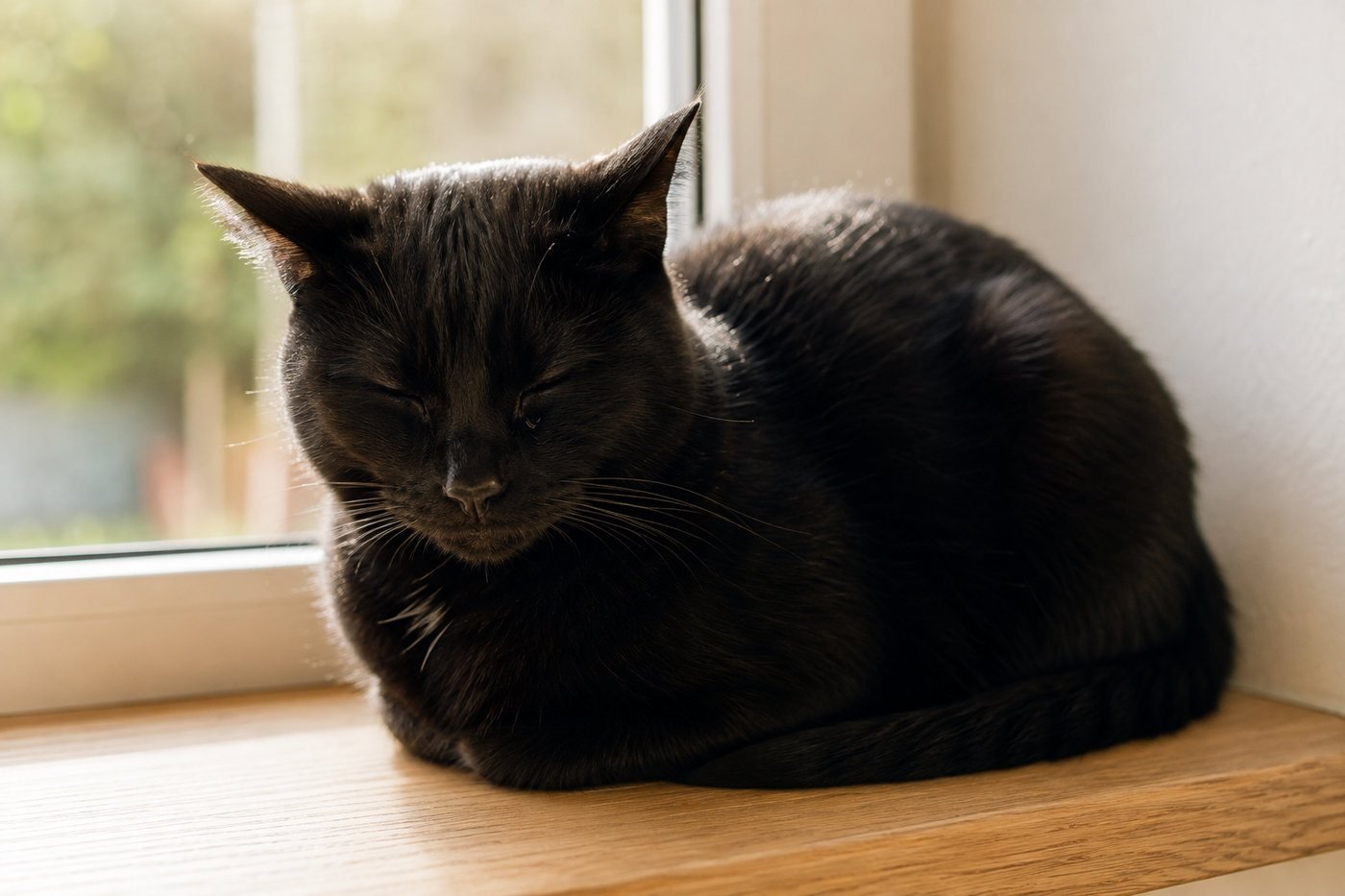
| The loaf — all paws tucked underneath | Relaxed but not fully off duty. Paws are still retrievable in a second. | Read as maximum relaxation. It is one step below that. | Nothing needed. Common and healthy. |
| Full loaf with tail wrapped tight | Content, and often conserving warmth. | Read as cold-only. | Check the room temperature if it becomes constant, particularly in a thin or senior cat. |
| Stretched flat on one side, legs extended | Deep relaxation. All defences down. | None common. | This is as relaxed as a cat gets. Do not disturb it. |
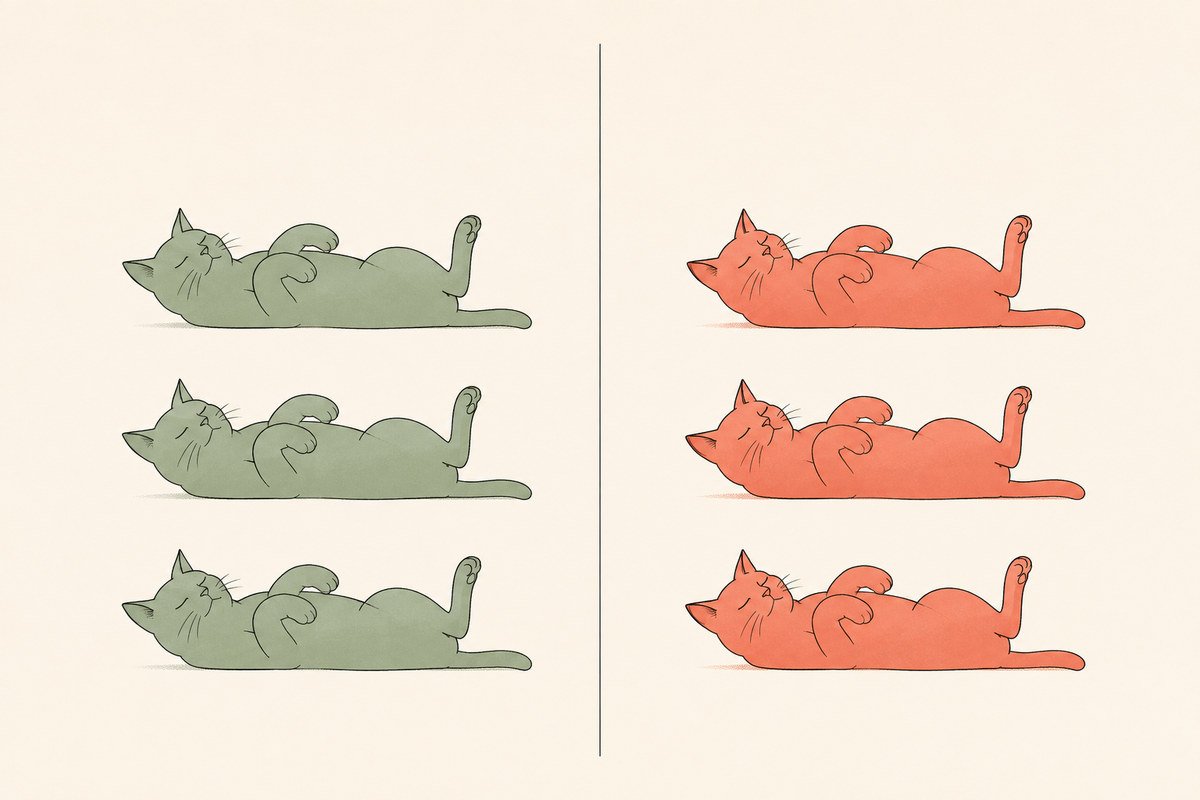
| Belly up, body soft, paws loose | Trust display. Exposing the abdomen means feeling safe. | Read as a belly rub invitation. It almost never is. | Rub the head or chin instead. The belly is a trap for the well-meaning. |
| Belly up, body tense, claws visible | Defensive. All four sets of claws and the teeth are now pointed at you. | Read as the same as a relaxed belly-up. | Back off entirely. This is a fighting position, not an invitation. |
| Arched back, fur raised, standing sideways | Defensive threat display. Sideways makes the silhouette larger. | Read as Halloween-cat playfulness. | Give space. Do not reach in to soothe. |
| Crouched low, weight forward, muscles loaded | Ready to move — pounce or flee. | Read as relaxed because the cat is low. | Look at the ears and pupils to tell which. Forward ears mean play; flat ears mean flight. |
| Crouched tight, hunched, head pulled in | Pain or significant fear. A hunched cat that will not settle needs attention. | Read as sulking or being cold. | If there is no obvious fear trigger, treat a persistently hunched posture as a medical sign. |
| Standing tall, weight forward, head up | Confidence. The cat owns the room. | None common. | Nothing needed. |
| Rubbing the face and head against you | Bunting. Depositing scent from facial glands — you are being claimed. | Read as itching. | Reciprocate with slow strokes along the cheek and jaw. |
| Kneading with the front paws | Contentment. A retained kitten nursing behaviour. | Read as sharpening claws on you. | Put a blanket between the claws and your legs. Do not punish it. |
| Rolling onto the back in front of you | Greeting and attention-seeking, particularly on your arrival. | Read as a request for belly contact. | Talk to your cat and offer a head scratch. Skip the belly. |
| Slow approach with the tail up | Friendly, deliberate greeting. | Read as hesitation. | Stay still and let your cat complete the approach. Moving toward it shortens the exchange. |
| Freezing completely mid-movement | Threat assessment. The cat is deciding. | Read as playing. | Stay still yourself. Sudden movement decides it for them, usually badly. |
| Fur raised along the spine only | Startle response, milder than a full bottlebrush. | Read as aggression. | Give a moment. It usually settles on its own within seconds. |
| Pressed flat to the ground, ears back | Terror. The cat is trying to disappear. | Read as submission or relaxation. | Stop everything. Do not pick the cat up. Leave the room if you are the trigger. |
| Sitting with its back turned to you | Trust. Turning its back means it does not consider you a threat. | Read as the cat being offended. | Take the compliment. |
| Hiding in an enclosed space | Could be normal preference, stress, or illness. Context decides. | Assumed always to be stress. | A cat that hides in a new hiding place and stops eating needs a vet, not more privacy. |
| Chattering the jaw at a window | Predatory arousal and frustration at unreachable prey. | Read as cold or a seizure. | Normal. Redirect the energy into a wand toy session. |
| Sudden vigorous grooming after a startle | Displacement behaviour. Grooming discharges tension. | Read as the cat having moved on. | Give a few minutes before interacting. The cat is still regulating. |
| Presenting its rear end to your face | Greeting. Among cats this is a normal social introduction. | Read as rudeness or an insult. | Acknowledge with a head scratch. No need to reciprocate in kind. |
| Perched high, watching the room | Surveillance and security. Height is safety. | Read as aloofness. | Provide more vertical space. Shelves and cat trees reduce stress in multi-cat homes. |
| Weight shifted backward, leaning away from your hand | A polite request for distance, one step before a swat. | Frequently missed entirely because the cat has not moved. | Withdraw the hand. Respecting this signal is why some people are described as good with cats. |
| Half-crouched with one front paw raised | Hesitation and assessment. Genuinely undecided. | Read as playfulness. | Stay still. Let your cat resolve it rather than deciding for them. |
| Scratching furniture while making eye contact | Territorial marking plus attention-seeking. Scratching is visual and scent marking, not just claw care. | Read as spite. | Put an appropriate scratching post in that exact spot. The location matters more than the post. |
Scroll sideways on mobile to see every column. 25 signals in this section.
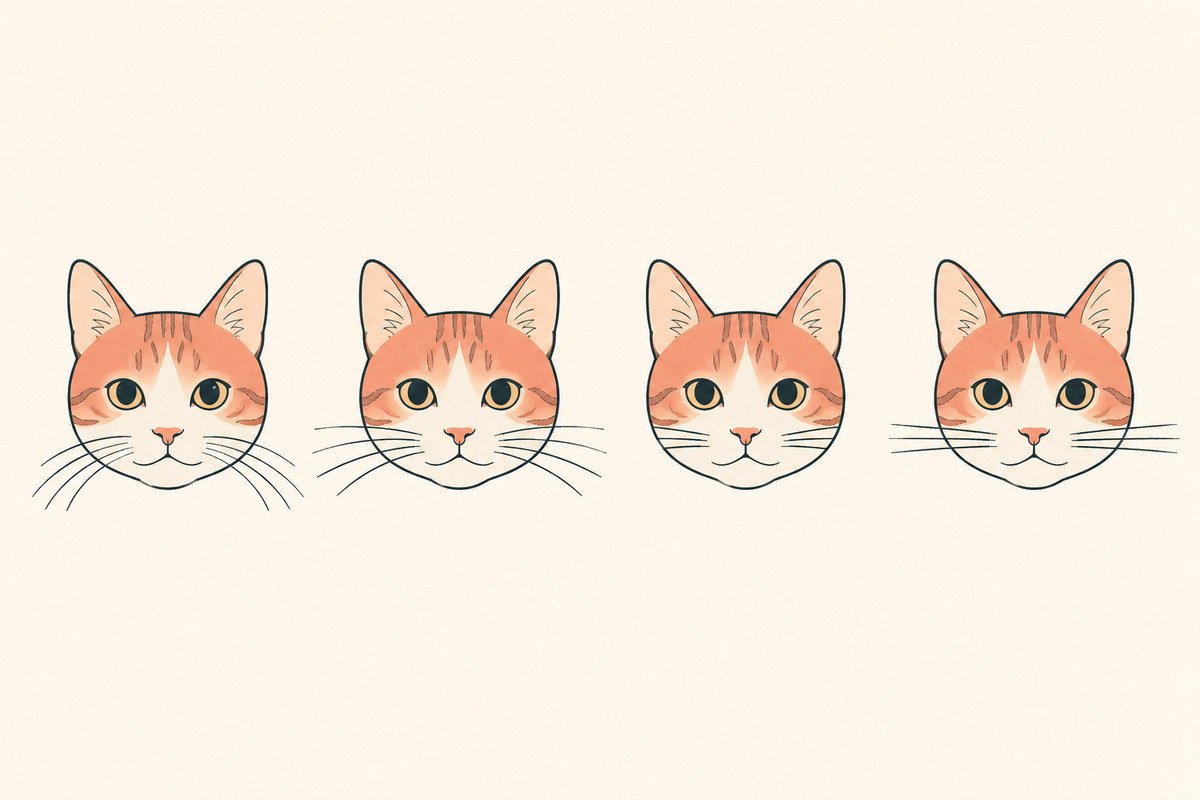
Whiskers are the channel almost nobody watches, and they are unusually honest — a cat can hold a neutral face while its whiskers give away the tension underneath.
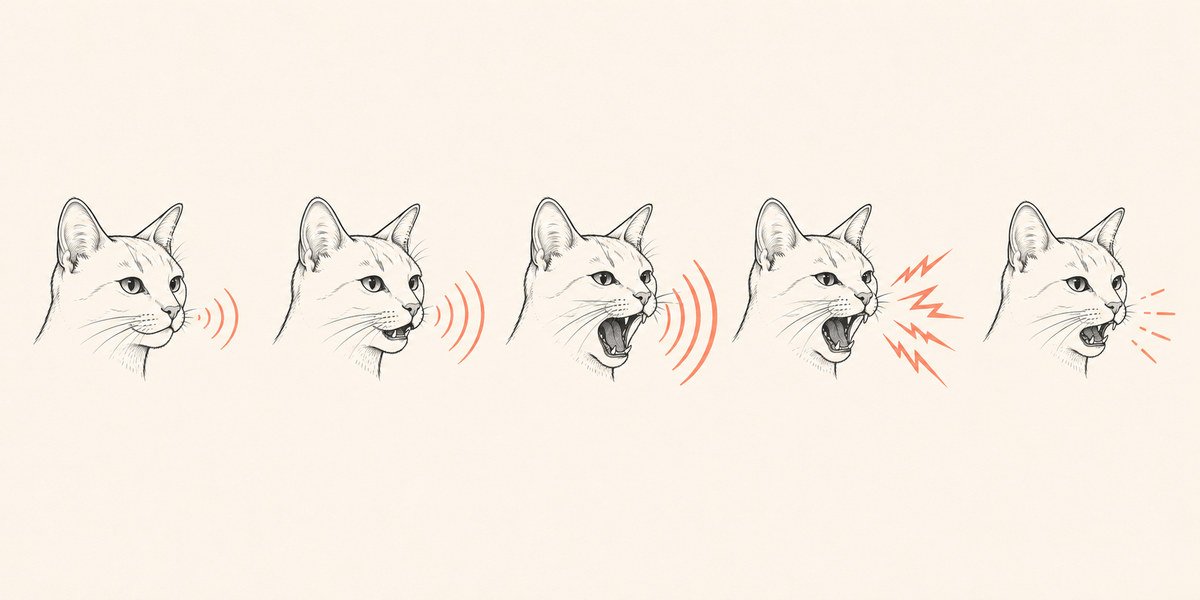
Here is the strange part: adult cats barely meow at each other. The meow is very largely a human-directed invention, developed and refined by each individual cat based on what gets a response from the specific people it lives with.
| The signal | What it means | Commonly misread as | What to do |
|---|---|---|---|
| Meow, directed at a human | Learned human-directed communication. Adult cats rarely meow at each other. | Assumed to be natural cat language. It is a dialect developed specifically for us. | Respond consistently. Cats refine their meows based on what works on you. |
| Short chirp or trill | Friendly greeting, often meaning follow me. Learned from a mother calling kittens. | Read as a strange meow. | Follow if you can. Cats frequently trill on the way to something they want shown. |
| Chattering or chirring at prey through glass | Predatory arousal and frustration. | Read as distress. | Normal. A wand toy afterwards resolves the frustration. |
| Purring in a relaxed context | Contentment. | Assumed to always mean happiness. It does not. | Nothing needed. |
| Purring at the vet, or while injured | Self-soothing. Purring appears to help cats regulate stress and pain. | Read as the cat being fine. | Do not use purring to rule out pain. Judge by posture and behaviour instead. |
| A purr with a cry embedded in it | The solicitation purr — an urgent request, usually for food. | Read as an ordinary purr. | Recognise it for what it is. It is engineered to be difficult to ignore. |
| Long, drawn-out meow | Demand or complaint. | Read as conversation. | Look at the context — an empty bowl, a closed door, a dirty litter box. |
| Repeated short meows in a burst | Excitement, usually greeting. | None common. | Greet back. This is enthusiasm. |
| Yowl | Distress, disorientation, or mating behaviour depending on context. | Read as attention-seeking noise. | In an unspayed or unneutered cat, likely mating. Otherwise investigate. |
| Caterwaul — loud, drawn-out, repeated | Mating call. | Read as pain. | If your cat is not neutered, this is the reason. Speak to your vet. |
| Night yowling in a senior cat | Often medical — cognitive dysfunction, hypertension, hyperthyroidism or deafness. | Dismissed as an old cat being difficult. | This warrants a vet visit including blood pressure and thyroid testing. It is treatable more often than owners expect. |
| Growl | Warning. Low, sustained, and unambiguous. | Read as playful grumbling. | Stop. Growling is a cat being unusually clear. |
| Hiss | Defensive warning. Almost always fear rather than aggression. | Read as the cat being mean. | Do not punish a hiss. A cat that learns hissing does not work escalates straight to scratching. |
| Spit — a sharp explosive sound | Startle-based threat, more reflexive than a hiss. | Read as the same as a hiss. | Same response. Space, and no reaching. |
| Shriek or scream | Pain or extreme fear. | Read as a fight, when it may be an injury. | Check for injury before assuming a scuffle. Approach with a towel if the cat is panicked. |
| Silent meow — mouth opens, no sound | Human-directed and usually affectionate. Some are simply pitched above human hearing. | Read as a voice problem. | Normal. Respond as you would to any meow. |
| Chirrup or brrp aimed at kittens or people | A call to gather or follow. | Read as a purr. | Follow the cat. It usually wants to show you something. |
| Rapid ekekek stuttering during hunting | Hunting excitement. | Read as a health issue. | Normal predatory vocalisation. |
| Teeth clicking while eating | Normal chewing mechanics in most cats. | Read as dental disease. | Only a concern if paired with dropping food, drooling or eating on one side. |
Scroll sideways on mobile to see every column. 19 signals in this section.
⚠ Warning
Every entry above has a misreading column, but five of them account for the overwhelming majority of mistakes. All five have the same root cause: applying human or canine social rules to an animal that uses neither.
In dogs, a moving tail is broadly positive. In cats it is broadly negative. A thrashing tail is the last warning before a swat, and a tail thumping the floor is a cat telling you it is aware of you and unhappy about it. This one signal probably causes more scratches than every other misreading combined.
A cat rolling onto its back near you is making a trust statement — it is exposing the least defended part of its body because it does not expect an attack. It is not a request for a belly rub. Reach in and you meet four sets of claws and the teeth, all of which are now perfectly positioned. Scratch the head or chin instead and the trust survives.
Pinned ears look aggressive, so people read anger. The cat is usually frightened, and it is folding its ears down to protect them in a fight it expects to happen. Treating it as aggression tends to produce exactly the escalation you were trying to prevent. Treating it as fear — more distance, less noise, no reaching — usually resolves it.
Cats purr when content, and they also purr when injured, frightened, in labour and at the vet. The mechanism appears to be self-soothing rather than a mood report. A purring cat that is hunched, hiding or refusing food is not a happy cat, and purring should never be used to rule out pain.
Sitting with its back to you is a compliment. A cat facing away has decided you are not something it needs to monitor, which is a considerable statement from an animal that is both predator and prey. The impulse to interpret it as sulking is entirely human.
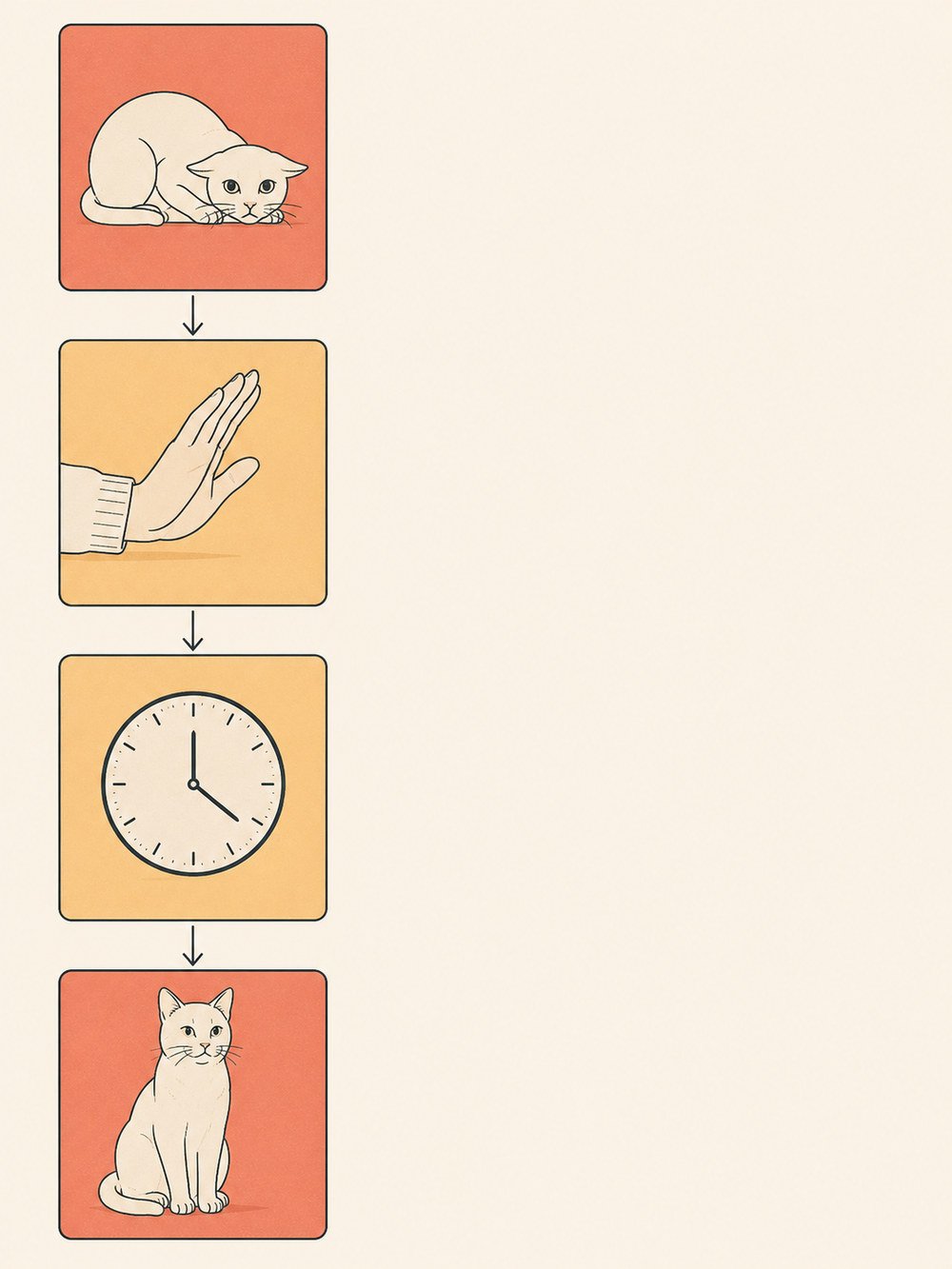
Almost every defensive signal on this page is a request for distance. Cats are unusually consistent about escalating in order — lean away, freeze, twitch, thrash, growl, hiss, swat — and a scratch almost always means several earlier steps were missed rather than that the cat lashed out without warning.
01
Read the signal early
Leaning away, a raised paw, a twitching tail tip or a freeze all mean the same thing. Acting on the first signal costs you nothing. Acting on the sixth costs you skin.
02
Withdraw the hand, not the room
Stop reaching and let your arm relax. You usually do not need to leave — you need to stop being an approaching object. Cats settle much faster around still people than absent ones.
03
Give it real time
Arousal takes several minutes to come down, and longer after a genuine fright. Reaching back in after thirty seconds restarts the whole sequence from where it left off.
04
Let the cat close the distance
When your cat is ready it will approach, usually with the tail up. Letting it make the last move is the whole difference between people cats like and people cats tolerate.
Almost the opposite of what it means in a dog. A cat thrashing its tail from side to side is agitated or overstimulated, and it is usually the last signal before a swat. A tail thumping the floor while the cat lies down is irritation. Only a slow, deliberate swish during focused attention — watching a bird, stalking a toy — is neutral. If you are petting a cat and the tail starts moving, stop petting.
Because the belly display was never an invitation. Rolling over exposes the least defended part of the body, which is a statement of trust rather than a request for contact. When a hand arrives, the cat finds itself on its back with something reaching for its abdomen, and it responds with the four sets of claws and the teeth that are already in position. Scratch the head or chin instead and the trust stays intact.
A slow blink is a long, deliberate closing of the eyes near another animal — a way of saying nothing is about to happen. It is the one signal you can send in the other direction. Soften your gaze, close your eyes for about a second, open them slowly, and repeat. Many cats return it, and it is the most reliable way to lower the tension with a nervous or unfamiliar cat.
Because the meow is very largely a human-directed invention. Adult cats communicate with each other through scent, posture and the occasional growl or hiss, and they rarely meow between themselves. Each cat develops its own repertoire of meows based on which sounds get a response from the specific people it lives with, which is why the meows of one household often make no sense in another.
No. Cats purr when content, and they also purr when injured, frightened, giving birth and at the vet. The current understanding is that purring is a self-soothing mechanism rather than a mood report. Judge by posture instead — a purring cat that is hunched, hiding, or refusing food is a cat that needs a vet, not reassurance.
Fear, in the overwhelming majority of cases. Ears pinned back against the skull are being protected in a fight the cat expects to happen. It looks like anger, which is why people commonly respond as though it were aggression, and that response tends to produce the escalation they were trying to prevent. More distance and less noise is almost always the right answer.
The opposite. A cat that turns its back has decided you are not something it needs to monitor, which is a substantial vote of confidence from an animal that is both a predator and prey. The instinct to read it as sulking is entirely human and does not transfer.
Several signals on this page are medical rather than behavioural. A visible third eyelid, persistent squinting in one eye, a hunched posture the cat will not release, hiding in a new place alongside not eating, and night yowling in a cat over ten all warrant a vet appointment. Sudden changes in vocalisation in either direction are worth investigating too — hyperthyroidism, hypertension, pain, deafness and cognitive dysfunction all present this way.
Predatory arousal combined with frustration at prey it cannot reach. The jaw movement resembles the killing bite cats deliver to the back of the neck, which is why it appears in the presence of prey and almost nowhere else. It is entirely normal, and a wand toy session afterwards gives the frustration somewhere to go.
Watch for the escalation sequence rather than waiting for a bite. Leaning away, a stiffening body, skin twitching along the back, the tail tip starting to move, ears rotating back — each of these comes before a swat, usually in that order. Stopping at the first one costs you nothing, and cats that are consistently listened to at that stage tolerate far longer sessions over time.
Cats are not subtle. They are specific, and they repeat themselves, and they escalate in a predictable order. What makes them seem inscrutable is that almost everybody is reading them with the wrong grammar — dog grammar for the tail, human grammar for eye contact and turned backs.
Swap the grammar and the whole thing opens up. Read three channels rather than one, judge pupils against the light, treat every posture as a statement about distance, and act on the first signal instead of the last. That is most of it.
For more on the behaviour behind the signals, see Understanding Cat Behavior, why cats knead, and why cats meow at night. If your cat is sleeping in unusual places or unusual amounts, how much cats sleep covers where normal ends. Everything else lives in Behavior & Training and The Ultimate Cat Care Guide.
The Meowive Library
The dictionary gives you the words. The book gives you the language.
The Feline Mind is a 58-page illustrated guide to how cats actually communicate — why the signals evolved, how the channels combine, what changes when trust breaks, and how to rebuild it. Forty-four plates, seven parts, no filler.
See what’s inside →58 pages · 7 parts · 44 illustrated plates · PDF, instant download
Disclaimer. This page is general educational information and is not veterinary advice. Sudden or persistent changes in body language, posture or vocalisation can indicate pain or illness — for any medical concern, consult a licensed veterinarian. Meowive participates in affiliate programmes and may earn from qualifying purchases.
Sources